Highlights

Hidden scale invariance of turbulence in a shell model: From forcing to dissipation scales

Alexei A. Mailybaev

Phys. Rev. Fluids 8, 054605 (2023) - Published 10 May, 2023

We describe a hidden scaling symmetry in developed turbulence which is restored in the inertial interval and, as a consequence, substantiates basic properties of intermittency, such as anomalous scaling. In this work we focus on how this symmetry gets broken in the forcing and dissipation ranges. The study is based on a shell model.

Angular momentum and moment of total enthalpy integral equations for high-speed boundary layers

Armin Kianfar, Mario Di Renzo, Christopher Williams, Ahmed Elnahhas, and Perry L. Johnson

Phys. Rev. Fluids 8, 054603 (2023) - Published 5 May, 2023

Angular momentum and moment of total enthalpy integral (AMI and MTEI) equations provide a quantitative mapping between flow phenomena such as turbulence on skin friction and surface heat flux for high-speed boundary layers relative to laminar flows. Using the AMI equation, the effect of edge Mach number (Ma) and wall-cooling are measured on the turbulent torque that enhances the skin friction coefficient. Moreover, the AMI equation introduces stress-weighted density that yields a more robust collapse of the dataset with different configurations. The MTEI equation distinguishes the impact of Ma and wall-cooling on the turbulent flux of mean kinetic energy and enthalpy, respectively.

Characterizing energy dissipation of shallow-water wave breaking in a storm surge

Hunter Boswell, Guirong Yan, and Wouter Mostert

Phys. Rev. Fluids 8, 054801 (2023) - Published 5 May, 2023

While understanding breaking waves is crucial for the development of parameterizations used in modeling ocean and climate, the complete description of wave breaking is not well understood. We present direct numerical simulations of two-dimensional solitary waves that break on a uniform beach in shallow water, including storm surge represented by an inshore region.

Presence of surfactants controls the stability of bubble chains in carbonated drinks

Omer Atasi, Mithun Ravisankar, Dominique Legendre, and Roberto Zenit

Phys. Rev. Fluids 8, 053601 (2023) - Published 3 May, 2023

In this paper we explain why bubble chains are stable in champagne, but unstable in other carbonated beverages. The hydrodynamic interactions among bubbles in a chain determine its stability. The wake behind each bubble affects the subsequent ones, producing a lift force. For a clean and small bubble, the lift force is destabilizing; when surfactants are present or the bubble size exceeds a certain value, the additional vorticity production on the surface changes the structure of the wake and the sign of the lift force is reversed resulting in a stable chain.

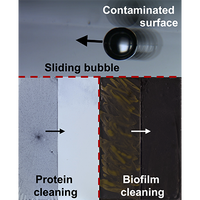
Effect of angle in removing proteins or bacteria on a tilted surface using air bubbles

Alireza Hooshanginejad, Timothy Sheppard, Purui Xu, Janeth Manyalla, John Jaicks, Ehsan Esmaili, and Sunghwan Jung

Phys. Rev. Fluids 8, 043602 (2023) - Published 28 April, 2023

Our work investigates cleaning surfaces coated with protein solutions or bacterial biofilms using continuous collisions and sliding air bubbles in an aqueous medium. Air bubbles between 0.5-1 mm in radius perform best when tilted at 20-25 degrees with respect to the horizontal plane. Based on our model, the interplay between the steady sliding speed and the steady film thickness between the bubble and the surface yields the best cleaning at 22.5 degrees. The technique offers a safe and environmentally friendly way of cleaning fresh agricultural produce without damaging it or reducing its freshness period.

Vortical cleaning of oil-impregnated porous surfaces

Siddhant Jain, Shubham Sharma, Durbar Roy, and Saptarshi Basu

Phys. Rev. Fluids 8, 044701 (2023) - Published 14 April, 2023

A novel concept of vortical cleaning in porous surfaces is studied experimentally. A vortex ring of various strengths is made to interact with oil-impregnated porous surfaces with the aim of understanding the mechanism of oil ejection from the porous surface. The vortex dynamics involves different phenomena like vortex cancellation and Kelvin-Helmholtz instabilities. The cleaning takes place from both sides of the porous surface through an intricate interaction process characterized by Rayleigh-Taylor and Rayleigh-Plateau type instabilities that is studied in three different regimes: i) Penetration, ii) Bag formation, and iii) Bag breakup.

Downslope granular flow through a forest of obstacles

Baptiste Darbois Texier, Yann Bertho, and Philippe Gondret

Phys. Rev. Fluids 8, 034303 (2023) - Published 31 March, 2023

This work investigates the role played by a forest of pillars on the steady flow of a granular layer down an inclined plane. We realized experiments for different inter-pillar distances to observe how the forest density slows down the granular flow. These observations are rationalized by an average approach that considers a granular rheology for the flow and includes the additional force exerted by the pillars on the granular layer.

Thickness profiles of giant soap films

Marina Pasquet, Frédéric Restagno, Isabelle Cantat, and Emmanuelle Rio

Phys. Rev. Fluids 8, 034001 (2023) - Published 24 March, 2023

In this work, we measure and model the thickness profile of soap films in the regime of large extensions and large extension rates. For this purpose, we developed an experiment to generate soap films up to two meters high at velocities of the order of a meter per second. We show that the thickness profile in the central part of the film is exponential and described by a static model where the soap film is modeled by an elastic object stretched under gravity.

Coupling between vortex flow and whisker sensor in cylinder wakes with time-varying streamwise gaps

Pengyao Gong, Dhanush Bhamitipadi Suresh, and Yaqing Jin

Phys. Rev. Fluids 8, 034701 (2023) - Published 22 March, 2023

The flow-induced vibration of a whisker in the wake of a movable circular cylinder with time-varying streamwise gaps is experimentally investigated to understand how whiskers detect variations in the swimming status of an upstream target. The results show that whisker sensitivity to gap growth rates gradually decreases when such growth rates become sufficiently high, regardless of initial gaps. From the integrated experimental measurements and theoretical model, the reduction of whisker sensitivity under high gap growth rates can be attributed to sufficiently strong vortices initiated by fast movement of the upstream cylinder, which compensate vortex strength decay due to the gap growth.

Role of geometry and adhesion in droplet freezing dynamics

Lila Seguy, Suzie Protiere, and Axel Huerre

Phys. Rev. Fluids 8, 033601 (2023) - Published 9 March, 2023

We propose a thermal and geometrical analytical model for the freezing front dynamics of a spherical drop. The growth is characterized by an effective diffusion coefficient that increases as the substrate temperature decreases and a spherical front that meets the edges of the drop perpendicularly. We compare our model with experimental data for substrate temperature ranging from -9 to -80 °C. We highlight the importance of heat diffusion in the liquid and the adhesion of drops to the substrate that decreases at low temperature.

Corner universality in polygonal hydraulic jumps

S. I. Tamim, T. Nichols, J. Lundbek Hansen, T. Bohr, and J. B. Bostwick

Phys. Rev. Fluids 8, L032001 (2023) - Published 7 March, 2023

Experiments show that vertical liquid jet impact on a solid plate creates a hydraulic jump which takes on a stable polygonal shape with sharp corners. The corner shape exhibits a striking universality that is characterized by the radius of curvature and corner angle at the tip, which remains nearly constant over a wide range of flow conditions. Knowledge of the corner angle allows one to determine the global jump shape, as defined by a dimensionless geometry number related to the isoperimetric inequality, thus giving a complete description of the jump shape.

Sub-meter wind detection with pulsed coherent Doppler lidar

Yunpeng Zhang, Jinlong Yuan, Yunbin Wu, Jingjing Dong, and Haiyun Xia

Phys. Rev. Fluids 8, L022701 (2023) - Published 27 February, 2023

High-resolution wind detection plays a crucial role in aviation safety and aerodynamics. In this work, the fine wind field within 700 meters is continuously detected at a resolution of 0.9 meters/0.5 seconds by a coherent Doppler wind LiDAR. A meter-scale perturbation by an electric fan is remotely sensed, and atmospheric turbulence with length scale down to 3 meters can be observed.

Dynamic mode structure of active turbulence

Richard J. Henshaw, Olivia G. Martin, and Jeffrey S. Guasto

Phys. Rev. Fluids 8, 023101 (2023) - Published 17 February, 2023

The collective motion of dense suspensions of swimming bacteria is typical of a broad class of active materials, which serve an array of important biological and ecological functions. This work combines microfluidic experiments with modal analysis, typically reserved for inertial turbulence, to quantify the active turbulence of bacterial suspensions. Our results unveil the underlying constituent flow structures responsible for the interactions of chaotic bacterial motion with solid boundaries and external flows, and establish an analysis framework to facilitate new experimental and modeling approaches in active matter systems.

Juggling soliton: A new kind of wave-particle entity

Camila Sandivari, Jacob Egge, Belén Barraza, Leonardo Gordillo, and Nicolás Mujica

Phys. Rev. Fluids 8, 024401 (2023) - Published 10 February, 2023

High-amplitude localized waves in a narrow channel can juggle large-sized droplets for tens of thousands of cycles without coalescing. The wave launches and softly catches the drop at every cycle, and laterally traps it. This system can be considered the gravity-wave analog of optical tweezers.

Canopy elastic turbulence: Spontaneous formation of waves in beds of slender microposts

Charlotte de Blois, Simon J. Haward, and Amy Q. Shen

Phys. Rev. Fluids 8, 023301 (2023) - Published 9 February, 2023

A microfluidic canopy flow device, formed from a large array of slender polymeric pillars within a glass microchannel, is subjected to viscoelastic flow in the regime of elastic turbulence. The system results in the spontaneous emergence of waves in the form of propagating regions of low flow velocity compared to the bulk, also inducing Monami-like waves in the canopy if the pillars are flexible. Due to the analogies with classical (inertial) canopy turbulence, this new phenomenon is named “canopy elastic turbulence”.

Scalings and decay of homogeneous, nearly isotropic turbulence behind a jet array

Shiyong Tan, Xu Xu, Yinghe Qi, and Rui Ni

Phys. Rev. Fluids 8, 024603 (2023) - Published 7 February, 2023

In the study of dispersed multiphase turbulence, using a jet array has shown promise in creating intense homogeneous, nearly isotropic turbulence with high dissipation rates in water and wind tunnels. However, the scaling of turbulent characteristics with jet nozzle diameter, velocity, and downstream location has not been fully explored. Our research, combined with previous experiments focusing on near-field measurements, offers a comprehensive understanding of the decay of kinetic energy and energy dissipation rate, as well as the flow inhomogeneity and anisotropy generated by a jet array.

Rocket drops: The self-propulsion of supercooled freezing drops

Claudiu A. Stan, Armin Kalita, Sebastian Marte, Thomas F. Kaldawi, Philip R. Willmott, and Sébastien Boutet

Phys. Rev. Fluids 8, L021601 (2023) - Published 3 February, 2023

Supercooled water drops move spontaneously while freezing in vacuum. This self-propulsion phenomenon is caused by an enhanced evaporation rate from the frozen regions of the drops. The evaporating molecules carry momentum, and the drops acquire an opposite momentum, the same as in rocket propulsion.

Intermittent versus continuous swimming: An optimization tale

Gen Li, Dmitry Kolomenskiy, Hao Liu, Ramiro Godoy-Diana, and Benjamin Thiria

Phys. Rev. Fluids 8, 013101 (2023) - Published 13 January, 2023

Intermittent swimming has been recognized as a strategy for fish to enhance their energetical efficiency. In this study, a hybrid computational fluid dynamic model is used to assess the swimming performance in intermittent swimming parametrically and quantitatively. The results show that the energetical performance of intermittent swimming can be better than that of continuous swimming, but also that an unoptimized intermittent gait may become very energetically expensive.

Mechanical impact on a breath figure

Lorenzo Betti, Céline Cohen, and Xavier Noblin

Phys. Rev. Fluids 8, 013601 (2023) - Published 9 January, 2023

We performed a new experiment of mechanical impact on a plate supporting a breath figure on its bottom surface. Although breath figures mature usually slowly, we show that the droplets pattern evolves here dramatically in a few milliseconds leading to a strong droplets number reduction above a threshold in acceleration. We interpret this by the droplets radii oscillations produced which then induce droplets contacting and coalescing with each other in a fascinating manner. Introducing an effective Bond number, coupling the droplets’ average initial radii and the acceleration amplitude, leads to a data collapse on a single master curve.

Gravity currents in the cabbeling regime

Andrew P. Grace, Marek Stastna, Kevin G. Lamb, and K. Andrea Scott

Phys. Rev. Fluids 8, 014502 (2023) - Published 5 January, 2023

Freshwater has been shown to have a maximum density at about four degrees Celsius, and this leads to a phenomenon known as cabbeling. Cabbeling occurs when masses of water on different sides of the temperature of maximum density mix and create a denser mass. What happens when intruding and ambient temperatures in a gravity current are on opposite sides of the temperature of maximum density? How does cabbeling affect the evolution characteristics of gravity currents, and what sort of long term behavior arises?

Sign In to Your Journals Account

Filter

Section

Filter

Article Lookup

Enter a citation