Recent Articles

Fully inertial active Brownian particle in a harmonic potential

Evgeny A. Lisin and Irina I. Lisina

Phys. Rev. E 113, 015417 (2026) - Published 23 January, 2026

Competing effect of disorder on phase separation in active systems

Pratikshya Jena, Shambhavi Dikshit, and Shradha Mishra

Phys. Rev. E 113, 014128 (2026) - Published 22 January, 2026

Cluster percolation and dynamical scaling in the Baxter-Wu model

Alexandros Vasilopoulos, Michail Akritidis, Nikolaos G. Fytas, and Martin Weigel

Phys. Rev. E 113, 014129 (2026) - Published 22 January, 2026

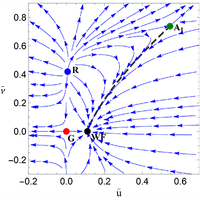
Scaling behaviors in active model B+ via the functional renormalization group

Gergely Fejős, Zsolt Szép, and Naoki Yamamoto

Phys. Rev. E 113, 014130 (2026) - Published 22 January, 2026

This work applies the functional renormalization group to active model B+, uncovering global flows inaccessible by earlier methods. By pushing the theoretical description of nonequilibrium phase separation into a new regime, the results advance the state of the art in active-matter field theory.

#AdvancingField #TechnicalAdvancement

Higher-order interactions enhance stochastic resonance in coupled oscillators

Hongye Wang, Xueqi Li, and Youming Lei

Phys. Rev. E 113, 014214 (2026) - Published 22 January, 2026

Phase separation and coexistence in spatial coordination games between microbes

Guanlin Li, Gabi Steinbach, Peter Yunker, Yao Yao, and Joshua S. Weitz

Phys. Rev. E 113, 014402 (2026) - Published 22 January, 2026

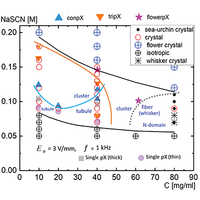
Electric response of multiarm protein crystals

D. Ray, F. Platten, and K. Kang

Phys. Rev. E 113, 014403 (2026) - Published 22 January, 2026

Applied electric fields precisely steer protein crystallization pathways, inducing distinct multiarm morphologies such as flowerlike and triconic structures. This field-driven control over angular ordering and phase behavior offers new insights into engineering complex protein architectures.

#BiophysicsSpotlight #TheoryExperiment

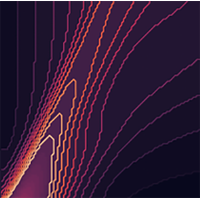
Factors controlling the statistics of magnetic reconnection in magnetohydrodynamic turbulence

M. B. Khan, M. A. Shay, S. Oughton, W. H. Matthaeus, C. C. Haggerty, S. Adhikari, P. A. Cassak, S. Fordin, D. O'Donnell, Y. Yang, R. Bandyopadhyay, and S. Roy

Phys. Rev. E 113, 015207 (2026) - Published 22 January, 2026

High-efficiency three-stroke quantum isochoric heat engine: From infinite potential wells to magic-angle twisted bilayer graphene

Hadi Mohammed Soufy and Colin Benjamin

Phys. Rev. E 113, 014126 (2026) - Published 21 January, 2026

Structure and dynamics in the low-density phase of a two-dimensional cellular automaton model of traffic flow

Gilad Hertzberg Rabinovich, Ofer Biham, and Eytan Katzav

Phys. Rev. E 113, 014127 (2026) - Published 21 January, 2026

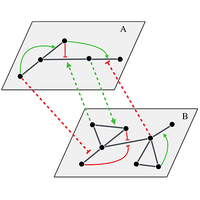
Triadic percolation on multilayer networks

Hanlin Sun, Filippo Radicchi, and Ginestra Bianconi

Phys. Rev. E 113, 014313 (2026) - Published 21 January, 2026

Triadic interactions between network nodes take place when interactions between two or more nodes are controlled by regulator nodes. Triadic regulators turn network percolation into a dynamical process very different from standard percolation, which has been extensively studied in single networks. Here, the authors go one step further and propose a framework to study triadic percolation in multilayer networks, called multilayer triadic percolation, and analyze how multilayer network structure affects the dynamical behavior of triadic percolation.

#AdvancingField #UniversalBehavior #ClearMotivation

Shortest-path percolation on scale-free networks

Minsuk Kim, Lorenzo Cirigliano, Claudio Castellano, Hanlin Sun, Robert Jankowski, Anna Poggialini, and Filippo Radicchi

Phys. Rev. E 113, 014314 (2026) - Published 21 January, 2026

Berezinskii-Kosterlitz-Thouless transition in a context-sensitive random language model

Yuma Toji, Jun Takahashi, Vwani Roychowdhury, and Hideyuki Miyahara

Phys. Rev. E 113, 015305 (2026) - Published 21 January, 2026

Analytical characterization of sloppiness in neural networks: Insights from linear models

Jialin Mao, Itay Griniasty, Yan Sun, Mark K. Transtrum, James P. Sethna, and Pratik Chaudhari

Phys. Rev. E 113, 015306 (2026) - Published 21 January, 2026

This study reports that low-dimensional structures in training manifolds of deep neural networks arise not due to limited flexibility, but rather from the intrinsic low-dimensionality of the training task.

#MachineLearningSpotlight

Ion-size-dependent electroconvective transport in confined channels

Qing Chen, Peng Wang, Yeye Wen, Wen Li, Zhengwu Jiang, Zhiguo Yan, Jiann-Wen Woody Ju, Hehua Zhu, and Wei Liu

Phys. Rev. E 113, 015416 (2026) - Published 21 January, 2026

Nanometer-scale proton focusing via density-gradient-induced intrinsic focusing electric fields

Q. Yu and Y. Zhang

Phys. Rev. E 113, L013201 (2026) - Published 21 January, 2026

Charging capacitors using diodes at different temperatures. I. Theory

L. L. Bonilla, A. Torrente, J. M. Mangum, and P. M. Thibado

Phys. Rev. E 113, 014123 (2026) - Published 20 January, 2026

Charging capacitors using diodes at different temperatures. II. Numerical studies

J. M. Mangum, L. L. Bonilla, A. Torrente, and P. M. Thibado

Phys. Rev. E 113, 014124 (2026) - Published 20 January, 2026

Intermittent Kac's flights with resetting

Manuel O. Cáceres and Marco Nizama

Phys. Rev. E 113, 014125 (2026) - Published 20 January, 2026

Quantum diffusion in the Harper model under polychromatic time-perturbation

Hiroaki S. Yamada and Kensuke S. Ikeda

Phys. Rev. E 113, 014211 (2026) - Published 20 January, 2026

Sign In to Your Journals Account

Filter

Recent Issues

Vol. 114, Iss. 4
October 2026
Vol. 114, Iss. 3
September 2026
Vol. 114, Iss. 2
August 2026
Vol. 114, Iss. 1
July 2026
Category
Article Type
Section

Filter

Article Lookup

Enter a citation