Recent Articles

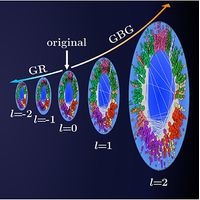
Editorial: DSNP Dissertation Award 2025 – Pushing the limits of active metamaterials

Ted Brzinski, Sebastian Deffner, Nathan C. Keim, Enkeleida Lushi, and Joshua E. S. Socolar

Phys. Rev. E 113, 030001 (2026) - Published 9 March, 2026

The DSNP Dissertation Award Selection Committee presents the 2025 Award sponsored by Physical Review E.

Phase diagram of the anisotropic spin-12 XZ chain through the lens of bifurcation in ground-state fidelity, fidelity susceptibility, and local quantum uncertainty

Yan-Wei Dai, D. C. Liu, Xi-Jing Liu, and Murray T. Batchelor

Phys. Rev. E 113, 034106 (2026) - Published 9 March, 2026

Rare trajectories in a prototypical mean-field disordered model: Insights into landscape and instantons

Patrick Charbonneau, Giampaolo Folena, Enrico M. Malatesta, Tommaso Rizzo, and Francesco Zamponi

Phys. Rev. E 113, 034107 (2026) - Published 9 March, 2026

Higher-order tensor renormalization group study of the Ising model on tunable fractal lattices

Xiaoman Chen and Z. J. Ding

Phys. Rev. E 113, 034108 (2026) - Published 9 March, 2026

Tensor network simulations for nonorientable surfaces

Haruki Shimizu and Atsushi Ueda

Phys. Rev. E 113, 034109 (2026) - Published 9 March, 2026

Hybrid quantum-classical systems: Statistics, entropy, microcanonical ensemble and its connection to the canonical ensemble

J. L. Alonso, C. Bouthelier-Madre, A. Castro, J. Clemente-Gallardo, and J. A. Jover-Galtier

Phys. Rev. E 113, 034110 (2026) - Published 9 March, 2026

Tightening the thermodynamic uncertainty relations with null-entropy events: What we learn when nothing happens

Abhaya S. Hegde, André M. Timpanaro, and Gabriel T. Landi

Phys. Rev. E 113, 034111 (2026) - Published 9 March, 2026

Phase-field approach to cellular blebbing

Kaihua Ji, Herbert Levine, and Alain Karma

Phys. Rev. E 113, 034403 (2026) - Published 9 March, 2026

Time-embedded convolutional neural networks for modeling plasma heat transport

Mufei Luo, Charles Heaton, Yizhen Wang, Daniel Plummer, Mila Fitzgerald, Francesco Miniati, Sam M. Vinko, and Gianluca Gregori

Phys. Rev. E 113, 035303 (2026) - Published 9 March, 2026

Training oscillator Ising machines to assign the dynamic stability of their equilibrium points

Yi Cheng and Zongli Lin

Phys. Rev. E 113, 035304 (2026) - Published 9 March, 2026

When velocity autocorrelations mirror force autocorrelations: Exact noise-cancellation in interacting Brownian systems

Anton Lüders, Suvendu Mandal, and Thomas Franosch

Phys. Rev. E 113, 035305 (2026) - Published 9 March, 2026

Operator learning augmented physics-informed neural networks for partial differential equations exhibiting sharp features

Bin Lin, Zhiping Mao, and Zhicheng Wang

Phys. Rev. E 113, 035306 (2026) - Published 9 March, 2026

Stress response of jammed solids: Prestress and screening

Surajit Chakraborty, Jishnu N. Nampoothiri, Subhro Bhattacharjee, Bulbul Chakraborty, and Kabir Ramola

Phys. Rev. E 113, 035407 (2026) - Published 9 March, 2026

Energetics-based model for a diffusiophoretic motion of a deformable droplet

Hiroyuki Kitahata, Yuki Koyano, Yasuaki Kobayashi, and Masaharu Nagayama

Phys. Rev. E 113, 035408 (2026) - Published 9 March, 2026

Long-tailed dissipationless hydromechanics: Weak thermalization and ergodicity breaking

Giuseppe Procopio, Chiara Pezzotti, and Massimiliano Giona

Phys. Rev. E 113, 034105 (2026) - Published 6 March, 2026

Resonance assisted tunneling in Floquet spin-J systems

Jesús A. Segura-Landa, Diego A. Wisniacki, Sergio Lerma-Hernández, and Jorge G. Hirsch

Phys. Rev. E 113, 034209 (2026) - Published 6 March, 2026

Dynamics due to competitive flip cycles in active Potts models

Hiroshi Noguchi

Phys. Rev. E 113, 034210 (2026) - Published 6 March, 2026

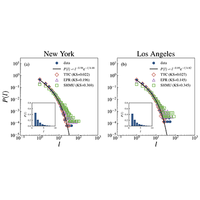
Scaling law of individual urban tour behavior

Xu-Jie Lin, Yitao Yang, Wei-Peng Nie, and Xiao-Yong Yan

Phys. Rev. E 113, 034303 (2026) - Published 6 March, 2026

Using Foursquare users’ check-in data and heavy truck GPS trajectory data, the authors study the number of intermediate stops in a tour of humans and heavy trucks. They find that the tour length distribution follows a truncated power-law distribution and propose a tour terminate-continue model to explain this.

#Interdisciplinary #AdvancingField

Robustness and size dependence of circadian rhythms in multiscale suprachiasmatic-nucleus networks

Youhao Zhuo, Yingpeng Liu, Jiao Wu, Kesheng Xu, and Muhua Zheng

Phys. Rev. E 113, 034304 (2026) - Published 6 March, 2026

Bridging concepts from statistical physics, complex networks, and biological rhythm dynamics, the authors study how multiscale network structure influences circadian rhythms in the suprachiasmatic nucleus. The results highlight the resilience of suprachiasmatic-nucleus rhythms to network scaling and establish a framework for linking multiscale network organization to biological timekeeping.

#Interdisciplinary #BiophysicsSpotlight

Phase transitions and plasma formation during the explosion of thin point cathodes in a high-current diode operating from vacuum to forevacuum

E. V. Parkevich, K. V. Shpakov, A. I. Khirianova, K. S. Vinogradova, A. A. Tarasenko, and D. V. Antonov

Phys. Rev. E 113, 035203 (2026) - Published 6 March, 2026
Sign In to Your Journals Account

Filter

Recent Issues

Vol. 114, Iss. 4
October 2026
Vol. 114, Iss. 3
September 2026
Vol. 114, Iss. 2
August 2026
Vol. 114, Iss. 1
July 2026
Category
Article Type
Section

Filter

Article Lookup

Enter a citation