Recent Articles

Dirac-Brueckner-Hartree-Fock approach for proton radioactivity of spherical proton emitters

Yin Fan, Xiao-Dong Sun, Leng-Jun Liao, Xiao Liu, Dong-Meng Zhang, Xiao-Hua Li, and Ming Li

Phys. Rev. C 112, 054311 (2025) - Published 14 November, 2025

Weak-charge radius of Ar40: From CREX constraints to CEνNS sensitivity

J. Piekarewicz

Phys. Rev. C 112, 054312 (2025) - Published 14 November, 2025

Production cross section and mass excess of rare fragments produced in U238 in-flight fission by Qg systematics

Xiao-Bao Wei, Tian-Ren Zhuo, Hui-Ling Wei, Chun-Yuan Qiao, Ya-Fei Guo, Jie Pu, Kai-Xuan Cheng, Yu-Ting Wang, Ge Ren, Wen-Ruo Wu, Yi-Bo Hao, Jiang-Bo Zhao, Zeng-Xiang Wang, and Chun-Wang Ma

Phys. Rev. C 112, 054608 (2025) - Published 14 November, 2025

Systematic study of the validity of the eikonal model including uncertainties

D. Shiu, C. Hebborn, and F. M. Nunes

Phys. Rev. C 112, 054609 (2025) - Published 14 November, 2025

Refined shell-model calculations of the δC correction to superallowed 0+→0+ nuclear β decay and standard-model implications

L. Xayavong, N. A. Smirnova, and F. Nowacki

Phys. Rev. C 112, 055503 (2025) - Published 14 November, 2025

Neutrinoless ββ decay in the interacting boson model based on the nuclear energy density functionals

Kosuke Nomura

Phys. Rev. C 112, 054310 (2025) - Published 13 November, 2025

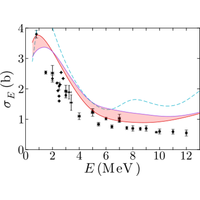
Microscopic optical potentials from a Green's function approach

G. H. Sargsyan, G. Potel, K. Kravvaris, and J. E. Escher

Phys. Rev. C 112, 054606 (2025) - Published 13 November, 2025

Phenomenological nuclear reaction models primarily rely on data from stable isotopes. It is uncertain how these models would perform when applied to reactions involving unstable, exotic isotopes the data of which are crucial for astrophysics, medicine, and energy applications. To address this challenge, the authors introduce a microscopic optical potential, derived from the Feshbach formalism and informed by the valence shell model. The work presents an innovative self-consistent, iterative approach for calculating the nonlocal Green’s function, forging a direct and systematic link between nuclear structure and reaction theory. Applied to n+24Mg elastic scattering, the new optical potential yields close agreement with experimental data, demonstrating a powerful and necessary tool for modeling reactions away from the valley of stability.

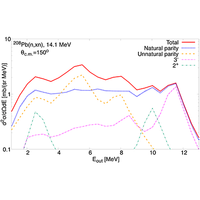
Modeling direct and pre-equilibrium processes of neutron-induced reactions with the noniterative finite amplitude method and with the distorted-wave Born approximation

Hirokazu Sasaki, Toshihiko Kawano, and Marc Dupuis

Phys. Rev. C 112, 054607 (2025) - Published 13 November, 2025

This work develops a fully microscopic framework for neutron-induced reactions to describe direct and one-step pre-equilibrium processes. The authors combine the noniterative finite-amplitude method (FAM) with the distorted-wave Born approximation (DWBA). The resulting FAM-QRPA+DWBA formalism employs the Skyrme effective interaction to derive quasiparticle random-phase approximation (QRPA) equations, which leads to a consistent and parameter-free treatment of neutron inelastic scattering to both discrete and continuum states. Applied to the 208Pb(n,n′) reaction, the method accurately reproduces measured differential and double-differential cross sections across 7–25 MeV without empirical adjustments. The calculated spin distributions of residual nuclei agree with combinatorial 1p–1h systematics, demonstrating that the noniterative FAM-QRPA+DWBA approach provides an efficient and predictive tool for modeling neutron-induced reactions within a unified microscopic framework.

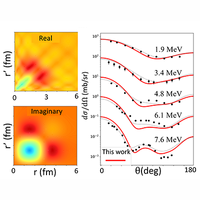
Nuclear cross sections from low-energy interactions

J. Boström, J. Rotureau, B. G. Carlsson, and A. Idini

Phys. Rev. C 112, L051602 (2025) - Published 13 November, 2025

Describing reactions with deformed nuclei remains a challenging task. The article proposes a microscopic method to consistently calculate cross sections and construct optical potentials for such systems, using symmetry breaking and restoration techniques. The formalism builds Green’s functions and self-energies from multiple reference states, with sum rules that allow truncation of the many-body space, overall reducing computational time. Applied to neutron scattering on 24Mg, the approach reproduces cross sections and demonstrates a promising path toward systematic microscopic optical potentials for heavy and deformed nuclei.

Effect of nuclear rotation on nucleon transfer and fusion in low-energy heavy-ion collisions

Xiang Jiang, Rong An, and Nan Wang

Phys. Rev. C 112, L051603 (2025) - Published 13 November, 2025

Probing nuclear excitation by electron capture in an electron beam ion trap with nondestructive isomer detection via precision mass spectrometry

Bingsheng Tu, Nan Xue, Jialin Liu, Qi Guo, Yuanbin Wu, Zuoye Liu, Adriana Pálffy, Yang Yang, Ke Yao, Baoren Wei, Yaming Zou, Xiangjin Kong, and Yu-Gang Ma

Phys. Rev. C 112, 054307 (2025) - Published 12 November, 2025

Octupole collectivity in low-lying states of N=126 isotones with particle-hole excited nucleon-pair approximation and realistic effective interaction

Y. Y. Cheng, R. V. Jolos, and N. V. Antonenko

Phys. Rev. C 112, 054308 (2025) - Published 12 November, 2025

Chirality of Sb115: Further evidence for a new chiral island in the neutron-rich A≈120 mass region

G. Y. Li (李广有) et al.

Phys. Rev. C 112, 054309 (2025) - Published 12 November, 2025

Multidimensional measurements of beam single-spin asymmetries in semi-inclusive deep-inelastic charged-kaon electroproduction off protons in the valence region

A. Kripko et al. (CLAS Collaboration)

Phys. Rev. C 112, 055202 (2025) - Published 12 November, 2025

Effects of the hadronic molecule N(2080)3/2− on K*+Λ photoproduction

Wen-Ya Tian, Neng-Chang Wei, Yu-Fei Wang, Fei Huang, and Bing-Song Zou

Phys. Rev. C 112, 055203 (2025) - Published 12 November, 2025

Half-life of Xe136 for neutrinoless double-β decay calculated with effective axial-vector current coupling unified for two-neutrino and neutrinoless double-β decay modes

J. Terasaki and O. Civitarese

Phys. Rev. C 112, L051302 (2025) - Published 12 November, 2025

Measurement of production branching ratio after muon nuclear capture reaction of Al and Si isotopes

R. Mizuno, M. Niikura, T. Y. Saito, T. Matsuzaki, S. Abe, H. Fukuda, M. Hashimoto, A. D. Hillier, K. Ishida, N. Kawamura, S. Kawase, T. Kawata, K. Kitafuji, F. Minato, M. Oishi, A. Sato, K. Shimomura, P. Strasser, S. Takeshita, D. Tomono, and Y. Watanabe

Phys. Rev. C 112, 054305 (2025) - Published 10 November, 2025

Relativistic Green's function in complex momentum representation for one-proton emission

Zhe Wang, Shu-Yuan Zhai, Jian-You Guo, and Quan Liu

Phys. Rev. C 112, 054306 (2025) - Published 10 November, 2025

Genetic-algorithm-based inverse potentials for resonant states of α−C12 using the variable phase approach

Ayushi Awasthi, Arushi Sharma, Barbie, Ishwar Kant, and O. S. K. S. Sastri

Phys. Rev. C 112, 054604 (2025) - Published 10 November, 2025

Role of a universal function of the nuclear proximity potential: A systematic study of α decay of heavy and superheavy nuclei and α-induced reactions

S. Mohammadi, R. Gharaei, and S. A. Alavi

Phys. Rev. C 112, 054605 (2025) - Published 10 November, 2025
Sign In to Your Journals Account

Filter

Recent Issues

Vol. 114, Iss. 4
October 2026
Vol. 114, Iss. 3
September 2026
Vol. 114, Iss. 2
August 2026
Vol. 114, Iss. 1
July 2026
Category
Article Type
Section

Filter

Article Lookup

Enter a citation