Recent Articles

Ab initio studies of the impact of the Debye-Waller factor on the structural and dynamical properties of amorphous semiconductors: The case of a-Si

Devilal Dahal, Raymond Atta-Fynn, Stephen R. Elliott, and Parthapratim Biswas

Phys. Rev. B 108, 094206 (2023) - Published 15 September, 2023

Anomalous Floquet-Anderson insulator with quasiperiodic temporal noise

Peng-Peng Zheng, Christopher I. Timms, and Michael H. Kolodrubetz

Phys. Rev. B 108, 094207 (2023) - Published 15 September, 2023

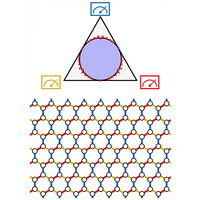
Topology, criticality, and dynamically generated qubits in a stochastic measurement-only Kitaev model

Adithya Sriram, Tibor Rakovszky, Vedika Khemani, and Matteo Ippoliti

Phys. Rev. B 108, 094304 (2023) - Published 15 September, 2023

Even in the absence of unitary evolution, measurements alone can induce a rich variety of dynamical phases and phenomena in many-body quantum systems. Inspired by the Kitaev honeycomb Hamiltonian, a paradigmatic model of topological physics, the authors construct here a stochastic measurement-only dynamics on a honeycomb lattice and show that it hosts distinct entanglement phases, including phases that protect topological qubits for an exponential amount of time and a critical phase with exotic dynamical scaling.

Theoretical study of the effect of lattice dynamics on the damping constant of FePt at finite temperature

Ivan Kurniawan, Yoshio Miura, Guangzong Xing, Terumasa Tadano, and Kazuhiro Hono

Phys. Rev. B 108, 094426 (2023) - Published 15 September, 2023

Noise-induced transition from superfluid to vortex state in two-dimensional nonequilibrium polariton condensates: Semianalytical treatment

Vladimir N. Gladilin and Michiel Wouters

Phys. Rev. B 108, 094510 (2023) - Published 15 September, 2023

Robust and tunable coreless vortices and fractional vortices in chiral d-wave superconductors

P. Holmvall, N. Wall-Wennerdal, and A. M. Black-Schaffer

Phys. Rev. B 108, 094511 (2023) - Published 15 September, 2023

Time evolution of spread complexity and statistics of work done in quantum quenches

Kuntal Pal, Kunal Pal, Ankit Gill, and Tapobrata Sarkar

Phys. Rev. B 108, 104311 (2023) - Published 15 September, 2023

Symmetry-enforced topological phononic quadratic Dirac points, type-III nodal rings, and nodal surfaces in BaNa2

Jiaxi Liu, Peitao Liu, Yan Sun, Xing-Qiu Chen, and Jiangxu Li

Phys. Rev. B 108, 104312 (2023) - Published 15 September, 2023

Control of the asymmetric band structure in Mn2Au by a ferromagnetic driver layer

Y. Lytvynenko, O. Fedchenko, S. V. Chernov, S. Babenkov, D. Vasilyev, O. Tkach, A. Gloskovskii, T. R. F. Peixoto, C. Schlueter, V. Grigorev, M. Filianina, S. Sobolev, A. Kleibert, M. Kläui, J. Demsar, G. Schönhense, M. Jourdan, and H. J. Elmers

Phys. Rev. B 108, 104413 (2023) - Published 15 September, 2023

Differential isotropic model of ferromagnetic hysteresis

Jan Pytlík, Jiří Luňáček, and Ondřej Životský

Phys. Rev. B 108, 104414 (2023) - Published 15 September, 2023

Field-dependent nanospin ordering in monolayers of Fe3O4 nanoparticles throughout the superparamagnetic blocking transition

Johnathon Rackham, Brittni Pratt, Dalton Griner, Dallin Smith, Yanping Cai, Roger G. Harrison, Alex Reid, Jeffrey Kortright, Mark K. Transtrum, and Karine Chesnel

Phys. Rev. B 108, 104415 (2023) - Published 15 September, 2023

Phase diagram of the ionic Hubbard model with density-dependent hopping

P. Roura-Bas and A. A. Aligia

Phys. Rev. B 108, 115132 (2023) - Published 15 September, 2023

Fermion quartets on the square lattice

Dionys Baeriswyl, Francesco Petocchi, and Philipp Werner

Phys. Rev. B 108, 115133 (2023) - Published 15 September, 2023

Correlation energy of the spin-polarized electron liquid studied using quantum Monte Carlo simulations

Sam Azadi, N. D. Drummond, and Sam M. Vinko

Phys. Rev. B 108, 115134 (2023) - Published 15 September, 2023

Monitored quantum dynamics and the Kitaev spin liquid

Ali Lavasani, Zhu-Xi Luo, and Sagar Vijay

Phys. Rev. B 108, 115135 (2023) - Published 15 September, 2023

The authors study the quantum dynamics of a (2+1)D monitored random circuit involving local projective measurements, inspired by the physics of the Kitaev quantum spin liquid. A Majorana parton description of the dynamics reveals a close connection between the entanglement dynamics of quantum trajectories and the 3D classical fully packed loop model. The authors uncover a critical phase where quantum trajectories exhibit long-range entanglement with a logarithmic (L log L) violation of the area law, and a topologically ordered phase reminiscent of the toric code phase.

Fixed lines in a non-Hermitian Kitaev chain with spatially balanced pairing processes

Y. B. Shi and Z. Song

Phys. Rev. B 108, 125121 (2023) - Published 15 September, 2023

Spin-polarized electrical transport and circularly polarized dichroic light absorption in chiral niobium triselenide nanowire

Lei Yang, Quan Gao, Zhikuan Wang, Xinxin Jiang, Xuhui Xu, Xuelian Sun, Dongmei Li, Bin Cui, and Desheng Liu

Phys. Rev. B 108, 125122 (2023) - Published 15 September, 2023

First-order phase transition between superconducting and charge/spin density wave states causes their coexistence in organic metals

Seidali S. Seidov, Vladislav D. Kochev, and Pavel D. Grigoriev

Phys. Rev. B 108, 125123 (2023) - Published 15 September, 2023

Tunable valley splitting in two-dimensional CrI3/MSi2P4(M=Mo, W) heterostructures: Interlayer coupling effects

Yunxi Qi, Can Yao, Jun Zhao, and Hui Zeng

Phys. Rev. B 108, 125304 (2023) - Published 15 September, 2023

Magnetohydrodynamic boundary conditions for the two-dimensional fermion gas

O. E. Raichev

Phys. Rev. B 108, 125305 (2023) - Published 15 September, 2023

In the hydrodynamic regime of electron transport, the distribution of electrical currents and potentials inside a conductor are determined by the Navier-Stokes equation with boundary conditions. The derivation of the boundary conditions from kinetic theory includes both an approximate approach, expressing them through the electronic viscosity, and a more accurate approach, implying numerical solution of the Boltzmann equation. With magnetic field, the results of the two approaches are considerably different when the mean free path length determined by electron-electron collisions is comparable to the cyclotron radius.

Sign In to Your Journals Account

Filter

Recent Issues

Vol. 114, Iss. 24
15 October 2026
Vol. 114, Iss. 23
15 October 2026
Vol. 114, Iss. 22
15 October 2026
Vol. 114, Iss. 21
1 October 2026
Category
Article Type
Section

Filter

Article Lookup

Enter a citation