Recent Articles

Exploiting the Hermitian symmetry in tensor network algorithms

Oscar van Alphen, Stijn V. Kleijweg, Juraj Hasik, and Philippe Corboz

Phys. Rev. B 111, 045105 (2025) - Published 3 January, 2025

Floating edge bands in the Bernevig-Hughes-Zhang model with altermagnetism

Yang-Yang Li and Song-Bo Zhang

Phys. Rev. B 111, 045106 (2025) - Published 3 January, 2025

Probing a modified Luttinger sum rule in the strongly interacting one-dimensional Fermi-Hubbard model

Annika Böhler, Henning Schlömer, Ulrich Schollwöck, Annabelle Bohrdt, and Fabian Grusdt

Phys. Rev. B 111, 045107 (2025) - Published 3 January, 2025

Fractional quantum Hall effect based on Weyl orbits

Jiong-Hao Wang, Yan-Bin Yang, and Yong Xu

Phys. Rev. B 111, 045108 (2025) - Published 3 January, 2025

Large magnetoresistance and quantum oscillations in quasi-one-dimensional ternary telluride TaCo2Te2

Wen-He Jiao, Yi Liu, Penghui Tao, Jiayi Lu, Ximin Liang, Wuzhang Yang, Zheyi Zhang, Sheng Xu, Yongkang Luo, Zeng-Wei Zhu, Dong Qian, Xiaofeng Xu, Zhi Ren, Guang-Han Cao, and Shaozhu Xiao

Phys. Rev. B 111, 045109 (2025) - Published 3 January, 2025

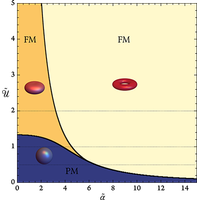
Altermagnetism from interaction-driven itinerant magnetism

Samuele Giuli, Carlos Mejuto-Zaera, and Massimo Capone

Phys. Rev. B 111, L020401 (2025) - Published 3 January, 2025

Altermagnetism is a new collinear magnetic phase with zero net magnetization and bands with nonrelativistic spin splitting. The search for intrinsic altermagnets has been focused so far on the role of anisotropy in the crystallographic symmetries. The authors present here a mechanism based on electronic correlations that leverages the itinerant magnetism driven by Hubbard repulsion and van Hove singularities, and orbital anisotropies. They discuss the fingerprints of correlations in spectral properties and transport, and demonstrate the tunability of spin currents via doping.

Unified defect mechanism for illumination effects on the rutile TiO2 (110) surface from first principles

Guo-Jun Zhu, Yong-Gang Xu, Pan Zhang, Yi-Bin Fang, Ji-Hui Yang, and Xin-Gao Gong

Phys. Rev. B 111, 014101 (2025) - Published 2 January, 2025

Quantum thermoelectric transmission functions with minimal current fluctuations

André M. Timpanaro, Giacomo Guarnieri, and Gabriel T. Landi

Phys. Rev. B 111, 014301 (2025) - Published 2 January, 2025

Predicting topological invariants and unconventional superconducting pairing from density of states and machine learning

Flávio Noronha, Askery Canabarro, Rafael Chaves, and Rodrigo G. Pereira

Phys. Rev. B 111, 014501 (2025) - Published 2 January, 2025

Ferroelectricity in charge-density-wave 1T−TiX2 (X = S, Se, and Te) bilayers

Yu Liu, ShuaiYu Wang, Yapeng Wu, Fengyu Li, and Lei Wang

Phys. Rev. B 111, 024101 (2025) - Published 2 January, 2025

Measuring weak microwave signals via current-biased Josephson junctions: Approaching the quantum limit of energy detection

Y. Q. Chai, S. N. Wang, P. H. OuYang, and L. F. Wei

Phys. Rev. B 111, 024501 (2025) - Published 2 January, 2025

Fast and scalable finite-element based approach for density functional theory calculations using projector augmented wave method

Kartick Ramakrishnan, Sambit Das, and Phani Motamarri

Phys. Rev. B 111, 035101 (2025) - Published 2 January, 2025

Metal-organic frameworks: Strain-tunable quantum phase transition and high-order topological insulator and emergent fermions

Lirong Wang, Yefeng Li, Lei Jin, Wei-Wang Yu, Xiaoming Zhang, Guodong Liu, Ying Liu, and Ting-Ting Zhang

Phys. Rev. B 111, 035102 (2025) - Published 2 January, 2025

Multiple metamagnetic transitions in the helical antiferromagnet CeVGe3

Hanshang Jin, Eun Sang Choi, Hung-Cheng Wu, N. J. Curro, K. Nawa, T. J. Sato, R. Kiyanagi, T. Ohhara, Peter Klavins, and Valentin Taufour

Phys. Rev. B 111, 035103 (2025) - Published 2 January, 2025

Electron interactions in Rashba materials

Yasha Gindikin and Alex Kamenev

Phys. Rev. B 111, 035104 (2025) - Published 2 January, 2025

Berry curvature in materials with a strong spin-orbit coupling results in spin- and momentum-dependent electron-electron interactions. Such interactions may lead to a host of novel collective phenomena. Examples are provided by p-wave superconducting states, mirroring superfluid phases of 3He in 3D, and by time-reversal-invariant topological superconductivity in 2D. They also drive ferromagnetism associated with the Lifshitz transition from spherical to toroidal Fermi surfaces. Such ferromagnetism may coexist with the p-wave superconductivity, opening new avenues for superconducting spintronics, unattainable with conventional superconductors.

Wannier interpolation of reciprocal-space periodic and nonperiodic matrix elements in the optimally smooth subspace

Giulio Volpato, Stefano Mocatti, Giovanni Marini, and Matteo Calandra

Phys. Rev. B 111, 035105 (2025) - Published 2 January, 2025

High mobility and directional magnetotransport in (001)- and (110)-oriented two-dimensional electron gas at spin-coated PrAlO3/SrTiO3 interfaces

Biswanath Maharana and Z. Hossain

Phys. Rev. B 111, 035401 (2025) - Published 2 January, 2025

Armchair carbon nanotube on Pt and hBN/Pt: From strong metallic contact to coherent spin transport regime

Marcin Kurpas, Marko Milivojević, and Martin Gmitra

Phys. Rev. B 111, 035402 (2025) - Published 2 January, 2025

Current-induced magnetization switching induced by Rashba and Ising spin-orbit torques

Peng Zhou, Zhanran Wang, Jiarui Liu, and Zhizhou Yu

Phys. Rev. B 111, 035403 (2025) - Published 2 January, 2025

Sign In to Your Journals Account

Filter

Recent Issues

Vol. 114, Iss. 24
15 October 2026
Vol. 114, Iss. 23
15 October 2026
Vol. 114, Iss. 22
15 October 2026
Vol. 114, Iss. 21
1 October 2026
Category
Article Type
Section

Filter

Article Lookup

Enter a citation