Recent Articles

Hardening of Ni-O bond-stretching phonons in LaNiO2

Yilin Wang

Phys. Rev. B 111, 085117 (2025) - Published 6 February, 2025

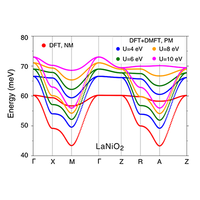
Using DFT+DMFT calculations, the authors demonstrate here that dynamical electron correlations and fluctuating local magnetic moments in the paramagnetic state induce significant hardening of the optical Ni-O bond-stretching phonons of the infinite-layer nickelate superconductor LaNiO2. The electron correlations are found to be sensitive to such phonons, indicating a strong electron coupling to the Ni-O bond-stretching phonons. It emphasizes that local spin fluctuations should be fully considered when describing the lattice dynamics of the infinite-layer nickelates without long-range magnetic order.

Material-oriented modeling of quantum many-body effects in a monolayer transition metal dichalcogenide nanolaser device

J. Buchgeister, A. Steinhoff, D. Erben, M. Lorke, and F. Jahnke

Phys. Rev. B 111, 085301 (2025) - Published 6 February, 2025

Monolayer transition metal dichalcogenides are a notable option as a gain material in future optoelectronic devices, in particular as source of stimulated emission. Here, the authors report a fully quantum mechanical theory to microscopically investigate the interplay of the efficient light-matter interaction and many-body effects in an MoS2 monolayer nanolaser operating at room temperature. The key finding is that such devices are capable of establishing stable gain phases for electron-hole-plasma-based lasing occurring at excited carrier densities above 5×1013cm−2.

Detecting winding and Chern numbers in topological matter using the spectral function

Kiran Babasaheb Estake and Dibyendu Roy

Phys. Rev. B 111, 085406 (2025) - Published 6 February, 2025

Probing quantum chaos through singular-value correlations in the sparse non-Hermitian Sachdev-Ye-Kitaev model

Pratik Nandy, Tanay Pathak, and Masaki Tezuka

Phys. Rev. B 111, L060201 (2025) - Published 6 February, 2025

Krylov fractality and complexity in generic random matrix ensembles

Budhaditya Bhattacharjee and Pratik Nandy

Phys. Rev. B 111, L060202 (2025) - Published 6 February, 2025

Kohn-Sham-Proca equations for ultrafast exciton dynamics

J. K. Dewhurst, D. Gill, S. Shallcross, and S. Sharma

Phys. Rev. B 111, L060302 (2025) - Published 6 February, 2025

Spin current generation due to differential rotation

Takumi Funato, Shunichiro Kinoshita, Norihiro Tanahashi, Shin Nakamura, and Mamoru Matsuo

Phys. Rev. B 111, L060403 (2025) - Published 6 February, 2025

The authors study here nonequilibrium spin dynamics in differentially rotating systems, deriving an effective Hamiltonian for conduction electrons in the comoving frame. In contrast to conventional spin current generation mechanisms that require vorticity, this theory describes spins and spin currents arising from differentially rotating systems regardless of vorticity. They demonstrate the generation of spin currents in differentially rotating systems, such as liquid metals with Taylor-Couette flow. This alternative mechanism will be important in the development of nanomechanical spin devices.

Superconductivity in twisted transition metal dichalcogenide homobilayers

Jihang Zhu, Yang-Zhi Chou, Ming Xie, and Sankar Das Sarma

Phys. Rev. B 111, L060501 (2025) - Published 6 February, 2025

Diffusion in liquid metals is directed by competing collective modes

Franz Demmel and Noel Jakse

Phys. Rev. B 111, L081104 (2025) - Published 6 February, 2025

Adiabatic transformations in dissipative and non-Hermitian phase transitions

Pavel Orlov, Georgy V. Shlyapnikov, and Denis V. Kurlov

Phys. Rev. B 111, L081105 (2025) - Published 6 February, 2025

Transverse voltage in anisotropic hydrodynamic conductors

Kaize Wang, Chunyu Guo, Philip J. W. Moll, and Tobias Holder

Phys. Rev. B 111, L081402 (2025) - Published 6 February, 2025

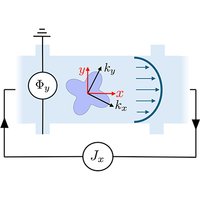
Here, the authors study correlated electron flow in a two-dimensional channel at highly anisotropic Fermi surfaces. If the principal crystal axes are misaligned with respect to the channel geometry, a transverse voltage develops whose sign is determined by the competition of viscous and dissipative forces. This effect presents a sensitive indicator for the onset of hydrodynamic electron transport, showcasing that real materials give rise to novel phenomena which are unattainable with purely isotropic Fermi surfaces.

Pauli spectrum and nonstabilizerness of typical quantum many-body states

Xhek Turkeshi, Anatoly Dymarsky, and Piotr Sierant

Phys. Rev. B 111, 054301 (2025) - Published 5 February, 2025

Anisotropic magnon-magnon coupling mediated by exchange bias in CoZr/Ru/FeNi/IrMn films

Bokai Liang, Shaohua Yuan, Fu Liu, Ying Jin, Yibing Zhao, Jie Xu, Chenglong Jia, and Changjun Jiang

Phys. Rev. B 111, 054408 (2025) - Published 5 February, 2025

Entropic selection of magnetization in a frustrated two-dimensional magnetic model

Anuradha Jagannathan and Thierry Jolicoeur

Phys. Rev. B 111, 054409 (2025) - Published 5 February, 2025

Ising superconductivity in the bulk incommensurate layered material (PbS)1.13(TaS2)

Sajilesh K. P., Roni Anna Gofman, Yuval Nitzav, Avior Almoalem, Ilay Mangel, Toni Shiroka, Nicholas C. Plumb, Chiara Bigi, Francois Bertran, J. Sánchez-Barriga, and Amit Kanigel

Phys. Rev. B 111, 054509 (2025) - Published 5 February, 2025

Intrinsic threshold electric field for domain wall motion in ferroelectrics based on a discretized phase-field model

Huanhuan Tian, Jianguo Yang, and Ming Liu

Phys. Rev. B 111, 064102 (2025) - Published 5 February, 2025

Phonon mode resolved anharmonic heat capacity of solids

Ethan J. Meitz, Gerald J. Wang, and Alan J. H. McGaughey

Phys. Rev. B 111, 064305 (2025) - Published 5 February, 2025

Positive temperature-dependent thermal conductivity induced by wavelike phonons in complex Ag-based argyrodites

Niuchang Ouyang, Dongyi Shen, Chen Wang, Ruihuan Cheng, Qi Wang, and Yue Chen

Phys. Rev. B 111, 064307 (2025) - Published 5 February, 2025

Impact of time-retarded noise on dynamical decoupling schemes for qubits

Kiyoto Nakamura and Joachim Ankerhold

Phys. Rev. B 111, 064503 (2025) - Published 5 February, 2025

Charge density waves and pinning by lattice anisotropy in 214 cuprates

Xiao Hu, P. M. Lozano, Feng Ye, Qiang Li, J. Sears, I. A. Zaliznyak, G. D. Gu, and J. M. Tranquada

Phys. Rev. B 111, 064504 (2025) - Published 5 February, 2025
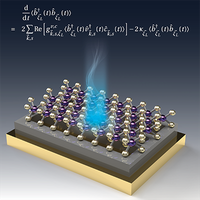
Unlocking the secrets of high-temperature superconductivity, researchers have turned their attention to the La2−x(Ba,Sr)xCuO4 family, where subtle lattice distortions play a pivotal role. By employing neutron diffraction, the authors have successfully identified that the tilt pattern of the CuO6 octahedra, which breaks the fourfold Cu-O bond symmetry, is uniquely responsible for pinning the charge density wave order to the lattice.

Sign In to Your Journals Account

Filter

Recent Issues

Vol. 114, Iss. 24
15 October 2026
Vol. 114, Iss. 23
15 October 2026
Vol. 114, Iss. 22
15 October 2026
Vol. 114, Iss. 21
1 October 2026
Category
Article Type
Section

Filter

Article Lookup

Enter a citation