Recent Articles

Haldane phase, field-induced magnetic ordering, and Tomonaga-Luttinger liquid behavior in the spin-one chain compound NiC2O4·2NH3

Shuo Li, Zhanlong Wu, Yanhong Wang, Jun Luo, Kefan Du, Xiaoyu Xu, Ze Hu, Ying Chen, Jie Yang, Zhengxin Liu, Rong Yu, Yi Cui, Rui Zhou, Hongcheng Lu, and Weiqiang Yu

Phys. Rev. B 111, 195164 (2025) - Published 29 May, 2025

The Haldane phase is a celebrated example of a magnetic topological phase but rarely reported in materials. The authors show here an NMR study on the spin-1 chain magnet NiC2O4·2NH3, which determines its ground state to be a Haldane phase at zero field. An applied magnetic field induces a magnetic ordering at low temperatures and a Tomonaga-Luttinger liquid phase above the ordering temperature with attractive fermionic interactions.

Rashba spin-orbit coupling effects on piezoelectric properties of two-dimensional Janus materials

Xinyi Lin, Yilimiranmu Rouzhahong, Chao Liang, Jian Yuan, Shunwei Yao, and Huashan Li

Phys. Rev. B 111, 195432 (2025) - Published 29 May, 2025

Instantons and topological order in two-leg electron ladders: A universality class

S.-R. Eric Yang, Hyun Cheol Lee, Hoang-Anh Le, and In-Hwan Lee

Phys. Rev. B 111, 205144 (2025) - Published 29 May, 2025

Probing topological degeneracy on a torus using superconducting altermagnets

Tsz Fung Heung and Marcel Franz

Phys. Rev. B 111, 205145 (2025) - Published 29 May, 2025

Screening in Hubbard models with long-range interactions

Florian Gebhard, Kevin Bauerbach, and Örs Legeza

Phys. Rev. B 111, 205146 (2025) - Published 29 May, 2025

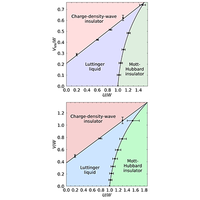
Can the 1/r long-range Coulomb interaction be replaced by a nearest-neighbor interaction? The authors argue here that the screening problem is indeed insignificant: the quantum phase diagrams of a generic Hubbard model with nearest-neighbor interactions (top) and with 1/r long-range interactions (bottom) agree qualitatively. Using constant renormalization factors, the agreement of the phase transition lines can even be made quantitative. Thus, at low energies, Hubbard-type models are seen to provide a significant and viable approach to the interacting electron problem.

Universal spreading dynamics in quasiperiodic non-Hermitian systems

Ze-Yu Xing, Shu Chen, and Haiping Hu

Phys. Rev. B 111, L180203 (2025) - Published 29 May, 2025

Correspondence between dynamic higher-order topological insulator and synthetic higher-order Dirac semimetal

Haonan Wang, Hui Liu, Yuanshuo Liu, Yugan Tang, Pengtao Lai, Hua Cheng, and Shuqi Chen

Phys. Rev. B 111, L201408 (2025) - Published 29 May, 2025

Thermal conductance at the superradiant phase transition in the quantum Rabi model

Tsuyoshi Yamamoto and Yasuhiro Tokura

Phys. Rev. B 111, L201409 (2025) - Published 29 May, 2025

Magnetic glassiness in noncentrosymmetric Sm7Pd3: Interplay of magnetic frustration, long-range order, and frozen domains

Ajay Kumar, Anis Biswas, and Yaroslav Mudryk

Phys. Rev. B 111, 174448 (2025) - Published 28 May, 2025

Charge order driven multiferroic behavior in Sr4Fe6O12: An ab initio study

Arindam Sarkar, Hena Das, Prashant Singh, and Aftab Alam

Phys. Rev. B 111, 174449 (2025) - Published 28 May, 2025

Elliptical stability of hopfions in bulk helimagnets

Konstantin L. Metlov

Phys. Rev. B 111, 174450 (2025) - Published 28 May, 2025

Pressure dependence of sound velocity, shear modulus, and yield strength of the amorphous 4:1 methanol-ethanol mixture to 78 GPa

Chen Hong, Yuanhao Deng, Feng Xu, Haijun Huang, and Andreas Zerr

Phys. Rev. B 111, 184110 (2025) - Published 28 May, 2025

Subballistic operator growth in spin chains with heavy-tailed random fields

Christopher L. Baldwin

Phys. Rev. B 111, 184204 (2025) - Published 28 May, 2025

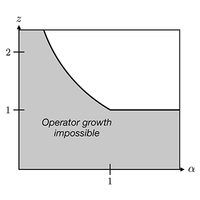
An active area of research in quantum many-body physics is the extent to which quenched disorder impedes “natural” behaviors, such as transport and thermalization. This is an inherently challenging problem to study, and thus it is particularly valuable to have rigorous results that unambiguously prove the absence of transport in certain situations. This work provides such a result: the author uses here the machinery of Lieb-Robinson bounds to prove that ballistic and even diffusive motion is indeed impossible when the distribution of on-site disorder is sufficiently heavy tailed, regardless of most other details of the Hamiltonian.

Bulk excitations in ultraclean α−RuCl3: Quantitative evidence for Majorana dispersions in a Kitaev quantum spin liquid

Kumpei Imamura, Ryuichi Namba, Riku Ishioka, Kota Ishihara, Yuji Matsuda, Seunghun Lee, Eun-Gook Moon, Kenichiro Hashimoto, and Takasada Shibauchi

Phys. Rev. B 111, 184440 (2025) - Published 28 May, 2025

High-order and adaptive optical conductivity calculations using Wannier interpolation

Lorenzo Van Muñoz, Jason Kaye, Alex Barnett, and Sophie Beck

Phys. Rev. B 111, 195162 (2025) - Published 28 May, 2025

Semiclassical kinetic equations for composite bosons

A. Kudlis, I. A. Aleksandrov, Y. S. Krivosenko, and I. A. Shelykh

Phys. Rev. B 111, 195427 (2025) - Published 28 May, 2025

Quantum-metric-induced plateau of nonlinear spin generation

G. T. Lu, Yuxuan Ma, and C. M. Wang

Phys. Rev. B 111, 195428 (2025) - Published 28 May, 2025

Multi-higher-order Dirac and nodal line semimetals

Amartya Pal and Arnob Kumar Ghosh

Phys. Rev. B 111, 195429 (2025) - Published 28 May, 2025

Ultrafast relaxation dynamics and nonequilibrium processes in graphite

Hao-Hsiang Jia, Yuki Nakata, Seigo Souma, Katsuaki Sugawara, Yang-Hao Chan, Cheng-Maw Cheng, Ming-Chang Chen, Takafumi Sato, Chih-Wei Luo, Ashish Chainani, and Ping-Hui Lin

Phys. Rev. B 111, 195430 (2025) - Published 28 May, 2025

Impact of phonon lifetimes on the single-photon indistinguishability in quantum emitters based on two-dimensional materials

Alexander Steinhoff, Steffen Wilksen, Ivan Solovev, Christian Schneider, and Christopher Gies

Phys. Rev. B 111, 195431 (2025) - Published 28 May, 2025

Many advanced quantum technologies rely on quantum interference of indistinguishable photons. Quantum emitters made from 2D semiconductors promise cost-efficient single-photon sources. Here, the authors report a fundamental reduction of the achievable photon indistinguishability compared to 3D systems due to increased exciton-phonon coupling efficiency. In particular, coherence is affected by the finite phonon lifetime in the 2D material. Although embedding the quantum emitters in a cavity partly remedies decoherence effects through Purcell enhancement, a maximum achievable indistinguishability of below 50% is predicted.

Sign In to Your Journals Account

Filter

Recent Issues

Vol. 114, Iss. 24
15 October 2026
Vol. 114, Iss. 23
15 October 2026
Vol. 114, Iss. 22
15 October 2026
Vol. 114, Iss. 21
1 October 2026
Category
Article Type
Section

Filter

Article Lookup

Enter a citation