: A nearly insulating half-filled heavy-fermion metal
Alexander B. Shick, Shin-ichi Fujimori, and Warren E. Pickett
Phys. Rev. B 103, 125136 (2021) - Published 16 March, 2021
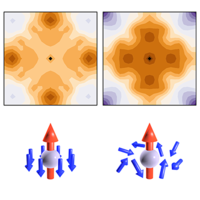
Correlated band theory implemented as a combination of density functional theory with exact diagonalization [(ED)] of the Anderson impurity term with Coulomb repulsion in the open 14-orbital shell is applied to . The small gap for , evidence of the half-filled subshell of uranium, is converted for to a flat-band semimetal with small heavy-carrier Fermi surfaces that will make properties sensitive to pressure, magnetic field, and off-stoichiometry, as observed experimentally. Two means of identification from the Green's function give a mass enhancement of the order of 12 for already heavy (flat) bands, consistent with the common heavy-fermion characterization of . The predicted Kondo temperature around 100 K matches the experimental values from resistivity. The electric field gradients for the two Te sites are calculated by (ED) to differ by a factor of 7, indicating a strong site distinction, while the anisotropy factor is similar for all three sites. The calculated uranium moment of is roughly consistent with the published experimental Curie-Weiss values of 2.8 and (which are field-direction dependent), and the calculated separate spin and orbital moments are remarkably similar to Hund's rule values for an ion. The spectral density is compared with angle-integrated and angle-resolved photoemission spectra, with agreement that there is strong character at, and for several hundred meV below, the Fermi energy. Our results support the picture that the underlying ground state of is that of a half-filled subshell with two half-filled orbitals forming a narrow gap by hybridization and then driven to a conducting state by configuration mixing (spin-charge fluctuations). displays similarities to with its -dominated Fermi surfaces rather than a strongly localized Kondo lattice system.