Recent Articles

Weak localization and crossover from Lifshitz transition in two dimensions

Kai-He Ding, Zhen-Gang Zhu, Yong-Le Hu, and Gang Su

Phys. Rev. B 104, 155135 (2021) - Published 21 October, 2021

Spatial structure of magnetic polarons in strongly interacting antiferromagnets

K. K. Nielsen, M. A. Bastarrachea-Magnani, T. Pohl, and G. M. Bruun

Phys. Rev. B 104, 155136 (2021) - Published 21 October, 2021

Dynamics of spectral correlations in the entanglement Hamiltonian of the Aubry-André-Harper model

Aamna Ahmed, Nilanjan Roy, and Auditya Sharma

Phys. Rev. B 104, 155137 (2021) - Published 21 October, 2021

Corrugation effect, Dirac cone splitting, and plasmon properties of biased twisted bilayer graphene

Chao Ding, Han Gao, Lei Sun, Xikui Ma, and Mingwen Zhao

Phys. Rev. B 104, 155427 (2021) - Published 21 October, 2021

Signatures of the charge density wave collective mode in the infrared optical response of VSe2

Xuanbo Feng (馮翾博), Jans Henke, Corentin Morice, Charles J. Sayers, Enrico Da Como, Jasper van Wezel, and Erik van Heumen

Phys. Rev. B 104, 165134 (2021) - Published 21 October, 2021

The layered transition-metal dichalcogenide VSe2 undergoes a phase transition from a good metal to a charge density wave phase. Recent advances in crystal growth enable a detailed study of the imprint of the charge density wave on the optical conductivity. The authors observe emerging infrared active phonon modes and a mass enhancement of the charge carriers due to the interaction with the lattice. They identify key signatures of the elusive sliding mode associated with the charge order in this material.

Charge disproportionation and Hund's insulating behavior in a five-orbital Hubbard model applicable to d4 perovskites

Maximilian E. Merkel and Claude Ederer

Phys. Rev. B 104, 165135 (2021) - Published 21 October, 2021

Comparison of finite-temperature topological indicators based on Uhlmann connection

Ye Zhang, Aixin Pi, Yan He, and Chih-Chun Chien

Phys. Rev. B 104, 165417 (2021) - Published 21 October, 2021

Analytical WKB theory for high-harmonic generation and its application to massive Dirac electrons

Hidetoshi Taya, Masaru Hongo, and Tatsuhiko N. Ikeda

Phys. Rev. B 104, L140305 (2021) - Published 21 October, 2021

Single-mode lasing based on PT-breaking of two-dimensional photonic higher-order topological insulator

Bofeng Zhu, Qiang Wang, Yongquan Zeng, Qi Jie Wang, and Y. D. Chong

Phys. Rev. B 104, L140306 (2021) - Published 21 October, 2021

Multiple energy scales and anisotropic energy gap in the charge-density-wave phase of the kagome superconductor CsV3Sb5

Kosuke Nakayama, Yongkai Li, Takemi Kato, Min Liu, Zhiwei Wang, Takashi Takahashi, Yugui Yao, and Takafumi Sato

Phys. Rev. B 104, L161112 (2021) - Published 21 October, 2021

Valley-polarized quantum anomalous Hall phase in bilayer graphene with layer-dependent proximity effects

Marc Vila, Jose H. Garcia, and Stephan Roche

Phys. Rev. B 104, L161113 (2021) - Published 21 October, 2021

Beyond magnons in Nd2ScNbO7: An Ising pyrochlore antiferromagnet with all-in–all-out order and random fields

A. Scheie, M. Sanders, Xin Gui, Yiming Qiu, T. R. Prisk, R. J. Cava, and C. Broholm

Phys. Rev. B 104, 134418 (2021) - Published 20 October, 2021

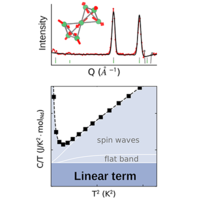
Many magnetic materials have quantum disordered magnetic ground states, but it is not always clear what drives them. Here, the authors study the pyrochlore magnet Nd2ScNbO7 using neutron diffraction, heat capacity, and neutron-sampled nuclear hyperfine excitations. The static magnetic moments inferred from these three techniques are inconsistent, pointing to some fraction of spins remaining dynamic to the lowest temperatures – an observation confirmed by the anomalous low-energy density of states in the specific heat. Similar behavior is seen in Nd2Zr2O7. It could indicate either quantum spin-liquid behavior or local disorder-induced spin singlets.

Resonant optical topological Hall conductivity from skyrmions

Sopheak Sorn, Luyi Yang, and Arun Paramekanti

Phys. Rev. B 104, 134419 (2021) - Published 20 October, 2021

Time-reversal symmetry breaking and d-wave superconductivity of triple-point fermions

Subrata Mandal, Julia M. Link, and Igor F. Herbut

Phys. Rev. B 104, 134512 (2021) - Published 20 October, 2021

Landau-Lifshitz-Bloch equation for ferrimagnets with higher-order interaction

Marco Menarini and Vitaliy Lomakin

Phys. Rev. B 104, 144303 (2021) - Published 20 October, 2021

Absence of spin transport in amorphous YIG evidenced by nonlocal spin transport experiments

Liupeng Yang, Yaoyu Gu, Lina Chen, Kaiyuan Zhou, Qingwei Fu, Wenqiang Wang, Liyuan Li, Chunjie Yan, Haotian Li, Like Liang, Zishuang Li, Yong Pu, Youwei Du, and Ronghua Liu

Phys. Rev. B 104, 144415 (2021) - Published 20 October, 2021

Steady-state phases of the dissipative spin-1/2 XYZ model with frustrated interactions

Xingli Li, Yan Li, and Jiasen Jin

Phys. Rev. B 104, 155130 (2021) - Published 20 October, 2021

Submonolayer copper telluride phase on Cu(111): Ad-chain and trough formation

Tilman Kißlinger, M. Alexander Schneider, and Lutz Hammer

Phys. Rev. B 104, 155426 (2021) - Published 20 October, 2021

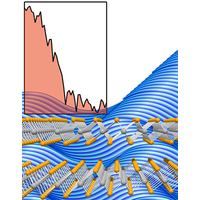
A new surface telluride phase on Cu(111) is revealed and structurally characterized with picometer accuracy by a concerted application of LEED-IV, STM, and DFT. It is demonstrated that tellurium interacts strongly with the surface, inducing a complex displacive reconstruction in order to increase the number of available tellurium sites. This finding suggests that the CuTe/Cu interfaces that are used in photovoltaic cells might also be of equally complex structure.

Resolving the Berezinskii-Kosterlitz-Thouless transition in the two-dimensional XY model with tensor-network-based level spectroscopy

Atsushi Ueda and Masaki Oshikawa

Phys. Rev. B 104, 165132 (2021) - Published 20 October, 2021

The discovery of the Berezinskii-Kosterlitz-Thouless transition some fifty years ago was a subject of the 2016 Nobel Prize in Physics. However, quantitative study of the transition in the two-dimensional XY spin model still suffers from significant finite-size effects. The authors implement the level-spectroscopy method, originally developed for quantum systems. They utilize the modern tensor-network renormalization scheme. This allows for an extremely accurate determination of the critical point as well as for a visualization of the celebrated Kosterlitz renormalization-group flow.

Nesting instability of gapless U(1) spin liquids with spinon Fermi pockets in two dimensions

Wilhelm G. F. Krüger and Lukas Janssen

Phys. Rev. B 104, 165133 (2021) - Published 20 October, 2021
Sign In to Your Journals Account

Filter

Recent Issues

Vol. 114, Iss. 24
15 October 2026
Vol. 114, Iss. 23
15 October 2026
Vol. 114, Iss. 22
15 October 2026
Vol. 114, Iss. 21
1 October 2026
Category
Article Type
Section

Filter

Article Lookup

Enter a citation