Recent Articles

Landauer-based study of transport in Chern insulator heterostructures

J. Luna-Ramos and A. Martín-Ruiz

Phys. Rev. B 113, 184204 (2026) - Published 5 May, 2026

Electric field driven polaron transport beyond the harmonic approximation in one-dimensional crystal lattices: From conventional polarons to supersonic solectrons

Yi Ming, Manuel G. Velarde, and Hao Hu

Phys. Rev. B 113, 184303 (2026) - Published 5 May, 2026

Transition from population- to coherence-dominated nondiffusive thermal transport

Laurenz Kremeyer, Bradley J. Siwick, and Samuel Huberman

Phys. Rev. B 113, 184304 (2026) - Published 5 May, 2026

Classical symmetry enriched topological orders and distinct monopole charges for dipole-octupole spin ices

Pengwei Zhao and Gang v. Chen

Phys. Rev. B 113, 184417 (2026) - Published 5 May, 2026

Simulation of a strongly quantum-degenerate uniform electron gas using the pseudofermion method

Yunuo Xiong, Tommaso Morresi, and Hongwei Xiong

Phys. Rev. B 113, 195104 (2026) - Published 5 May, 2026

Symmetry-enriched topological order and quasifractonic behavior in ZN stabilizer codes

Siyu He and Hao Song

Phys. Rev. B 113, 205110 (2026) - Published 5 May, 2026

Here, the authors study the ℤN bivariate-bicycle (BB) codes, a versatile class of exactly solvable models that generalize binary BB codes and arise naturally from gauging modulated symmetries. They show that the core topological properties can be determined by the associated ℤp codes for the prime factors of N, enabling efficient extraction of topological invariants via algebraic-geometric (BKK) and computational (Gröbner) methods. They further elucidate the translation-symmetry–enriched structure underlying quasifractonic mobility, thereby resolving a key puzzle regarding how anyons move in these models.

Intrinsic negative magnetoresistance in layered antiferromagnetic semimetals: The case of EuSn2As2

K. S. Pervakov, A. V. Sadakov, O. A. Sobolevskiy, V. A. Vlasenko, V. P. Martovitsky, E. A. Sedov, E. I. Maltsev, P. D. Grigoriev, N. S. Pavlov, I. A. Nekrasov, O. E. Tereshchenko, V. A. Golyashov, and V. M. Pudalov

Phys. Rev. B 113, 205111 (2026) - Published 5 May, 2026

Robust multipartite entanglement in dirty topological wires

Luca Pezzè and Luca Lepori

Phys. Rev. B 113, 205112 (2026) - Published 5 May, 2026

Emergent one-dimensional Luttinger liquid states at charge density wave domain walls embedded in monolayer 1T−VSe2

Chen Zhang, Sahr Izadi Vishkayi, Qiwei Tian, Yulong Zeng, Bo Li, Linghui Tong, Yang Zhang, Li Zhang, Yuan Tian, Long-Jing Yin, Meysam Bagheri Tagani, Lijie Zhang, and Zhihui Qin

Phys. Rev. B 113, 205113 (2026) - Published 5 May, 2026

Temperature-driven reversible n- to p-type conductivity switch in Bi-doped SnSe

Mehmet Ozdogan, Thomas Iken, Carlos Munoz, Deniz Cakir, and Nuri Oncel

Phys. Rev. B 113, 205202 (2026) - Published 5 May, 2026

Drift and Hall mobility of graphene-like Dirac materials

Yingqi Wang and Zhirong Liu

Phys. Rev. B 113, 205408 (2026) - Published 5 May, 2026

Sliding-driven switchable layer-polarized anomalous Hall effect in inversion-symmetric van der Waals systems

Xinyang Li, Yehui Zhang, and Liang Ma

Phys. Rev. B 113, 205409 (2026) - Published 5 May, 2026

Anisotropic Anderson localization in higher-dimensional nonreciprocal lattices

Jinyuan Shang and Haiping Hu

Phys. Rev. B 113, L180201 (2026) - Published 5 May, 2026

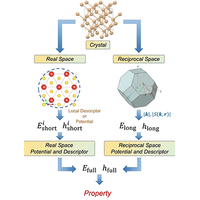
Capturing long-range interactions with a reciprocal-space neural network

Ruijie Guo, Hongyu Yu, Liangliang Hong, Shiyou Chen, Xingao Gong, and Hongjun Xiang

Phys. Rev. B 113, 174101 (2026) - Published 4 May, 2026

Standard machine learning interatomic potentials often neglect crucial long-range interactions. Inspired by the Ewald summation method, the authors introduce here a reciprocal-space neural network to capture diverse long-range interactions (including Coulomb and van der Waals interactions), while preserving Euclidean symmetry. This approach significantly enhances the accuracy of the potentials and global properties for complex materials, such as defective gallium nitride and hafnium oxide.

Critical sample sizes for apperance and disappearance of ferroelectricity in nanosized hafnia-zirconia: Landau-type theory

Anna N. Morozovska, Eugene A. Eliseev, Sergei V. Kalinin, and Maksym V. Strikha

Phys. Rev. B 113, 174102 (2026) - Published 4 May, 2026

Evolution of quantum geometric tensor of one-dimensional periodic systems after a quench

Jia-Chen Tang, Xu-Yang Hou, Yu-Huan Huang, Hao Guo, and Chih-Chun Chien

Phys. Rev. B 113, 174301 (2026) - Published 4 May, 2026

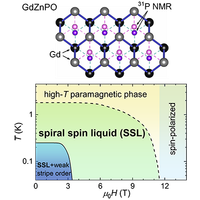
Spiral spin liquid resilient to quantization in the frustrated honeycomb antiferromagnet GdZnPO

Xun Chen, Rui Bian, Yuqian Zhao, Haijun Liao, Weiqiang Yu, Yi Cui, and Yuesheng Li

Phys. Rev. B 113, 174402 (2026) - Published 4 May, 2026

Spin liquids usually emerge in low-spin (S=½ or 1) systems with strong quantum fluctuations. Here, the authors show that GdZnPO—a structurally disorder-free, high-spin (S=7⁄2) frustrated honeycomb antiferromagnet—defies this expectation. Nuclear magnetic resonance (NMR) measurements reveal persistent spin dynamics and spin-liquid behavior down to the lowest accessible temperatures in GdZnPO.

Functional renormalization group study of a dissipative Bose-Hubbard model

Oscar Bouverot-Dupuis, Vincent Grison, and Nicolas Paris

Phys. Rev. B 113, 174503 (2026) - Published 4 May, 2026

Ginzburg-Landau theory of Rashba superconductors: Concave upper critical field

Fedor V. Kusmartsev, Anna Kusmartseva, Jack C. M. Hughes, Fatemah H. Alkallas, Amira Ben Gouider Trabelsi, Qihong Chen, and Kui Jin

Phys. Rev. B 113, 179601 (2026) - Published 4 May, 2026

Broken inversion symmetry together with Rashba spin-orbit coupling fundamentally alters how superconductivity withstands applied magnetic fields. This work constructs a symmetry-respecting Ginzburg–Landau framework for Rashba superconductors and demonstrates that the upper critical field Hc2(T) exhibits a distinctly concave temperature dependence in contrast to the usual saturationlike behavior of conventional superconductors. Within this theory, the interplay between Rashba coupling and the effective mass of Cooper pairs is shown to control the superconducting phase boundary, yielding a compact analytic tool for interpreting and fitting unusually high critical fields in noncentrosymmetric systems. The approach further reveals that parity-mixed, multicomponent order parameters can host soft relative-phase modes with axionlike properties, thereby connecting the physics of the phase boundary to topological superconductivity, spintronics, axion dark matter, and the targeted design of future quantum materials.

E.I. Rashba and the semiconductor theory sector at the L.D. Landau Institute for Theoretical Physics

D. E. Khmelnitskii

Phys. Rev. B 113, 179602 (2026) - Published 4 May, 2026

An account is given of the intense research collaborations and scientific output of Rashba at the Landau Institute for Theoretical Physics over a period spanning a quarter of a century (1966-1991).

Sign In to Your Journals Account

Filter

Recent Issues

Vol. 114, Iss. 24
15 October 2026
Vol. 114, Iss. 23
15 October 2026
Vol. 114, Iss. 22
15 October 2026
Vol. 114, Iss. 21
1 October 2026
Category
Article Type
Section

Filter

Article Lookup

Enter a citation