Recent Articles

Dipole-coupled Er3+ spins in silicon

Wenda Fan, Ruiwen Chen, Yang Yang, Jian Wang, Rose L. Ahlefeldt, Gabriele G. de Boo, Alexey Lyasota, Guangchong Hu, Jiliang Yang, Brett C. Johnson, Jeffrey C. McCallum, Matthew J. Sellars, Sven Rogge, Kangwei Xia, Chang-Kui Duan, and Chunming Yin

Phys. Rev. B 114, 175303 (2026) - Published 22 September, 2026

Magnetization induced by nonlinear response to temperature gradient in d′, g′, and i′ altermagnets

Motohiko Ezawa

Phys. Rev. B 114, 175304 (2026) - Published 22 September, 2026

Electric-polarization probe of the magnon orbital moment current in altermagnets

Sankar Sarkar and Amit Agarwal

Phys. Rev. B 114, 175408 (2026) - Published 22 September, 2026

Antibunching in locally driven dissipative Lieb lattices

Alex Ferrier, Michał Matuszewski, Piotr Deuar, and Marzena H. Szymańska

Phys. Rev. B 114, 185306 (2026) - Published 22 September, 2026

Tunable second-harmonic generation in twisted graphene superlattices: Role of layer stacking and twist angle

Yingliang Chen, Jiansheng Hu, Weibin Zhang, and Xiaobo Feng

Phys. Rev. B 114, 185424 (2026) - Published 22 September, 2026

Effect of temperature-induced dielectric response on radiative heat transfer in the extreme near-field regime

Md Jahid Hasan Sagor and Sheila Edalatpour

Phys. Rev. B 114, 185425 (2026) - Published 22 September, 2026

Beyond topological invariants: Order parameters from dominant Fock-state patterns

Tsz Hin Hui, Xiaodan Xia, Pedro D. Sacramento, and Wing Chi Yu

Phys. Rev. B 114, L171113 (2026) - Published 22 September, 2026

Hot carrier localization in continuum states of a quantum dot solid

Ajay K. Poonia, Naresh Aggarwal, Swapnil S. Deshpande, Barnali Mondal, Angshuman Nag, Sudip Chakraborty, and K. V. Adarsh

Phys. Rev. B 114, L171406 (2026) - Published 22 September, 2026

Hot carriers in semiconductors typically cool within a picosecond, dissipating their excess energy as heat. Here, the authors demonstrate that intrinsic positional disorder in a metal halide perovskite quantum dot solid usually treated as a defect of such assemblies, can instead strongly suppress hot-carrier cooling. Ultrafast transient absorption spectroscopy reveals hot carriers localized in continuum states, with cooling times more than an order of magnitude longer than those in uncoupled quantum dots. First-principles density functional theory traces this localization to disorder-induced local potential fluctuations.

Strain engineering of superconductivity in the kagome metal CsV3Sb5: Combined first-principles and Eliashberg theory study

D. Hu, Yizhi Li, Jianxin Zhong, and Lijun Meng

Phys. Rev. B 114, 134105 (2026) - Published 21 September, 2026

Prediction of ultralow thermal conductivity halides via rotational soft modes and octahedral distortion

Yu Wu, Luman Shang, Yufan Liu, Shuming Zeng, Gang Tang, Liujiang Zhou, Hao Zhang, and Chenhan Liu

Phys. Rev. B 114, 134306 (2026) - Published 21 September, 2026

Geometric origin of phonon magnetic moment in Dirac materials

Wenqin Chen, Xiao-Wei Zhang, Ting Cao, Shi-Zeng Lin, and Di Xiao

Phys. Rev. B 114, 134307 (2026) - Published 21 September, 2026

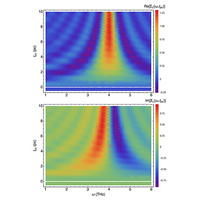
Intrinsic temporal and spectral mixing in time-resolved terahertz spectroscopy

Benjamin J. Dringoli and David G. Cooke

Phys. Rev. B 114, 134308 (2026) - Published 21 September, 2026

Ultrafast studies of photoinduced phase transitions increasingly rely on terahertz probes to track structural reorganization. Here, the authors show that when materials are altered faster than the THz probe duration, measured response functions can generate spurious time-frequency oscillations mimicking coherent dynamics. THz measurements on photoexcited SnSe, FDTD simulations, and an extended nonequilibrium response formalism demonstrate that these artifacts arise from fast photoinduced changes combined with long momentum relaxation times. This result offers a diagnostic for separating genuine signatures of photoinduced transitions from measurement-induced distortions.

Robust realization of spin-polarized specular Andreev reflection in V2O-based altermagnets

Yutaro Nagae, Andreas P. Schnyder, and Satoshi Ikegaya

Phys. Rev. B 114, 134513 (2026) - Published 21 September, 2026

Current induced switching of superconducting order and enhancement of superconducting diode efficiency

Uddalok Nag, Jonathan Schirmer, Chao-Xing Liu, and J. K. Jain

Phys. Rev. B 114, 134514 (2026) - Published 21 September, 2026

Phonon fluctuation diagnostics: Origin of charge order in AV3Sb5 kagome metals

Stefan Enzner, Jan Berges, Arne Schobert, Dongjin Oh, Mingu Kang, Riccardo Comin, Ronny Thomale, Tim Wehling, Domenico Di Sante, and Giorgio Sangiovanni

Phys. Rev. B 114, 144304 (2026) - Published 21 September, 2026

The authors utilize phonon fluctuation diagnostics here to resolve the open question of the microscopic origin of charge density wave order in AV3Sb5 (A=K, Rb, Cs) kagome metals. Here, combining momentum-resolved ab initio calculations with ARPES measurements, they identify electron-phonon coupling as the primary driver of the lattice instability, rather than Van Hove singularities or nesting alone. Remarkably, the strongest contributions arise away from the high-symmetry M points, revealing a common mechanism across the three compounds.

Evanescent reweighting of acoustic radiation force channels in whispering gallery resonances

Yiyun Chen, Huimin Cheng, Xiao Li, and Jack Ng

Phys. Rev. B 114, 144305 (2026) - Published 21 September, 2026

Physical trends and design principles in aliovalent double half-Heusler thermoelectrics from high-throughput computational screening

Danil R. Baigutlin, Vladimir V. Sokolovskiy, and Sergey V. Taskaev

Phys. Rev. B 114, 144306 (2026) - Published 21 September, 2026

Microscopic magnetic phase evolution in the Weyl semimetal Mn3Sn revealed by μ+SR

U. Miniotaite, O. K. Forslund, H. Luetkens, V. Rai, J. Perßon, G. D. Morris, D. Zuhair, D. W. Tam, S. Nandi, Y. Sassa, and M. Månsson

Phys. Rev. B 114, 144419 (2026) - Published 21 September, 2026

The Weyl semimetal Mn3Sn hosts a rich sequence of magnetic states. Here, the authors combine muon spin relaxation and magnetization measurements to reveal a broad crossover between helical and inverse triangular antiferromagnetic order. At low temperatures, their nearly stoichiometric sample develops a growing ferromagnetic component and slowing spin fluctuations, without evidence of static spin-glass freezing within the experimental time window. These findings suggest that low-temperature ferromagnetism can emerge independently of glassy freezing.

Electric polarization driven by noncollinear spin alignment investigated by first principles calculations

Sergiy Mankovsky, Svitlana Polesya, Jan Minar, Hongbin Zhang, and Hubert Ebert

Phys. Rev. B 114, 144420 (2026) - Published 21 September, 2026

Thermal conductivity in amorphous strontium titanate

Siu Ting Tai and Yue Chen

Phys. Rev. B 114, 154204 (2026) - Published 21 September, 2026

Sign In to Your Journals Account

Filter

Recent Issues

Vol. 114, Iss. 30
15 November 2026
Vol. 114, Iss. 29
15 November 2026
Vol. 114, Iss. 28
15 November 2026
Vol. 114, Iss. 27
1 November 2026
Category
Article Type
Section

Filter

Article Lookup

Enter a citation