Recent Articles

Photon-atom interactions in the intermediate magnetic field regime using an atomic beam

Chen Liu, Tingxuan Xiang, Yuanhao Li, Junhua Liu, Wenming Wang, and Yanhui Wang

Phys. Rev. Applied 25, 054030 (2026) - Published 12 May, 2026

Practical countermeasure against attacks exploiting detection-efficiency mismatch in quantum key distribution

Ben J. Taylor, Peter R. Smith, James F. Dynes, Robert I. Woodward, Marco Lucamarini, R. Mark Stevenson, and Andrew J. Shields

Phys. Rev. Applied 25, 054029 (2026) - Published 12 May, 2026

Enhanced detection of rotational Doppler shift from sunlight

Jiedong Yang, Yuan Li, Wuhong Zhang, and Lixiang Chen

Phys. Rev. Applied 25, 054028 (2026) - Published 12 May, 2026

Spin and orbital Rashba response in ferroelectric polarized PtSe2/MoSe2/LiNbO3 heterostructures

A. Pezo, S. Massabeau, F. Miljevic, J.-M. George, H. Jaffrès, J. Li, F. Ibrahim, M. Jamet, and M. Chshiev

Phys. Rev. Applied 25, 054027 (2026) - Published 11 May, 2026

Enhanced quality factors at resonance in acoustofluidic cavities embedded in matched elastic metamaterials

Valdemar Frederiksen and Henrik Bruus

Phys. Rev. Applied 25, 054026 (2026) - Published 11 May, 2026

Microscale ultrasound acoustofluidics has become an important tool for handling cells and microparticles in lab-on-a-chip technology, but it fails in separation and focusing of submicrometer particles, due to dissipation processes in the viscous boundary layer. Here a theoretical proof-of-concept analysis shows that by embedding the microfluidic channel in a properly designed fused-silica metamaterial, the vibrational motion of the fluid and the metamaterial can be matched, which prevents formation of the viscous boundary layer. This increases the Q factor of the ultrasound resonance modes by several orders of magnitude, reduces acoustic streaming, and enables nanoparticle focusing.

Temporal evolution of thermoacoustic streaming around a spatially confined temperature gradient

Franziska Martens, Enrico Corato, David van Assche, Ola Jakobsson, Wei Qiu, and Per Augustsson

Phys. Rev. Applied 25, 054025 (2026) - Published 11 May, 2026

Improved quantum algorithms for eigenvalue finding and gradient descent

Nhat A. Nghiem and Tzu-Chieh Wei

Phys. Rev. Applied 25, 054024 (2026) - Published 11 May, 2026

Learning-optimized qubit mapping and reuse to minimize intercore communication in modular quantum architectures

Sokea Sang, Leanghok Hour, and Youngsun Han

Phys. Rev. Applied 25, 054023 (2026) - Published 8 May, 2026

Semi-device-independent quantum random-number generator resistant to general attacks

Zhenguo Lu, Jundong Wu, Yu Zhang, Shaobo Ren, Xuyang Wang, Hongyi Zhou, and Yongmin Li

Phys. Rev. Applied 25, 054022 (2026) - Published 8 May, 2026

Squeezing of light in a dual-pumped microresonator revealed by a common-pass local oscillator

Andrei N. Danilin, Timur R. Yunusov, Alexey P. Dushanin, Natalia S. Salakhova, Alexander K. Vorobyev, Alexey D. Ivanov, Anatoly V. Masalov, Igor A. Bilenko, and Dmitry A. Chermoshentsev

Phys. Rev. Applied 25, 054021 (2026) - Published 8 May, 2026

Synthetic topological device for advancing elastic energy harvesting

Jiamin Guo, Zhongming Gu, Lei Fan, Jie Liu, Yafeng Chen, Zhongqing Su, and Jie Zhu

Phys. Rev. Applied 25, 054020 (2026) - Published 8 May, 2026

Reconfigurable oxide nanoelectronics by tip-induced electron delocalization

Chengyuan Huang, Changjian Ma, Mengke Ha, Longbing Shang, Zhenlan Chen, Qing Xiao, Zhiyuan Qin, Danqing Liu, Haoyuan Wang, Dawei Qiu, Qianyi Zhao, Ziliang Guo, Yanling Liu, Dingbang Chen, Chengxuan Ye, Zhenhao Li, Chang-Kui Duan, and Guanglei Cheng

Phys. Rev. Applied 25, L051003 (2026) - Published 7 May, 2026

Reconfigurable lithography based on conductive atomic force microscopy on oxide interfaces has long been limited to ambient conditions. This Letter reports a mechanism that overcomes this constraint, enabling the writing, measuring, and erasing of quantum devices in situ at 100 mK with ultrafine resolution. This capability establishes a versatile “Hubbard toolbox” for correlated oxides, providing a platform to engineer and simulate programmable quantum phases in the solid state.

Highly linear proximity-based double-loop SQUID operating above 4 K

G. Trupiano, E. Riccardi, C. Puglia, M. Kiczynski, A. Gardin, G. De Simoni, G. C. Tettamanzi, and F. Giazotto

Phys. Rev. Applied 25, 054019 (2026) - Published 7 May, 2026

Defect, phase coexistence, and electromechanical properties of K0.5Na0.5NbO3 thin films with intentional and unintentional Ti doping

Jueyu Chen, Shashidhara Acharya, Mingsheng Zhang, Ming Lin, Poh Chong Lim, Jianwei Chai, Milan Shrestha, Edwin Hang Tong Teo, and Kui Yao

Phys. Rev. Applied 25, 054018 (2026) - Published 7 May, 2026

Diamond-based magnetometer aboard the International Space Station

Yarne Beerden, Boo Carmans, Remy Vandebosch, Dries Hendrikx, Sam Bammens, Musa Aydogan, Siemen Achten, Jeffrey Gorissen, Sebastiaan Vanspauwen, Siemen Vandervoort, Teoman Köseoglu, Jens Mannaerts, Stijn Jacobs, Daphne Box, Milos Nesladek, and Jaroslav Hruby

Phys. Rev. Applied 25, 054017 (2026) - Published 7 May, 2026

Precise mapping of the geomagnetic field is essential for geophysics, space weather, and navigation, but current magnetometers are limited by sensitivity, dynamic range, and compactness. The authors present the OSCAR-QUBE quantum magnetometer based on nitrogen-vacancy centers in diamond, achieving vector magnetic-field measurements aboard the International Space Station in a compact device with sensitivity below 300 nT/√Hz. They further validate its performance through direct comparison to geomagnetic field models, showing good agreement with the expected field in low Earth orbit. This establishes diamond-based quantum magnetometry as viable for compact, high-performance space missions.

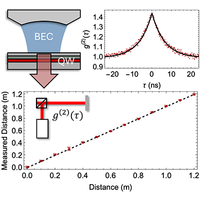
Semiconductor photon Bose-Einstein condensate as a practical light source for range finding

Ross C. Schofield, Daniel Lim, Nathan R. Gemmell, Edmund Clarke, Ian Farrer, Aristotelis Trapalis, Jon Heffernan, and Rupert F. Oulton

Phys. Rev. Applied 25, L051002 (2026) - Published 6 May, 2026

Photon Bose-Einstein condensates combine coherence, low threshold, and thermal photon statistics, making them promising optical sources and sensors. Here researchers show that a room-temperature semiconductor photon condensate can be used directly for thermal range finding by operating just above threshold, where bright continuous-wave single-mode emission still shows measurable photon bunching. The resulting second-order coherence peak provides a robust measure of optical delay, enabling millimeter-precision distance measurements and simultaneous extraction of multiple path delays. This work links many-body quantum optics with practical optical metrology.

Synthesis of artificial transmission lines tailored for traveling-wave parametric processes

M. Malnou

Phys. Rev. Applied 25, 054016 (2026) - Published 6 May, 2026

Traveling-wave parametric amplifiers (TWPAs), essential components of superconducting quantum processors, are built from artificial transmission lines for which dispersion relations must be tailored to favor specific parametric processes, while suppressing spurious ones. A unified framework to guide the design of such dispersion relations has been lacking. This study develops such a framework, borrowing concepts from periodic structures and filter synthesis. Innovative architectures are revealed, including an “ambidextrous” right-left-handed TWPA.

Universal route toward a field-free electrically polarity-reversible Josephson diode

Pramod K. Sharma, Sagnik Banerjee, Biswajit Dutta, Vansh Singhal, Pushpak Banerjee, Sonam Bhakat, Hridis K. Pal, and Avradeep Pal

Phys. Rev. Applied 25, 054015 (2026) - Published 6 May, 2026

Revealing negative thermal expansion and constructing dominant spin-correlation functions in polar antiferromagnetic Fe2Mo3O8 through site-dependent acoustic wave generation

Y.H. Li, C.P. Chang, T. Kurumaji, Y. Tokura, and Y.M. Sheu

Phys. Rev. Applied 25, 054014 (2026) - Published 6 May, 2026

Spin correlations and their coupling to the lattice underpin magnetostrictive functionality, yet conventional probes capture only its collective response. By selectively exciting crystal-field-split d–d transitions, the authors isolate site-specific spin contributions through the generation of acoustic strain pulses. Their distinct temperature dependences expose multiple spin-correlation channels, and uncover negative thermal expansion in Fe2Mo3O8 driven by spontaneous magnetostriction. This approach opens an ultrafast-acoustics route to resolving magnetic contributions to mechanical response.

Doppler-shift mitigation in a chip-scale atomic beam clock

Alexander Staron, Gabriela Martinez, Nicholas Nardelli, Travis Autry, John Kitching, and William McGehee

Phys. Rev. Applied 25, L051001 (2026) - Published 5 May, 2026

Chip-scale atomic beams are a promising approach for realizing low-drift, low-power microwave atomic clocks, as atomic beams can circumvent some of the sources of drift present in other chip-scale atomic clock architectures. The spectroscopic approach used in such work can be limited by light shifts, but the authors find a surprisingly simple method to mitigate the dominant ones, using a competition between resonant light shifts and Doppler shifts. Employing this technique, they dramatically reduce the clock’s sensitivity to laser-frequency variation, and the measured clock performance indicates that full miniaturization of this approach is feasible.

Sign In to Your Journals Account

Filter

Recent Issues

Vol. 26, Iss. 4
October 2026
Vol. 26, Iss. 3
September 2026
Vol. 26, Iss. 2
August 2026
Vol. 26, Iss. 1
July 2026
Category
Article Type

Filter

Article Lookup

Enter a citation