Letters

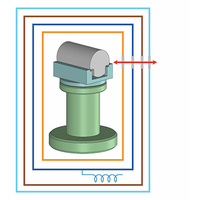
Cryogenic photonic resonator with 10−17/s drift

Wei Zhang, William R. Milner, Jun Ye, and Scott B. Papp

Phys. Rev. A 113, L061501 (2026) - Published 1 June, 2026

Thermal noise sets stringent limits on precision measurement in physical systems. This work explores a photonic resonator design that suppresses thermal sensitivity and achieves fractional frequency drift at the 10^{-17}/s level in a cryogenic fused-silica resonator.

Decaying superfluid turbulence near an anomalous nonthermal fixed point

Niklas Rasch and Thomas Gasenzer

Phys. Rev. A 113, L051302 (2026) - Published 28 May, 2026

The authors show that the far-from-equilibrium dynamics of a two-dimensional superfluid Bose gas develop complex turbulent motion that follows the scaling laws predicted by classical turbulence theory, including higher-order intermittency corrections. Simultaneously, the gas approaches a dynamical attractor with spatio-temporal self-similarity, known as a non-thermal fixed point, demonstrating a close connection between these two theoretical frameworks.

Tuning the critical current in toroidal superfluids via controllable impurities

K. Xhani, G. Del Pace, N. Grani, D. Hernández-Rajkov, B. Donelli, G. Roati, and L. Pezzè

Phys. Rev. A 113, L051301 (2026) - Published 21 May, 2026

By combining experiments with simulations, the authors show how the density of controllable impurities and their spatial distribution tune the maximum current sustained by a ring bosonic superfluid. The impurity arrangement also allows for engineering vortex emission and pinning dynamics.

Cavity-based optical switching via phase modulation in warm rubidium vapor

G. Booton, T. Wasawo, W. O. C. Davis, C. McGarry, K. R. Rusimova, A. O. C. Davis, J. Nunn, and P. J. Mosley

Phys. Rev. A 113, L051701 (2026) - Published 20 May, 2026

The authors present an all-optical switch mediated by warm rubidium vapor. Phase modulation of a detuned signal field enables fast routing with low loss.

Exact parent Hamiltonians for all Landau level states in a half-flux lattice

Xin Shen, Guangyue Ji, Jinjie Zhang, David E. Palomino, Bruno Mera, Tomoki Ozawa, and Jie Wang

Phys. Rev. A 113, L050201 (2026) - Published 15 May, 2026

The authors construct Hofstadter Hamiltonians with exactly flat bands whose wave functions can realize the states of any Landau level on the lattice. It opens up a route towards engineering exotic many-body states with ultracold atoms in optical lattices.

Matter-wave interference caused by an ultraviolet-induced virtual state based on high-harmonic generation

A. A. Romanov, A. V. Flegel, A. A. Silaev, N. V. Vvedenskii, Liang-You Peng, and M. V. Frolov

Phys. Rev. A 113, L051101 (2026) - Published 15 May, 2026

A short ultraviolet pulse superimposed on an intense infrared field creates an alternative channel for high-harmonic generation, whose dynamics is controlled by the UV-created virtual state and may lead to enhancement or suppression of the harmonic yield. Interference between the alternative channel and the direct infrared-driven channel provided by the three-step scenario produces fringes in the harmonic yield as a function of the ultraviolet–infrared delay, encoding the UV-pulse waveform.

Enhanced security in quantum token protocols using hybrid spin-photon interfaces

Yang Wang, Jörg Wrachtrup, and Durga Bhaktavatsala Rao Dasari

Phys. Rev. A 113, L050601 (2026) - Published 7 May, 2026

Quantum communication networks using spin–photon interfaces can enhance security and unforgeability for quantum token protocols.

Spin-redirection Berry phase with planar rays

Aymeric Braud and Renaud Gueroult

Phys. Rev. A 113, L051501 (2026) - Published 5 May, 2026

The authors demonstrate that, contrary to common wisdom, light propagating along a straight ray can acquire a spin-redirection Berry phase if the wave spin is redirected along the ray. They expose this effect through the example of a moving unmagnetized plasma, and show how it more generally pertains to waves with transverse spin.

Universal relations in long-range quantum spin chains

Ning Sun, Lei Feng, and Pengfei Zhang

Phys. Rev. A 113, L041308 (2026) - Published 30 April, 2026

The authors establish universal relations in long-range quantum spin chains that connect equal-time spin correlations and dynamical response functions to a single quantity, termed the contact. Their results reveal how few-body correlations manifest in many-body systems with long-range couplings.

Emergent universality class in dissipative quantum systems with dipole symmetry

Wenbo Zhou, Yuke Zhang, and Pengfei Zhang

Phys. Rev. A 113, L041307 (2026) - Published 29 April, 2026

The authors develop an effective field theory for dissipative quantum systems with dipole symmetry, identifying an interacting non-equilibrium fixed point that governs universal phase fluctuations.

Unified theory of attractive and repulsive polarons in a one-dimensional Bose gas

Nikolay Yegovtsev, T. Alper Yoğurt, Matthew T. Eiles, and Victor Gurarie

Phys. Rev. A 113, L041306 (2026) - Published 21 April, 2026

The authors present a unified description of attractive and repulsive polarons formed in a one-dimensional Bose gas hosting an impurity particle by semi-analytically obtaining all solutions to the Gross-Pitaevskii equation. This analysis shows how, as the impurity-bath coupling increases, the excited states of this system evolve from pair-soliton configurations to hybridized soliton-polaron states, eventually crossing over from repulsive to attractive polarons at unitarity.

Signatures of rigidity and second sound in dipolar supersolids

G. A. Bougas, T. Bland, H. R. Sadeghpour, and S. I. Mistakidis

Phys. Rev. A 113, L041305 (2026) - Published 20 April, 2026

The authors employ a double-well potential and a phase imprinting technique to unveil both the rigidity and phase coherence of one-dimensional supersolids in dipolar quantum gases. A damped coupled oscillators model adequately captures the rigid dynamics, while the out-of-phase collective motion between the crystal and the superfluid background is controllably excited by means of phase imprinting.

Creating multicomponent Schrödinger cat states in a coupled qubit-oscillator system

Pavel Stránský and Pavel Cejnar

Phys. Rev. A 113, L040403 (2026) - Published 17 April, 2026

The authors demonstrate theoretically that coupling a semiclassical oscillator to a quantum spin (or a set of qubits) and performing a quantum quench followed by a spin measurement produces exotic Schrödinger cat states composed of an arbitrary number of superposed wavepackets with tunable weights and dynamics in the oscillator phase space. The method is implementable with current experimental platforms, including trapped ions and superconducting circuits.

Coulomb crystallization of xenon highly charged ions in a laser-cooled Ca+ matrix

Leonid Prokhorov, Aaron A. Smith, Mingyao Xu, Kostas Georgiou, Vera Guarrera, Lakshmi P. Kozhiparambil Sajith, Elwin A. Dijck, Christian Warnecke, Malte Wehrheim, Alexander Wilzewski, Laura Blackburn, Matthias Keller, Vincent Boyer, Thomas Pfeifer, Ullrich Schwanke, Cigdem Issever, Steven Worm, Piet O. Schmidt, José R. Crespo López-Urrutia, and Giovanni Barontini

Phys. Rev. A 113, L041102 (2026) - Published 15 April, 2026

The authors demonstrate sympathetic cooling and Coulomb crystallization of highly charged xenon ions, which are promising systems for optical clocks and searches for new physics. They show that the resulting mixed crystals can be prepared with controlled ion number and ordering, and with well-characterized collective motion, enabling high-resolution spectroscopy of these highly charged ions.

Stability of dark solitons in a bubble Bose-Einstein condensate

Raphael Wictky Sallatti, Lauro Tomio, Dmitry E. Pelinovsky, and Arnaldo Gammal

Phys. Rev. A 113, L041303 (2026) - Published 13 April, 2026

The authors demonstrate theoretically that dark solitons in a Bose-Einstein condensed bubble exhibit an instability threshold in the nonlinear interaction parameter, beyond which they decay into vortex dipoles via snake instability.

Index theorem and vortex kinetics in Bose-Einstein condensates on a Haldane sphere with a magnetic monopole

Xi-Yu Chen, Lijia Jiang, Tao Yang, and Jun-Hui Zheng

Phys. Rev. A 113, L041304 (2026) - Published 13 April, 2026

The authors reveal an index theorem linking vortex configurations to the topology of a gauge field in Bose–Einstein condensates on a Haldane sphere with a magnetic monopole, enabling the construction of vortex–monopole composites. They further develop a kinetic theory where vortex motion reduces to spin precession under the monopole’s topological constraint.

Green's-function expansion for multiple coupled optical resonators with finite retardation using quasinormal modes

Robert Meiners Fuchs, Juanjuan Ren, Stephen Hughes, and Marten Richter

Phys. Rev. A 113, L041503 (2026) - Published 13 April, 2026

For multiple coupled and lossy optical resonators with significant spatial separation, the authors develop a scheme for the scattered Green’s function using only the quasinormal modes (QNMs) of the individual resonators as input. Retardation delays are fully included, and complex multi-resonator scattering naturally decomposes into products of simple two-resonator scattering processes.

Disappearance of measurement-induced phase transition in a quantum spin system for large sizes

Paranjoy Chaki, Protyush Nandi, Ujjwal Sen, and Subinay Dasgupta

Phys. Rev. A 113, L040201 (2026) - Published 10 April, 2026

Classically, it seems counterintuitive that measurements can drastically alter the overall character of a quantum system, and yet it happens. The authors report that for a quantum spin chain, the measurement-induced entanglement transition is captured in the behavior of the survival probability of the initial state, and moreover, this probability can be calculated analytically for large sizes. The result reveals that as the system size increases, the transition, so prominent at small size, simply disappears, leaving a single (“volume-law”) phase.

Optimal sample complexity for testing unitary properties

Masahito Hayashi, Yu-Ao Chen, Chenghong Zhu, and Xin Wang

Phys. Rev. A 113, L040402 (2026) - Published 10 April, 2026

This work explores how to predict whether an unknown quantum process has a specific symmetry, such as identity or time-reversal symmetry. Combining group representation theory with quantum hypothesis testing, it determines the minimum number of tests required for reliable detection and shows that parallel strategies perform as well as more complex adaptive or indefinite-causal-order protocols.

Coherent transport in two-dimensional disordered potentials under spatially uniform SU(2) gauge fields

Masataka Kakoi, Christian Miniatura, and Keith Slevin

Phys. Rev. A 113, L041302 (2026) - Published 10 April, 2026

The authors investigate the real-time dynamics of a spin-1/2 particle undergoing coherent multiple scattering in a disordered potential under a uniform non-Abelian gauge field realizable with cold atoms. They show how the gauge field induces a transient coherent backscattering effect in addition to the usual interference dip in the momentum distribution.

Sign In to Your Journals Account

Filter

Category
Section

Filter

Article Lookup

Enter a citation