Letters

Impact of chaos on the excited-state quantum phase transition of the Kerr parametric oscillator

Ignacio García-Mata, Miguel A. Prado Reynoso, Rodrigo G. Cortiñas, Jorge Chávez-Carlos, Victor S. Batista, Lea F. Santos, and Diego A. Wisniacki

Phys. Rev. A 111, L031502 (2025) - Published 4 March, 2025

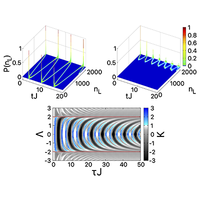
The Kerr parametric oscillator is a key platform for superconducting-qubit-based quantum technologies. This work helps pave the way for the development of more robust and reliable quantum devices by identifying the safe parameter landscape to avoid chaos and the breakdown of the excited-state quantum phase transition (ESQPT), which is a key feature for state stabilization.

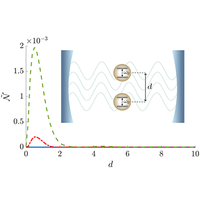
Correlated and critical phenomena in multipartite quantum non-Markovianity

Ignacio González and Ángel Rivas

Phys. Rev. A 111, L020204 (2025) - Published 25 February, 2025

The authors analyze the exact dynamics of two interacting atoms in a resonant cavity, showing how memory effects can be induced by decreasing atom-separation or by increasing the number of atoms. In order to do this, they introduce a non-singular measure to characterize Markovian to non-Markovian transitions in multipartite systems influenced by structured environments.

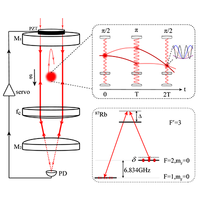
Raman-type absolute atom gravimeter assisted by a degenerate optical cavity

Liang Yuan, Bin Chen, Yu-Hang Li, Chen Yao, and Sheng-Jun Yang

Phys. Rev. A 111, L021303 (2025) - Published 24 February, 2025

The authors experimentally demonstrate a Raman-type absolute atom gravimeter assisted by a newly designed degenerate optical cavity, achieving a decent sensitivity of about 28.5(9)×10−8 g Hz−1/2. They systematically measure and analyze the main noises affecting the g-measure sensitivity, indicating no physical obstacles to achieving higher sensitivity.

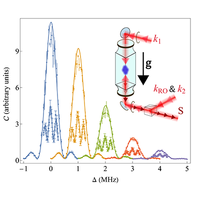
Velocimetry using free-induction decay of matter-wave lattices

Gehrig Carlse, Jaskaran Randhawa, Eduardo Ramos, Thomas Vacheresse, Alex Pouliot, and A. Kumarakrishnan

Phys. Rev. A 111, L021304 (2025) - Published 24 February, 2025

This work describes the realization of an atomic velocimeter in which spectral signatures can be imprinted on the coherently backscattered signal from a lattice of cold atoms undergoing free-induction decay. The lattice forms as a result of matter-wave interference of momentum states following an optical standing-wave excitation in the reference frame of falling atoms. The authors show that the precision of velocity measurements can be augmented by narrowing the lattice contrast spectrum using time-separated oscillatory fields applied within the coherence time of the cold sample.

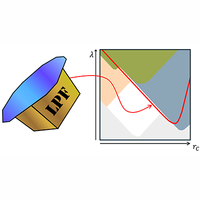
Improved bounds on collapse models from rotational noise of the Laser Interferometer Space Antenna Pathfinder mission

Davide Giordano Ario Altamura, Andrea Vinante, and Matteo Carlesso

Phys. Rev. A 111, L020203 (2025) - Published 18 February, 2025

The space mission LISA Pathfinder, the demonstrator for the future space-based gravitational wave detector LISA, digs again into the foundations of quantum mechanics by placing a further constraint on the Continuous Spontaneous Localizations (CSL) collapse model.

Long-lived metastable-qubit memory

Xiaoyang Shi, Jasmine Sinanan-Singh, Kyle DeBry, Susanna L. Todaro, Isaac L. Chuang, and John Chiaverini

Phys. Rev. A 111, L020601 (2025) - Published 18 February, 2025

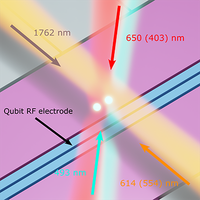
The authors demonstrate an experimental realization of a long-lived quantum memory using the optical-frequency–metastable-state–ground-state architecture in a trapped ion, where the qubit is stored in the metastable states while an ancillary ion is used for sympathetic cooling. A dynamical decoupling sequence and leakage detection are employed to extend the coherence time to approximately four times the natural lifetime of the metastable state.

Correlation between acid dissociation states and average dipole moments of HCl-water clusters realized by a strong electric field

Chuanfu Huang, Lei Zhuang, Jing Wang, and Jianguo Wan

Phys. Rev. A 111, L020802 (2025) - Published 13 February, 2025

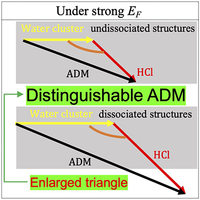
The authors reveal that increasing the electric field enhances the correlation between HCl dissociation and average dipole moments in water clusters, without altering the four-water-molecule requirement for one HCl dissociation. Their physical model explains this phenomenon, while the beam deflection method proves effective at strong electric field strengths, challenging the conventional perspective of lower field strengths.

Imprecision plateaus in quantum steering

Elna Svegborn, Nicola d'Alessandro, Otfried Gühne, and Armin Tavakoli

Phys. Rev. A 111, L020404 (2025) - Published 11 February, 2025

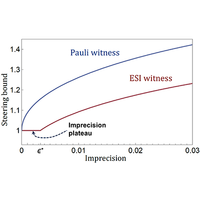
Standard quantum steering assumes that the experimenter can perfectly control their measurements. The authors show that the ability of well-chosen criteria to detect steering remains unchanged even when measurements are imprecise, thereby permitting tests of steering without idealized measurements.

SU(N) Fermi-Hubbard model on two sites: Bethe ansatz solution and quantum phase transition of the Lipkin-Meshkov-Glick model in the large-N limit

Pierre Nataf

Phys. Rev. A 111, L020201 (2025) - Published 10 February, 2025

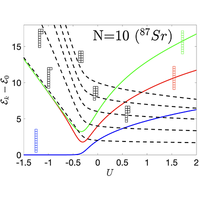
The authors find that the SU(N) Fermi-Hubbard model on two sites can be mapped to the Lipkin-Meshkov-Glick model. It admits a Bethe ansatz solution and exhibits a quantum phase transition in the large-N limit that could be experimentally accessible using current technologies involving SU(N) ultracold atoms or molecules.

Crypto-nonlocality in arbitrarily dimensional systems

Jianqi Sheng, Dongkai Zhang, and Lixiang Chen

Phys. Rev. A 111, L020202 (2025) - Published 10 February, 2025

The authors extend the crypto-nonlocal model to arbitrary dimensions while preserving well-defined local properties. The model allows for the derivation of testable inequalities that reveal incompatibilities with quantum mechanics and thus can be used to explore crypto-nonlocality in high-dimensional systems.

Metrological usefulness of entanglement and nonlinear Hamiltonians

Satoya Imai, Augusto Smerzi, and Luca Pezzè

Phys. Rev. A 111, L020402 (2025) - Published 10 February, 2025

The authors establish metrological criteria for entanglement in quantum systems with nonlinear Hamiltonians, deriving separability bounds for quantum Fisher information. Their findings reveal classes of entangled states beyond GHZ-like structures, offering insights into the metrological advantages of nonlinear dynamics.

Universal time scalings of sensitivity in Markovian quantum metrology

Arpan Das, Wojciech Górecki, and Rafał Demkowicz-Dobrzański

Phys. Rev. A 111, L020403 (2025) - Published 10 February, 2025

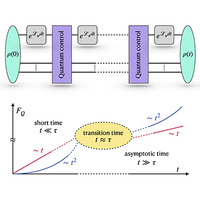
The paper provides a full understanding on the maximal achievable quantum Fisher information (QFI) in quantum sensing protocols, with continuous time dynamics in the presence of Markovian noise, assuming arbitrary quantum controls. It provides simple algebraic conditions on the character of short time and long time scalings of the QFI (quadratic or linear) as well as characterization of the corresponding time scales.

Spin dependence in core-valence double photoionization of neon

Takeshi Odagiri, Yuma Sugawara, Tatsuo Kaneyasu, Jun-ichi Adachi, Hirokazu Tanaka, Isao H. Suzuki, Sakura Suzuki, and Yasumasa Hikosaka

Phys. Rev. A 111, L020801 (2025) - Published 7 February, 2025

Core-valence double photoionization (DPI) of neon is an epitome for exploring electron correlation in core-electron photoionization. The authors use the knock-out / shake-off model to analyze their measurements on the DPI probabilities and find evidence of spin dependence in the core-valence DPI process.

Violation of the Leggett-Garg inequality for dynamics of a Bose-Einstein condensate in a double-well potential

Tsubasa Sakamoto, Ryosuke Yoshii, and Shunji Tsuchiya

Phys. Rev. A 111, L021302 (2025) - Published 7 February, 2025

Violation of the Leggett-Garg inequality challenges classical realism and noninvasive measurement and is often associated with Schrödinger’s cat-like phenomena. Using this framework, the authors show that Josephson oscillations of a Bose-Einstein condensate, well described by the semi-classical Gross-Pitaevskii equation, deviate from macrorealism, while self-trapping does not. Remarkably, in experimentally accessible parameter regimes, the Leggett-Garg inequality remains violated.

Optimal limits of continuously monitored thermometers and their Hamiltonian structure

Mohammad Mehboudi, Florian Meier, Marcus Huber, and Harry J. D. Miller

Phys. Rev. A 111, L020401 (2025) - Published 5 February, 2025

This study demonstrates that continuous measurement enables thermometric precision to scale linearly with probe dimension, achieving an exponential improvement over equilibrium methods. The optimal probe exhibits an effective two-level energy structure, and the precision scaling remains robust against deviations from this ideal configuration.

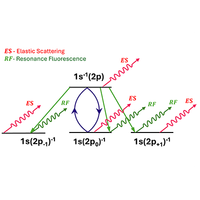
Effect of Rabi dynamics in resonant x-ray scattering of intense attosecond pulses

Akilesh Venkatesh and Phay J. Ho

Phys. Rev. A 111, L021101 (2025) - Published 5 February, 2025

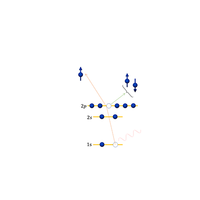
This study theoretically examines the effects of x-ray-driven Rabi oscillations on resonant x-ray scattering in Ne+, showing that the total photon yield and angular distribution are strongly influenced by pulse area and interference between resonance fluorescence and elastic scattering channels. The findings reveal enhanced photon yields under resonant conditions and offer insights for using resonant attosecond pulses for site-specific x-ray imaging.

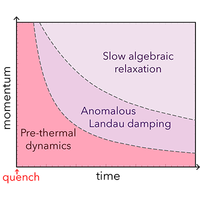
Anomalous Landau damping and algebraic thermalization in two-dimensional superfluids far from equilibrium

Clément Duval and Nicolas Cherroret

Phys. Rev. A 111, L021301 (2025) - Published 5 February, 2025

The authors find that the thermalization dynamics of two-dimensional Bose superfluids far from equilibrium reveal a two-stage evolution: first, a damping of quasiparticles that deviates from the conventional Landau picture, followed by a slow algebraic relaxation at long times.

Supersolidity in Rydberg tweezer arrays

Lukas Homeier, Simon Hollerith, Sebastian Geier, Neng-Chun Chiu, Antoine Browaeys, and Lode Pollet

Phys. Rev. A 111, L011305 (2025) - Published 31 January, 2025

The authors propose a scheme to realize lattice supersolids in Rydberg tweezer arrays by combing van der Waals and resonant dipole-dipole interactions. The numerical simulations reveal critical entropies that are accessible in current experimental platforms.

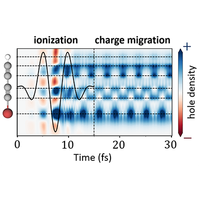
Strong-field ionization with few-cycle, midinfrared laser pulses inducing a localized ionization followed by long-lasting charge migration in halogenated organic molecules

Kyle A. Hamer, François Mauger, Kenneth Lopata, Kenneth J. Schafer, and Mette B. Gaarde

Phys. Rev. A 111, L011101 (2025) - Published 29 January, 2025

The authors use large-scale simulations to investigate how to initiate robust and high-contrast charge migration in halogenated organic molecules. They find that tunnel ionization by an intense few-cycle laser pulse initiates a localized hole on the halogen atom, which in turn leads to charge migration with a periodicity that is independent of the laser wavelength, for a large range of laser parameters.

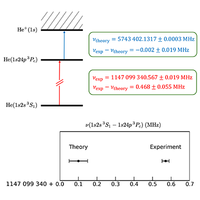
Theory for the Rydberg states of helium: Comparison with experiment for the 1s24pP11 state (n=24)

Aaron T. Bondy, G. W. F. Drake, Cody McLeod, Evan M. R. Petrimoulx, Xiao-Qiu Qi, and Zhen-Xiang Zhong

Phys. Rev. A 111, L010803 (2025) - Published 28 January, 2025

High-lying Rydberg states of helium provide absolute points of reference for the precision metrology of transition frequencies. Agreement between theory and experiment at principal quantum number n=24 confirms a 7σ disagreement between QED theory and experiment for the ionization energy of the metastable 1s2s3S1 state. The discrepancy challenges QED theory.

Sign In to Your Journals Account

Filter

Category
Section

Filter

Article Lookup

Enter a citation