Letters

Hyperfine anomaly in mercury and test of the Moskowitz-Lombardi rule

J. Vandeleur, G. Sanamyan, B. M. Roberts, and J. S. M. Ginges

Phys. Rev. A 111, L050801 (2025) - Published 2 May, 2025

The authors determine empirical values for the Bohr-Weisskopf effect for isotopes of mercury, using a combination of muonic-atom and atomic experimental data, together with their atomic calculations. They find that the well-known Moskowitz-Lombardi rule, which relates the effect to the atom’s nuclear magnetic moment, requires significant revision.

Resonant stroboscopic Rydberg dressing: Electron-motion coupling and multibody interactions

Chris Nill, Sylvain de Léséleuc, Christian Groß, and Igor Lesanovsky

Phys. Rev. A 111, L041104 (2025) - Published 29 April, 2025

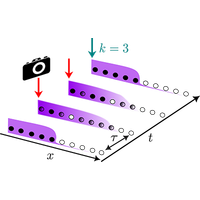
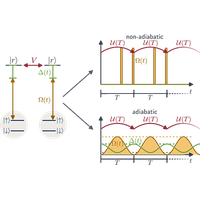
Recent experiments demonstrate that stroboscopic Rydberg dressing offers advantages over the conventional dressing approach. In this work, the authors develop analytical models for two stroboscopic dressing protocols—non-adiabatic and adiabatic—that reveal the natural emergence of electron-motion coupling and multibody interactions in these systems.

Thermodynamic phases in first detected return times of quantum many-body systems

Benjamin Walter, Gabriele Perfetto, and Andrea Gambassi

Phys. Rev. A 111, L040202 (2025) - Published 28 April, 2025

The authors develop an analytical treatment of the probability of first detection of a quantum many-body state under stroboscopic projective measurements. The ensuing analysis is based on a mapping of the many-body quantum first detection probability to the partition function of classical spins and it allows to classify different asymptotic decays of the former in terms of equilibrium thermodynamic phases of the latter.

Gaussian-basis-set approach to one-loop self-energy

Dávid Ferenc, Maen Salman, and Trond Saue

Phys. Rev. A 111, L040802 (2025) - Published 28 April, 2025

The authors developed a method for computing the self-energy correction in one-electron atoms using Gaussian-type basis functions. This approach opens a path toward the calculation of QED corrections in more complex systems.

Resonance nuclear excitation of the Th229 nucleus via electronic bridge process in Th ii

V. A. Dzuba and V. V. Flambaum

Phys. Rev. A 111, L041103 (2025) - Published 22 April, 2025

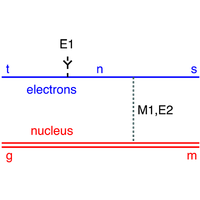
Resonant coupling between electronic and nuclear states in Th II enables laser-driven excitation of the 229Th nucleus via the electronic bridge mechanism, offering a promising pathway toward realizing a high-precision nuclear clock.

Universal criticality of nonequilibrium quantum phase transition in a driven-dissipative Kerr cavity

Jun-Yi Liu, Lei-Lei Nian, Nengji Zhou, Long Xiong, Jing-Tao Lü, and Bo Zheng

Phys. Rev. A 111, L040201 (2025) - Published 18 April, 2025

The authors investigate the universal criticality of the nonequilibrium quantum phase transition in a single-mode driven-dissipative Kerr cavity. With the scaling theory, the critical point and critical exponents are precisely measured, and the feature characterized by the divergent correlation length is revealed.

Optimal sensing of photon addition and subtraction on nonclassical light

Soumyabrata Paul, Arman, S. Lakshmibala, Prasanta K. Panigrahi, S. Ramanan, and V. Balakrishnan

Phys. Rev. A 111, L040601 (2025) - Published 16 April, 2025

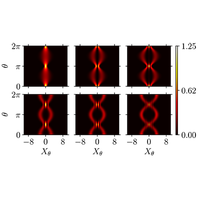
Optical tomograms are shown to directly discriminate between a wide range of nonclassical states of light, as they are sensitive to variations in photon number, which can be quantified through the Wasserstein distance calculated from tomograms. This approach circumvents the state reconstruction procedure, and can find use in precision sensing and quantum error correction with continuous variables.

Space-dependent photoelectron dynamics driven by intense vector vortex beams

Alex Schimmoller, Spencer Walker, Harrison Pasquinilli, and Alexandra S. Landsman

Phys. Rev. A 111, L041102 (2025) - Published 16 April, 2025

Probing non-Gaussian correlations through entanglement generation in a many-body quantum system

J. van de Kraats, D. J. M. Ahmed-Braun, V. E. Colussi, and S. J. J. M. F. Kokkelmans

Phys. Rev. A 111, L041302 (2025) - Published 10 April, 2025

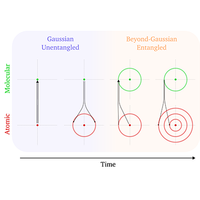
The authors show that entanglement in momentum space shells can be used to detect the presence of beyond-Gaussian correlations in a many-body quantum system. This method is then applied to analyze the correlation dynamics between particles ejected from a Bose-Einstein condensate following a rapid quench of the interaction strength.

Penning-trap mass measurement of He3

O. Bezrodnova, S. Sasidharan, W. Quint, S. Sturm, and K. Blaum

Phys. Rev. A 111, L040801 (2025) - Published 9 April, 2025

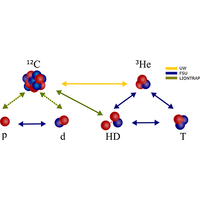
The authors experimentally determine the atomic mass of 3He to 12-parts-per-trillion relative precision from the measurement of the cyclotron frequency ratio of 3He+ and 12C4+ in a Penning trap. The result resolves discrepancies in the reported masses of light atomic nuclei from previous experiments.

Detecting quantum resources in a semi-device-independent framework

Shubhayan Sarkar and Chandan Datta

Phys. Rev. A 111, L040402 (2025) - Published 8 April, 2025

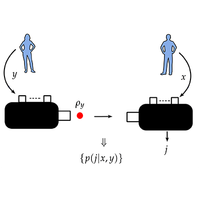
Addressing the question whether every quantum resource can be detected without any prior information about it, the authors develop a method to identify hidden quantum resources, even with very limited device knowledge. The results could pave the way for new applications in quantum technologies.

Complete retrieval of attosecond photoelectron dynamics from partially coherent states in entangled photoemission

Morgan Berkane, Richard Taïeb, Gabriel Granveau, Pascal Salières, Charles Bourassin-Bouchet, Camille Lévêque, and Jérémie Caillat

Phys. Rev. A 111, L041101 (2025) - Published 8 April, 2025

The authors investigate the possibility of reconstructing photoemission dynamics at the attosecond time scale when the outcome of the process is only partially characterized, i.e., when the measurement is hampered by a loss of coherence. Borrowing from both attosecond science and quantum information, they show that deciphering decoherence rather than considering it as a technical limitation can give access to detailed insight on attosecond time-resolved entanglement in photoemission.

Scaling laws governing the collapse of a Bose-Einstein condensate

Sebastian J. Morris, Christopher J. Ho, Simon M. Fischer, Jiří Etrych, Gevorg Martirosyan, Zoran Hadzibabic, and Christoph Eigen

Phys. Rev. A 111, L041301 (2025) - Published 7 April, 2025

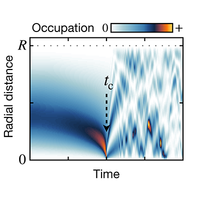
The authors numerically study the implosion of a self-focusing atomic matter wave, finding agreement with experiments and analytical theory, as well as uncovering new scaling laws that govern the implosion dynamics. The study also shows how future experiments could reveal elusive three-body atomic interactions.

Protecting quantum information via many-body dynamical localization

Ling-Zhi Tang, Dan-Wei Zhang, Hai-Feng Yu, and Z. D. Wang

Phys. Rev. A 111, L040401 (2025) - Published 2 April, 2025

The authors explore many-body dynamical localization (MBDL) and dynamical decoupling in a clean quantum spin chain under periodic kicks. They propose to protect and store quantum information based on the disorder-free MBDL states, which are robust against thermal noises.

Verifying energy-time entanglement via nonlocal dispersion cancellation

Jin-Woo Chae, Heebong Seo, U-Shin Kim, and Yoon-Ho Kim

Phys. Rev. A 111, L030403 (2025) - Published 25 March, 2025

The authors experimentally demonstrate direct verification of continuous-variable energy-time entanglement via nonlocal dispersion cancellation under realistic telecom conditions, effectively emulating photon propagation through a 379-km optical fiber. They observe a significant violation of the separability criterion by 32 standard deviations, confirming robust entanglement suitable for secure long-distance quantum communication.

Biased estimator channels for classical shadows

Zhenyu Cai, Adrian Chapman, Hamza Jnane, and Bálint Koczor

Phys. Rev. A 111, L030402 (2025) - Published 21 March, 2025

The classical shadow framework is paired with the well-studied bias-variance tradeoff to further reduce the number of shots needed to estimate properties of quantum states.

Error-mitigated photonic quantum circuit Born machine

Alexia Salavrakos, Tigran Sedrakyan, James Mills, Shane Mansfield, and Rawad Mezher

Phys. Rev. A 111, L030401 (2025) - Published 18 March, 2025

This work focuses on generative learning in the framework of photonic quantum computing. The authors present a quantum circuit Born machine tailored to linear optics. They apply an error-mitigation technique that deals with photon loss to the model, and show that the error mitigation improves model training through simulations and experiments on a quantum photonic integrated processor.

Accelerated creation of NOON states with ultracold atoms via counterdiabatic driving

Simon Dengis, Sandro Wimberger, and Peter Schlagheck

Phys. Rev. A 111, L031301 (2025) - Published 10 March, 2025

The authors develop a theoretical protocol for creating highly entangled states with ultracold atoms, based on a combination of geodesic driving and counterdiabatic evolution. They demonstrate that the time required to generate high-quality NOON states robustly is reduced by several orders of magnitude using only time-independent controls.

Polarization-agnostic continuous-variable quantum key distribution

Brian P. Williams and Nicholas A. Peters

Phys. Rev. A 111, L030601 (2025) - Published 5 March, 2025

The authors introduce a polarization agnostic encoding method for continuous-variable quantum key distribution. No active optical polarization control is required and only a single receiver polarization is monitored. These simplifications reduce loss and noise.

Redistributing the imaginary Poynting momentum based on radially varying polarization

Qiang Wang, Jiafeng Zeng, Xiangsheng Xie, and Chenghou Tu

Phys. Rev. A 111, L031501 (2025) - Published 4 March, 2025
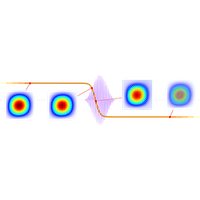
The authors develop a theoretical framework for redistributing the imaginary Poynting momentum of light by introducing a radial degree of freedom in polarization. They apply this framework to manipulate nanoparticles, offering insights into light-driven motion that doesn’t depend on spin, orbital angular momentum, or inhomogeneous particles.

Sign In to Your Journals Account

Filter

Category
Section

Filter

Article Lookup

Enter a citation