Letters

Mitigating higher-band heating in Floquet-Hubbard lattices via two-tone driving

Yuanning Chen, Zijie Zhu, and Konrad Viebahn

Phys. Rev. A 112, L021301 (2025) - Published 12 August, 2025

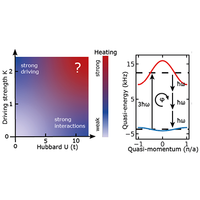
The authors investigate an experimental method for coherent cancellation of heating in a broad class of interacting lattice systems under periodic Floquet driving. The combination of theoretical and experimental results reveals that heating suppression remains effective despite the simultaneous presence of strong driving and strong interactions.

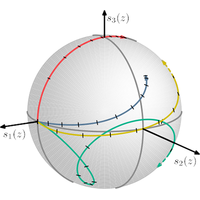
Photoinduced flipping of optical chirality during backward-wave parametric amplification in a chiral nonlinear medium

Christos Flytzanis, Fredrik Jonsson, and Govind P. Agrawal

Phys. Rev. A 112, L021503 (2025) - Published 6 August, 2025

The authors study backward-wave parametric amplification and oscillation in a nonlinear chiral medium. Their results reveal the novel phenomenon of photo-induced flipping of the optical polarization state between the signal and idler waves, without any change in structural chirality of the medium.

Controlled displacement of stored light at room temperature

Arash Ahmadi, Yağız Murat, Pei-Chen Kuan, Mustafa Gündoğan, and Markus Krutzik

Phys. Rev. A 112, L021501 (2025) - Published 5 August, 2025

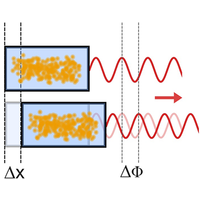
The authors report the demonstration of spatially translating a stored optical pulse at room temperature over distances exceeding one optical wavelength. By implementing an interferometric scheme, they further measure the average speed of this linear translation, thus harnessing a stopped-light experiment for a sensing application.

Ideal magnetic-resonance scatterers in the visible range

Zhihui Liu, YaFei Li, Meng Wang, Mansha Li, Lexiang Zhao, Jianhong Rong, Peijie Wang, and Ze Li

Phys. Rev. A 112, L021502 (2025) - Published 5 August, 2025

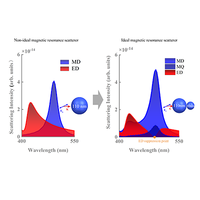
The authors find that nonmagnetic silicon nanoparticle dimers can scatter visible light as pure magnetic scatterers under plane-wave illumination. By suppressing electric dipole responses via the anapole mode, they enable the superposition of magnetic dipole and quadrupole modes with tunable resonant wavelengths, providing a stable platform for studying nanoscale magnetic light-matter interactions and developing new optoelectronic devices.

Quadratic spin-phonon coupling and bipolarons in trapped ions

L. P. H. Gallagher, M. Mazzanti, Z. E. D. Ackerman, R. J. C. Spreeuw, A. Safavi-Naini, and R. Gerritsma

Phys. Rev. A 112, L020401 (2025) - Published 4 August, 2025

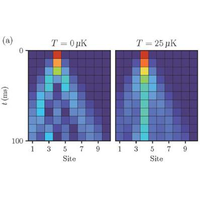
The authors use trapped ions to simulate the emergence of bipolarons, which are spin pairs coupled to lattice distortions, in an analogous mechanism to their formation in solids. By plotting the dynamics, they show that bipolarons are mobile across the lattice due to the zero-point energy of the system, and are thermally-pinned when the temperature is increased.

Correlated-hopping-induced topological order in an atomic mixture

Ashirbad Padhan, Luca Barbiero, and Tapan Mishra

Phys. Rev. A 112, L011305 (2025) - Published 25 July, 2025

The authors have proposed a scheme to achieve topological phase and phase transitions in an atomic mixture on a one-dimensional lattice solely induced by inter-atomic interactions. It has been demonstrated that while the individual atomic species do not possess any topological character on their own, one of the components can become topological if it is coupled to the other species through correlated hopping.

Attosecond pulse synthesis from high-order harmonic generation in intense squeezed light

ShiJun Wang, XuanYang Lai, and XiaoJun Liu

Phys. Rev. A 112, L011102 (2025) - Published 22 July, 2025

The authors reveal that intense squeezed light can control the harmonic amplitudes of different trajectories via quantum interference, enabling the use of the full high-order harmonic generation (HHG) spectrum for the synthesis of ultrashort attosecond pulses.

Scattering resonances and pairing in a Rabi-coupled Fermi gas

Olivier Bleu, Brendan C. Mulkerin, Cesar R. Cabrera, Jesper Levinsen, and Meera M. Parish

Phys. Rev. A 112, L011304 (2025) - Published 22 July, 2025

The authors theoretically show that a Rabi drive, which couples two internal atomic states, can induce new resonances in the scattering between driven and undriven atoms. They demonstrate that the resonances directly alter the superfluid transitions in Rabi-coupled Fermi gases.

Tuning the terahertz response of liquids by creating polar many-body excitations

Gerard McCaul, Matthias Runge, Michael Woerner, Diyar Talbayev, Thomas Elsaesser, and Denys I. Bondar

Phys. Rev. A 112, L011101 (2025) - Published 21 July, 2025

The authors show how solvated electrons can be used to control the optical properties of distinct molecular liquids, tuning their many-body polaronic response frequencies to become identical in the terahertz range.

Area laws and thermalization from classical entropies in a Bose-Einstein condensate

Yannick Deller, Martin Gärttner, Tobias Haas, Markus K. Oberthaler, Moritz Reh, and Helmut Strobel

Phys. Rev. A 112, L011303 (2025) - Published 15 July, 2025

The authors propose schemes to access information in complex quantum many-body systems via classical information measures. They demonstrate that these measures resolve the transition from area to volume law scaling after a global quench, indicating thermalization via quantum correlations.

Tailoring indistinguishability of photons using longitudinal spatial coherence

Preeti Sharma, Gaytri Arya, and Bhaskar Kanseri

Phys. Rev. A 112, L011702 (2025) - Published 15 July, 2025

The authors utilize effective spatial coherence of light to generate photons with tailored indistinguishability. They show both experimentally and theoretically that in addition to frequency width, the effective coherence width given by the longitudinal spatial coherence of light provides a direct control on the width of Hong-Ou-Mandel dip and hence on the indistinguishability of photons.

Extra cost of erasure due to quantum lifetime broadening

Joe Dunlop, Federico Cerisola, Juliette Monsel, Sofia Sevitz, Jorge Tabanera-Bravo, Jonathan Dexter, Federico Fedele, Natalia Ares, and Janet Anders

Phys. Rev. A 112, L010601 (2025) - Published 10 July, 2025

Quantum dots are a promising platform for future ultraefficient information technologies. This Letter establishes new bounds on the energy cost of erasure in quantum dots, which may be dominated by quantum and nonequilibrium noise sources.

Engineering the Bogoliubov modes through geometry and interaction: From collective edge modes to flat-band excitations

Maryam Darvishi, Fatemeh Pouresmaeeli, and Saeed H. Abedinpour

Phys. Rev. A 112, L011302 (2025) - Published 8 July, 2025

The authors show how collective excitations in Bose-Einstein condensate arrays can simulate topological edge states and flat-band excitations through geometric design and tunable interactions, offering new ways to emulate quantum lattice models with ultracold atoms.

Local entanglement transfer from an entanglement source to multiple pairs of spatially separated observers

Tanmoy Mondal, Kornikar Sen, Chirag Srivastava, and Ujjwal Sen

Phys. Rev. A 112, L010402 (2025) - Published 7 July, 2025

The authors explore how entanglement in a shared quantum state possessed by a single pair can be locally and sequentially transferred to multiple, possibly arbitrarily large, spatially separated pairs of observers. They identify unitary operations that enable efficient redistribution of entanglement without requiring direct interaction between the recipients.

Direct extraction of nuclear structure information using precision lithium-ion spectroscopy

Hua Guan, Xiao-Qiu Qi, Jian-Guo Li, Peng-Peng Zhou, Wei Sun, Shao-Long Chen, Xu-Rui Chang, Yao Huang, Pei-Pei Zhang, Zong-Chao Yan, G. W. F. Drake, Ai-Xi Chen, Zhen-Xiang Zhong, Jia-Li Wang, Nicolas Michel, Ting-Yun Shi, and Ke-Lin Gao

Phys. Rev. A 112, L010801 (2025) - Published 7 July, 2025

Nuclear structural parameters determined from atomic physics offer essential benchmarks to validate and advance nuclear theory. This work measures the hyperfine splittings of lithium ions and, through combined theory and experiment, determines the Zemach magnetic radius and quadrupole moment of the nuclei. The results reveal a significant discrepancy in the nuclear quadrupole moment.

Magic-wavelength nanofiber-based two-color dipole trap with sub-λ/2 spacing

Lucas Pache, Martin Cordier, Hector Letellier, Max Schemmer, Philipp Schneeweiss, Jürgen Volz, and Arno Rauschenbeutel

Phys. Rev. A 112, L011701 (2025) - Published 7 July, 2025

The authors realized and characterized a nanofiber-based dipole trap, which allows for trapping and optically interfacing one-dimensional arrays of cesium atoms with a lattice spacing of about one-third of their resonant wavelength on the D2 transition. This trapping scheme can serve as a platform for experimentally observing novel collective radiative effects, such as selective radiance.

Quantum algorithm for the advection-diffusion equation by direct block encoding of the time-marching operator

Paul Over, Sergio Bengoechea, Peter Brearley, Sylvain Laizet, and Thomas Rung

Phys. Rev. A 112, L010401 (2025) - Published 1 July, 2025

The authors present a time-marching quantum algorithm for simulating scalar transport in multidimensional fluid flows, which promotes the use of quantum computing in computational engineering.

Topological quantum floating phase of dipolar bosons in an optical ladder

Henning Korbmacher, Gustavo A. Domínguez-Castro, Mateusz Łącki, Jakub Zakrzewski, and Luis Santos

Phys. Rev. A 112, L011301 (2025) - Published 1 July, 2025

The authors show that experiments on dipolar gases in optical ladders may realize a gapless topological floating phase, characterized by incommensurate density-density correlations, which constitutes an intermediate step in the melting of a crystal to the gapped Haldane phase.

Observation of transition radiation carrying orbital angular momentum

Y. Takabayashi, H. Takeda, E. Magome, K. Sumitani, P. O. Kazinski, P. S. Korolev, O. V. Bogdanov, and T. A. Tukhfatullin

Phys. Rev. A 111, L061501 (2025) - Published 27 June, 2025

The authors investigate the orbital angular momentum carried by transition radiation generated through the interaction of a relativistic electron beam with a solid target. Diffraction patterns for the transition radiation, observed after the radiation has passed through a triangular aperture and a double slit, clearly demonstrate that the radiation possesses orbital angular momentum.

Multivariate bicycle codes

Lukas Voss, Sim Jian Xian, Tobias Haug, and Kishor Bharti

Phys. Rev. A 111, L060401 (2025) - Published 23 June, 2025
This work introduces multivariate bicycle codes, a class of quantum low-density parity-check codes that generalize bivariate constructions. By combining low-weight parity checks with efficient use of physical qubits, these codes achieve higher encoding rates than surface codes and are well-suited for near-term experimental implementation.

Sign In to Your Journals Account

Filter

Category
Section

Filter

Article Lookup

Enter a citation