Highlights

Mode coupling and multiquantum vibrational excitations in Feshbach-resonant positron annihilation in molecules

G. F. Gribakin, J. F. Stanton, J. R. Danielson, M. R. Natisin, and C. M. Surko

Phys. Rev. A 96, 062709 (2017) - Published 22 December, 2017

Effects of anharmonic vibrational mode coupling are studied for low-energy positron annihilation via vibrational Feshbach resonance (VFR) in polyatomic molecules. It is found that the mode coupling is important for both enhancement and suppression of the annihilation by VFR.

Scattering of charged particles on two spatially separated time-periodic optical fields

Lóránt Zs. Szabó, Mihály G. Benedict, and Péter Földi

Phys. Rev. A 96, 063419 (2017) - Published 22 December, 2017

Transmission of a beam of charged particles is studied with the control of two spatially separated oscillating light fields. Narrow resonances are identified to be useful as precise energy filters for transmitting particles.

Experimental investigation of strong-field-ionization theories for laser fields from visible to midinfrared frequencies

Yu Hang Lai, Junliang Xu, Urszula B. Szafruga, Bradford K. Talbert, Xiaowei Gong, Kaikai Zhang, Harald Fuest, Matthias F. Kling, Cosmin I. Blaga, Pierre Agostini, and Louis F. DiMauro

Phys. Rev. A 96, 063417 (2017) - Published 20 December, 2017

Ionization of atoms in intense laser fields is experimentally studied to evaluate the validity of the widely used ionization rate formulas from the ADK and PPT models at different laser wavelengths, intensities, polarizations and types of targets. It is found that the PPT model including the Coulomb correction agrees well with all the experimental data in the study, whereas the ADK formula can only be applied in some limited regimes.

Resonant persistent currents for ultracold bosons on a lattice ring

Geva Arwas, Doron Cohen, Frank Hekking, and Anna Minguzzi

Phys. Rev. A 96, 063616 (2017) - Published 19 December, 2017

Persistent currents are studied for a one-dimensional bosonic gas in a ring lattice that has a SQUID-like geometry. While generically such currents are expected to be strongly suppressed in the Mott insulator phase, they show a pronounced resonant behavior when the barrier strength becomes of the order of the interparticle interaction energy.

Interference between two resonant transitions with distinct initial and final states connected by radiative decay

A. Marsman, M. Horbatsch, and E. A. Hessels

Phys. Rev. A 96, 062111 (2017) - Published 11 December, 2017

It is demonstrated that the spectroscopy of a resonant transition can be altered by a nonvanishing population of the system in states away from the transition, so long as those states can radiatively decay into the states involved in the resonant transition. This finding identifies a systematic effect that can be important to precision measurements.

Past observable dynamics of a continuously monitored qubit

Luis Pedro García-Pintos and Justin Dressel

Phys. Rev. A 96, 062110 (2017) - Published 8 December, 2017

The role of intrinsic postselection is analyzed for individual stochastic quantum measurement records of a continuously monitored observable. The measurement operators and linearized limits of the past collected measurement are outlined, linking together smoothing, weak measurements, and the information contained in the noisy record with simple formulas.

Heisenberg-Langevin versus quantum master equation

Daniel Boyanovsky and David Jasnow

Phys. Rev. A 96, 062108 (2017) - Published 7 December, 2017

The reliability of the Born and Markov approximations is studied within the framework of quantum Brownian motion described by a mechanical oscillator coupled to a bath of oscillators in thermal equilibrium. It is found that the conditions for the validity of the Born approximation with or without the Markov approximation are more stringent than the usual condition with a weak coupling.

Beyond-Born-Oppenheimer effects in sub-kHz-precision photoassociation spectroscopy of ytterbium atoms

Mateusz Borkowski, Alexei A. Buchachenko, Roman Ciuryło, Paul S. Julienne, Hirotaka Yamada, Yuu Kikuchi, Kakeru Takahashi, Yosuke Takasu, and Yoshiro Takahashi

Phys. Rev. A 96, 063405 (2017) - Published 6 December, 2017

Low-lying rovibrational levels of Yb2 molecules are measured by photoassociation to an accuracy of about 500 Hz. The measurements, in combination with a potential model that includes some beyond-Born-Oppenheimer effects, produce a determination of the s-wave scattering lengths with error bars which are over two orders of magnitude better than previous determinations.

Generation of circularly polarized XUV and soft-x-ray high-order harmonics by homonuclear and heteronuclear diatomic molecules subject to bichromatic counter-rotating circularly polarized intense laser fields

John Heslar, Dmitry A. Telnov, and Shih-I Chu

Phys. Rev. A 96, 063404 (2017) - Published 5 December, 2017

Generation of circularly polarized high-order harmonics is studied with the targets of diatomic molecules subject to bichromatic counter-rotating circularly polarized laser fields. It is also found that with the driving field polarized perpendicular to the molecular axis, even-order harmonics polarized along the molecular axis can be generated by heteronuclear molecules, even if the permanent dipole moment of the molecules is very small.

Quantum tiltmeter with atom interferometry

Wen-Jie Xu, Min-Kang Zhou, Miao-Miao Zhao, Ke Zhang, and Zhong-Kun Hu

Phys. Rev. A 96, 063606 (2017) - Published 5 December, 2017

An atom interferometer serves as a sensitive tiltmeter that can measure Earth’s tidal deformations.

Photonic band structure of two-dimensional atomic lattices

J. Perczel, J. Borregaard, D. E. Chang, H. Pichler, S. F. Yelin, P. Zoller, and M. D. Lukin

Phys. Rev. A 96, 063801 (2017) - Published 4 December, 2017

A general approach for the calculation of photonic band structures in generic two-dimensional atomic lattices is developed. The framework can be used to design topologically protected photonic quantum systems.

Gate-error analysis in simulations of quantum computers with transmon qubits

D. Willsch, M. Nocon, F. Jin, H. De Raedt, and K. Michielsen

Phys. Rev. A 96, 062302 (2017) - Published 1 December, 2017

Usual metrics, such as the fidelity, used to characterize the success of implementing superconducting qubit-based quantum gates are analyzed. By numerically solving time-dependent Schrödinger equations for a transmon system, it is found that such metrics are not reliable to predict the performance of a quantum algorithm when the gates are used repeatedly.

Macroscopic quantum tunneling escape of Bose-Einstein condensates

Xinxin Zhao, Diego A. Alcala, Marie A. McLain, Kenji Maeda, Shreyas Potnis, Ramon Ramos, Aephraim M. Steinberg, and Lincoln D. Carr

Phys. Rev. A 96, 063601 (2017) - Published 1 December, 2017

A theoretical analysis is performed to explain the nonexponential decay of the macroscopic quantum tunneling of a Bose-Einstein condensate, where it is found that the self-interaction is responsible for the macroscopic decaying behavior.

Perfect polarization for arbitrary light beams

Aaron Z. Goldberg and Daniel F. V. James

Phys. Rev. A 96, 053859 (2017) - Published 28 November, 2017

Perfectly polarized, pure and mixed, quantum states of light are investigated. Using symmetry and geometry arguments, the canonical degree of polarization is reinterpreted, which can be used as a benchmark for applications where extremely precise experimental control of the polarization is required.

Transmission of near-resonant light through a dense slab of cold atoms

L. Corman, J. L. Ville, R. Saint-Jalm, M. Aidelsburger, T. Bienaimé, S. Nascimbène, J. Dalibard, and J. Beugnon

Phys. Rev. A 96, 053629 (2017) - Published 27 November, 2017

A dense cloud of rubidium atoms is employed to study the optical properties of randomly positioned, resonant scatterers, where a blueshift of the resonance line is observed as a signature of the strongly correlated regime due to dipole-dipole interactions.

Full-dimensional treatment of short-time vibronic dynamics in a molecular high-order-harmonic-generation process in methane

Serguei Patchkovskii and Michael S. Schuurman

Phys. Rev. A 96, 053405 (2017) - Published 9 November, 2017

The method of multiconfigurational strong-field approximation with Gaussian nuclear wave packets is developed to study the effect of nuclear motion for molecules in strong laser fields, where an investigation on the polyatomic molecule methane reveals that the high-order-harmonic generation contains signatures of field-free vibronic dynamics at the conical intersection and signatures of other chemical processes.

Conditioned spin and charge dynamics of a single-electron quantum dot

Eliska Greplova, Edward A. Laird, G. Andrew D. Briggs, and Klaus Mølmer

Phys. Rev. A 96, 052104 (2017) - Published 7 November, 2017

A method to reconstruct the dynamics of a quantum dot is proposed. The procedure, based on signal processing aided by quantum trajectory methods, can find application in situations where parameters that govern spin evolution must be estimated efficiently.

Unconventional photon blockade

H. Flayac and V. Savona

Phys. Rev. A 96, 053810 (2017) - Published 6 November, 2017

Experimental schemes to observe the effect of unconventional photon blockade are discussed. The mechanism can be explored to optimize the performance of single-photon sources or, more generally speaking, as a tool to reveal nonclassical features.

Observation of a spinning top in a Bose-Einstein condensate

R. N. Bisset, S. Serafini, E. Iseni, M. Barbiero, T. Bienaimé, G. Lamporesi, G. Ferrari, and F. Dalfovo

Phys. Rev. A 96, 053605 (2017) - Published 2 November, 2017

The spinning-top behavior of quantized vortices in an elongated cigar-shaped Bose-Einstein condensate is analyzed theoretically and verified experimentally. It is found that contributions to the angular momentum of these vortices are tightly confined to the region surrounding the core of the condensate, in stark contrast to untrapped condensates where all atoms contribute a unit of ħ.

Role of atoms in atomic gravitational-wave detectors

Matthew A. Norcia, Julia R. K. Cline, and James K. Thompson

Phys. Rev. A 96, 042118 (2017) - Published 30 October, 2017

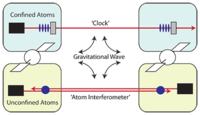
A theoretical framework is developed to unify the mechanisms of atomic gravitational-wave detectors implemented as atomic clocks or as atom interferometers. Major enhancements to the sensitivity of the detectors using confined atoms are proposed thanks to the unified understanding.

Sign In to Your Journals Account

Filter

Section

Filter

Article Lookup

Enter a citation