Highlights

Mode entanglement of Gaussian fermionic states

C. Spee, K. Schwaiger, G. Giedke, and B. Kraus

Phys. Rev. A 97, 042325 (2018) - Published 16 April, 2018

The entanglement properties of multipartite Gaussian fermionic states are investigated. It is shown that there exist no nontrivial Gaussian local operations assisted by classical communication among pure fully entangled Gaussian fermionic states.

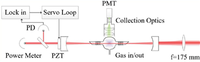
Dispersive detection of radio-frequency-dressed states

Sindhu Jammi, Tadas Pyragius, Mark G. Bason, Hans Marin Florez, and Thomas Fernholz

Phys. Rev. A 97, 043416 (2018) - Published 16 April, 2018

A method is developed to dispersively detect alkali-metal atoms in radio-frequency-dressed states, allowing for low-noise measurements of atom numbers due to modulation of the atomic response at radio frequencies.

Subcycle interference upon tunnel ionization by counter-rotating two-color fields

S. Eckart, M. Kunitski, I. Ivanov, M. Richter, K. Fehre, A. Hartung, J. Rist, K. Henrichs, D. Trabert, N. Schlott, L. Ph. H. Schmidt, T. Jahnke, M. S. Schöffler, A. Kheifets, and R. Dörner

Phys. Rev. A 97, 041402(R) (2018) - Published 13 April, 2018

Interference patterns from subcycle electron trajectories are experimentally observed in three-dimensional electron momentum distributions of helium atoms in counter-rotating two-color laser fields. Such patterns may be used to extract ultrafast electronic phase information in atoms and molecules.

Experimental nonlocality-based randomness generation with nonprojective measurements

S. Gómez, A. Mattar, E. S. Gómez, D. Cavalcanti, O. Jiménez Farías, A. Acín, and G. Lima

Phys. Rev. A 97, 040102(R) (2018) - Published 12 April, 2018

An experiment on randomness generation is performed with a quantum optical setup, which shows that nonprojective measurements improve randomness generation against the standard protocols that lack such measurements.

Stochastic gradient ascent outperforms gamers in the Quantum Moves game

Dries Sels

Phys. Rev. A 97, 040302(R) (2018) - Published 12 April, 2018

Are human players suitable to deliver good strategies for developing quantum protocols? While recent results suggest a positive answer to this question, here a simple stochastic local optimization method is shown to outperform all players.

Practical quantum appointment scheduling

Dave Touchette, Benjamin Lovitz, and Norbert Lütkenhaus

Phys. Rev. A 97, 042320 (2018) - Published 12 April, 2018

A quantum appointment-scheduling protocol based on coherent states and basic linear optics operations is proposed. The protocol is shown to perform better than a classical one in terms of information leakage.

Energy-absorption spectroscopy of unitary Fermi gases in a uniform potential

Pengfei Zhang and Zhenhua Yu

Phys. Rev. A 97, 041601(R) (2018) - Published 11 April, 2018

A method is proposed to extract local transport properties of unitary Fermi gases with energy-absorption spectroscopy, where such measurements of the kinetic coefficients of the unitary gases are estimated to be within the reach of current experiments.

Insufficiency of avoided crossings for witnessing large-scale quantum coherence in flux qubits

Florian Fröwis, Benjamin Yadin, and Nicolas Gisin

Phys. Rev. A 97, 042103 (2018) - Published 9 April, 2018

The generation of “Schrödinger-cat” states with superconducting devices is scrutinized. While the size of the cat cannot be quantified by standard measurements of avoided crossings, another metric is shown to appropriately witness large-scale quantum coherence.

Time-dependent nonlinear Jaynes-Cummings dynamics of a trapped ion

F. Krumm and W. Vogel

Phys. Rev. A 97, 043806 (2018) - Published 6 April, 2018

Solving the dynamics of a system described by a time-dependent nonlinear Jaynes-Cummings model is a daunting task due to time-ordering effects. The problem is shown to be circumvented by quantizing the pump field, leading to exactly solvable solutions.

Measuring nuclear-spin-dependent parity violation with molecules: Experimental methods and analysis of systematic errors

Emine Altuntaş, Jeffrey Ammon, Sidney B. Cahn, and David DeMille

Phys. Rev. A 97, 042101 (2018) - Published 3 April, 2018

High-precision measurements of nuclear-spin-dependent parity-violation (NSD-PV) effects are demonstrated with the diatomic molecule 138Ba19F, where the sensitivity of the measurements is expected to be sufficient to measure NSD-PV effects of the size anticipated across a wide range of nuclei.

Semiclassical dynamics, Berry curvature, and spiral holonomy in optical quasicrystals

Stephen Spurrier and Nigel R. Cooper

Phys. Rev. A 97, 043603 (2018) - Published 3 April, 2018

Topological properties of noninteracting band structures of quasicrystal potentials are studied, where concepts such as the pseudo–Brillouin zone, spiral holonomy, generalized Berry phase, and Berry curvatures are discussed using a class of relatively simple models.

Hardware-efficient bosonic quantum error-correcting codes based on symmetry operators

Murphy Yuezhen Niu, Isaac L. Chuang, and Jeffrey H. Shapiro

Phys. Rev. A 97, 032323 (2018) - Published 27 March, 2018

A family of bosonic quantum error-correcting codes is introduced to boost the reliability of quantum computation schemes against photon loss. These codes, which are based on symmetry properties of three-wave-mixing interactions, are hardware efficient for architectures involving microwave photons stored in superconducting resonators.

Frequency measurement of the 2 S01–3D21 two-photon transition in atomic He4

Yi-Jan Huang, Yu-Chan Guan, Yao-Chin Huang, Te-Hwei Suen, Jin-Long Peng, Li-Bang Wang, and Jow-Tsong Shy

Phys. Rev. A 97, 032516 (2018) - Published 26 March, 2018

The transition frequency between the 2 1S0 and 3 1D2 states of 4He atoms is measured by two-photon spectroscopy with an accuracy more than one order of magnitude higher than in previous experiments. The determination of some related transition frequencies provides a good test against the theoretically calculated energy levels.

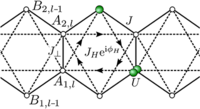
Quantum phases of strongly interacting bosons on a two-leg Haldane ladder

S. Greschner and F. Heidrich-Meisner

Phys. Rev. A 97, 033619 (2018) - Published 23 March, 2018

The ground-state physics of strongly interacting bosonic particles on a hexagonal two-leg ladder geometry is studied with a single-component Haldane model, where an unconventional vortex-lattice phase is found to emerge even for hard-core interactions.

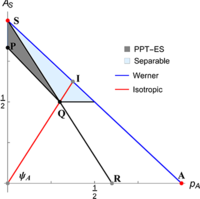
Simple class of bound entangled states based on the properties of the antisymmetric subspace

Enrico Sindici and Marco Piani

Phys. Rev. A 97, 032319 (2018) - Published 16 March, 2018

A recipe to construct bound entangled states, i.e., entangled in a way that cannot be distilled, is presented. Contrary to known previous examples, the proposed method leads to states with a simpler structure, considered as generalizations of the well-known W states, which may, therefore, be more attractive for experimental investigations.

Analytical results for a conditional phase shift between single-photon pulses in a nonlocal nonlinear medium

Balakrishnan Viswanathan and Julio Gea-Banacloche

Phys. Rev. A 97, 032314 (2018) - Published 13 March, 2018

The use of optical nonlinearities to implement quantum logical gates at the single-photon level is analytically investigated. A thorough discussion on why previous no-go arguments may not hold is presented.

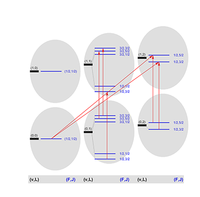
Laser-stimulated electric quadrupole transitions in the molecular hydrogen ion H2+

V. I. Korobov, P. Danev, D. Bakalov, and S. Schiller

Phys. Rev. A 97, 032505 (2018) - Published 12 March, 2018

Laser-induced electric quadrupole transition rates between hyperfine states of the rovibrational levels of the molecular ion H2+ are calculated. These transitions are of metrological interest since they may be used for independent determination of fundamental constants such as particle-mass ratios and the Rydberg constant

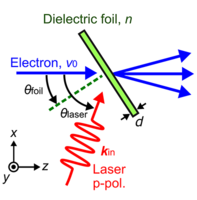
Attosecond control of electron beams at dielectric and absorbing membranes

Yuya Morimoto and Peter Baum

Phys. Rev. A 97, 033815 (2018) - Published 12 March, 2018

Attosecond electron pulses can be generated by crossing electrons with a laser beam at a membrane. A comprehensive experimental and theoretical investigation of this method is presented, offering a high-resolution tool to reveal the fundamental physics behind light-matter interaction.

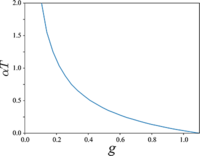
Second sound in a two-dimensional Bose gas: From the weakly to the strongly interacting regime

Miki Ota and Sandro Stringari

Phys. Rev. A 97, 033604 (2018) - Published 7 March, 2018

The temperature and interaction dependence of the first and second sound in a two-dimensional Bose gas is studied in the vicinity of the Berezinskii-Kosterlitz-Thouless transition, where it is found that the excitation of the second sound through a density perturbation becomes weaker as the interaction strength increases, as a consequence of the fast decrease of the thermal expansion coefficient.

Geometrical picture of photocounting measurements

O. P. Kovalenko, J. Sperling, W. Vogel, and A. A. Semenov

Phys. Rev. A 97, 023845 (2018) - Published 28 February, 2018

A geometrical interpretation of Born’s rule is established to construct a quantum measurement framework that aids in delivering expectation values. The technique is particularly helpful for taking into account imperfections and is applied to experimentally accessible click-counting detectors.

Sign In to Your Journals Account

Filter

Section

Filter

Article Lookup

Enter a citation