Highlights

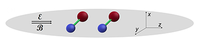
Quantum optics in Maxwell's fish eye lens with single atoms and photons

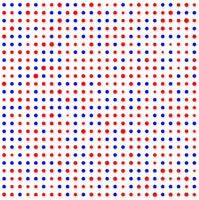
J. Perczel, P. Kómár, and M. D. Lukin

Phys. Rev. A 98, 033803 (2018) - Published 5 September, 2018

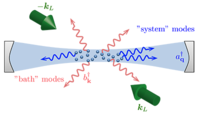
The imaging properties of a lens that may perfectly focus electromagnetic waves is investigated at the quantum level. The lens is shown to be diffraction limited, and its role in entangling operations based on dipole-dipole interactions is discussed.

Gaussian quantum resource theories

Ludovico Lami, Bartosz Regula, Xin Wang, Rosanna Nichols, Andreas Winter, and Gerardo Adesso

Phys. Rev. A 98, 022335 (2018) - Published 31 August, 2018

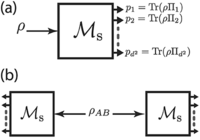
A general framework is developed to assess capabilities and limitations of the Gaussian toolbox in continuous-variable quantum information theory. It is shown that under a few assumptions on the set of free states, no Gaussian quantum resource can be distilled with free Gaussian operations, even when an unlimited supply of the resource state is available.

Glassy dynamics due to a trajectory phase transition in dissipative Rydberg gases

Carlos Pérez-Espigares, Igor Lesanovsky, Juan P. Garrahan, and Ricardo Gutiérrez

Phys. Rev. A 98, 021804(R) (2018) - Published 30 August, 2018

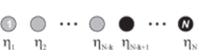
The dynamics of a strongly interacting many-body system away from equilibrium is investigated. The work reinforces the emergence of a glassy phase transition in Rydberg gases.

Canceling spin-dependent contributions and systematic shifts in precision spectroscopy of molecular hydrogen ions

S. Schiller and V. I. Korobov

Phys. Rev. A 98, 022511 (2018) - Published 15 August, 2018

Properties of a class of traceless Hamiltonians are employed to cancel spin-dependent contributions and systematic shifts to molecular transition frequencies. The examples of H2+ and HD+ molecular ions are shown to demonstrate the cancellations of spin structure, electric quadrupole shift, the Zeeman shift, and partially the Stark shift.

Exploring six modes of an optical parametric oscillator

Luis F. Muñoz-Martínez, Felippe Alexandre Silva Barbosa, Antônio Sales Coelho, Luis Ortiz-Gutiérrez, Marcelo Martinelli, Paulo Nussenzveig, and Alessandro S. Villar

Phys. Rev. A 98, 023823 (2018) - Published 13 August, 2018

Researchers have entangled six modes of a laser cavity—a record number for such a device.

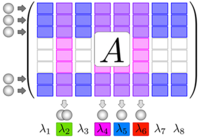
Enhanced entanglement criterion via symmetric informationally complete measurements

Jiangwei Shang, Ali Asadian, Huangjun Zhu, and Otfried Gühne

Phys. Rev. A 98, 022309 (2018) - Published 10 August, 2018

The challenges of entanglement detection lead to the development of several entanglement measures and criteria. Here a special type of measurement is used to attest entanglement in a stronger way, i.e. it catches forms that are missed by other criteria and is effective in a single-shot fashion.

Dissipative quantum phase transitions of light in a generalized Jaynes-Cummings-Rabi model

R. Gutiérrez-Jáuregui and H. J. Carmichael

Phys. Rev. A 98, 023804 (2018) - Published 3 August, 2018

A generalized Jaynes-Cummings model is developed, establishing a link between the Dicke model for quantum phase transition and the breakdown of photon blockade.

Optical levitation and feedback cooling of a nanoparticle at subwavelength distances from a membrane

Rozenn Diehl, Erik Hebestreit, René Reimann, Felix Tebbenjohanns, Martin Frimmer, and Lukas Novotny

Phys. Rev. A 98, 013851 (2018) - Published 30 July, 2018

Optomechanical control of a levitated nanoparticle at subwavelength distances from an interface is demonstrated. The advances in terms of force sensitivity and positioning are relevant for the characterization of short-range interactions, such as Casimir forces, and for building on-chip levitated-optomechanical devices, among others.

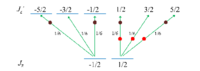
Closing the detection loophole in multipartite Bell experiments with a limited number of efficient detectors

Kamil Kostrzewa, Wiesław Laskowski, and Tamás Vértesi

Phys. Rev. A 98, 012138 (2018) - Published 27 July, 2018

The problem of closing the detection loophole in Bell tests is studied in the presence of a limited number of efficient detectors using multipartite quantum states. It is found that most of the studied pure multipartite states can violate a family of multipartite Bell inequalities with only two efficient detectors, whereas the remaining detectors may have arbitrary small efficiencies.

Relation between absorption and emission directivities for dipoles coupled with optical antennas

Zhexin Zhao, Yu Shi, Kaifeng Chen, and Shanhui Fan

Phys. Rev. A 98, 013845 (2018) - Published 27 July, 2018

An in-depth theoretical analysis of optical antennas is presented. The study is not only helpful for the understanding of fundamental questions, such as the subtleties of reciprocity between the absorption and emission processes of emitters coupled with optical antennas, but it may also contribute to better design antennas for a given application.

Photon thermalization via laser cooling of atoms

Chiao-Hsuan Wang, M. J. Gullans, J. V. Porto, William D. Phillips, and Jacob M. Taylor

Phys. Rev. A 98, 013834 (2018) - Published 19 July, 2018

Laser cooling, a well-known technique, is now investigated from the point of view of the reemitted photons. A general framework to study multiple scattering of photons inside an optically thick atomic ensemble is developed, which might help to engineer photonic states with controllable chemical potential and temperature in a many-body setting.

Quantum Monte Carlo study of the long-range site-diluted XXZ model as realized by polar molecules

C. Zhang and B. Capogrosso-Sansone

Phys. Rev. A 98, 013621 (2018) - Published 18 July, 2018

Properties of ultracold polar molecules trapped in deep optical lattices are studied with the site-diluted long-ranged XXZ model. It is found that a superfluid, a checkerboard solid and a checkerboard supersolid phase are stabilized in the absence of site dilution, whereas localization may never occur in the presence of site dilution.

Statistics of photon-subtracted and photon-added states

Stephen M. Barnett, Gergely Ferenczi, Claire R. Gilson, and Fiona C. Speirits

Phys. Rev. A 98, 013809 (2018) - Published 5 July, 2018

A description of the photon statistics of photon-added and photon-subtracted states is presented. It is found that photon subtraction may increase the mean photon number or leave it unchanged, whereas photon addition may increase the mean photon number by more than the number of photons added.

Controlling rare-earth ions in a nanophotonic resonator using the ac Stark shift

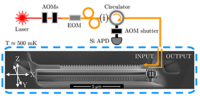
John G. Bartholomew, Tian Zhong, Jonathan M. Kindem, Raymond Lopez-Rios, Jake Rochman, Ioana Craiciu, Evan Miyazono, and Andrei Faraon

Phys. Rev. A 97, 063854 (2018) - Published 28 June, 2018

Rare-earth ions in crystals are one of the most promising platforms for building quantum technologies, such as quantum memories. Now, through the miniaturization of such systems in an on-chip nanophotonic resonator, the ac Stark shift due to a single photon can be used as a versatile way to control the ions.

Quantum-optical tests of Planck-scale physics

Shreya P. Kumar and Martin B. Plenio

Phys. Rev. A 97, 063855 (2018) - Published 28 June, 2018

Tests of quantum gravity are hampered by any tiny real-world deviations of measurement devices from idealized schemes. A method to improve the accuracy and precision of cavity-optomechanical tests of quantum gravity is set forth, promising to boost near-future experiments.

Lattice-induced photon scattering in an optical lattice clock

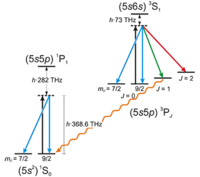
Sören Dörscher, Roman Schwarz, Ali Al-Masoudi, Stephan Falke, Uwe Sterr, and Christian Lisdat

Phys. Rev. A 97, 063419 (2018) - Published 25 June, 2018

Off-resonant scattering of lattice laser radiation by 87Sr atoms in the two states 1S0 and 3P0 and its effect on clock operation are investigated. It is found that Raman scattering eventually limits the achievable frequency instability and thus limits the useful interrogation time in optical lattice clocks at presently used lattice depths.

Two interacting ultracold molecules in a one-dimensional harmonic trap

Anna Dawid, Maciej Lewenstein, and Michał Tomza

Phys. Rev. A 97, 063618 (2018) - Published 20 June, 2018

Properties of two interacting ultracold polar molecules trapped in a one-dimensional harmonic potential are studied with the quantum rigid-rotor model. The interplay of the molecular rotational structure, anisotropic dipolar interactions, spin-rotation coupling, electric and magnetic fields, and the harmonic trapping potential are examined in detail.

Totally destructive interference for permutation-symmetric many-particle states

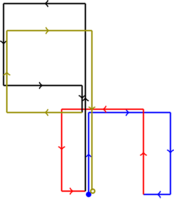
Christoph Dittel, Gabriel Dufour, Mattia Walschaers, Gregor Weihs, Andreas Buchleitner, and Robert Keil

Phys. Rev. A 97, 062116 (2018) - Published 15 June, 2018

Interference is at the heart of quantum mechanics and is most intriguing in the complexity of multiple interfering particles. Here fundamental symmetry considerations are used to develop a general formalism for understanding the totally destructive interference of many bosons and fermions.

Spin-resolved single-atom imaging of Li6 in free space

Andrea Bergschneider, Vincent M. Klinkhamer, Jan Hendrik Becher, Ralf Klemt, Gerhard Zürn, Philipp M. Preiss, and Selim Jochim

Phys. Rev. A 97, 063613 (2018) - Published 15 June, 2018

An efficient scheme to image freely propagating 6Li atoms with spin and position resolution is presented. Combined with time of flight, it enables the measurement of single-particle momenta.

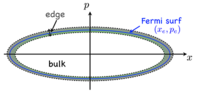
Wigner function of noninteracting trapped fermions

David S. Dean, Pierre Le Doussal, Satya N. Majumdar, and Grégory Schehr

Phys. Rev. A 97, 063614 (2018) - Published 15 June, 2018

The Wigner function is studied for trapped noninteracting fermions. Universal scaling behavior of the function, independent of the trapping potential and the spatial dimension, is found at both zero and finite temperatures.

Sign In to Your Journals Account

Filter

Section

Filter

Article Lookup

Enter a citation