Highlights

Quantum limit to subdiffraction incoherent optical imaging

Mankei Tsang

Phys. Rev. A 99, 012305 (2019) - Published 3 January, 2019

The problem of finding the fundamental resolution of an optical system can be cast in terms of a quantum estimation problem. Here an upper bound on the quantum Fisher Information for the moments of an arbitrary subdiffraction object is derived, establishing a criterion of resolution for far-field incoherent imaging.

Modern description of Rayleigh's criterion

Sisi Zhou and Liang Jiang

Phys. Rev. A 99, 013808 (2019) - Published 3 January, 2019

A comprehensive Fisher information analysis is put forward to understand and achieve the limits in imaging resolution. It is shown that for any incoherence sources, a 1D or 2D image can be precisely estimated up to its second moment.

Momentum distribution and coherence of a weakly interacting Bose gas after a quench

Giovanni I. Martone, Pierre-Élie Larré, Alessandro Fabbri, and Nicolas Pavloff

Phys. Rev. A 98, 063617 (2018) - Published 12 December, 2018

The time evolution of a weakly interacting uniform atomic Bose gas with a time-dependent nonlinear coupling constant is investigated with a Bogoliubov treatment. The evolution of Bogoliubov modes in different momentum regimes, the existence of exact solutions, and the coherence property of the system in one spatial dimension are discussed.

Kibble-Zurek scaling of the one-dimensional Bose-Hubbard model at finite temperatures

Werner Weiss, Matthias Gerster, Daniel Jaschke, Pietro Silvi, and Simone Montangero

Phys. Rev. A 98, 063601 (2018) - Published 3 December, 2018

A one-dimensional Bose-Hubbard model for zero and finite temperatures is simulated with tensor network methods. The effects of finite temperature on the properties of the insulating and superfluid phase, and the dynamics of the system triggered by a linear quench in the particle hopping parameter, are both explored.

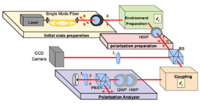
Controlling non-Markovian dynamics using a light-based structured environment

Daniel F. Urrego, Jefferson Flórez, Jiří Svozilík, Mayerlin Nuñez, and Alejandra Valencia

Phys. Rev. A 98, 053862 (2018) - Published 30 November, 2018

Non-Markovian dynamics is simulated in an optical platform, allowing the identification and control of the flow of information. The study is relevant for controlling real quantum systems, which are unavoidably coupled to their environment.

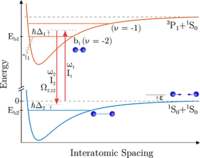
Photoassociative spectroscopy of a halo molecule in Sr86

J. A. Aman, J. C. Hill, R. Ding, Kaden R. A. Hazzard, T. C. Killian, and W. Y. Kon

Phys. Rev. A 98, 053441 (2018) - Published 28 November, 2018

Halo 86Sr2 molecules are photoassociated in their ground electronic state. The large sensitivity of the molecular binding energy to the near-resonant light suggests the possibility of probing naturally occurring Efimov states by optical means.

Experimental realization of ultracold Yb-Li7 mixtures in mixed dimensions

F. Schäfer, N. Mizukami, P. Yu, S. Koibuchi, A. Bouscal, and Y. Takahashi

Phys. Rev. A 98, 051602(R) (2018) - Published 19 November, 2018

A doubly-quantum-degenerate Bose-Bose mixture of 174Yb-7Li and a Fermi-Bose mixture of 173Yb-7Li are experimentally realized in mixed spatial dimensions. The formation and characterization of the Fermi-Bose mixture make a step towards a possible realization of a topological superfluid.

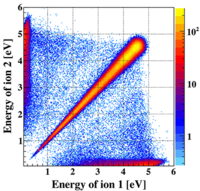
Frustrated Coulomb explosion of small helium clusters

S. Kazandjian, J. Rist, M. Weller, F. Wiegandt, D. Aslitürk, S. Grundmann, M. Kircher, G. Nalin, D. Pitters, I. Vela Pérez, M. Waitz, G. Schiwietz, B. Griffin, J. B. Williams, R. Dörner, M. Schöffler, T. Miteva, F. Trinter, T. Jahnke, and N. Sisourat

Phys. Rev. A 98, 050701(R) (2018) - Published 16 November, 2018

Energetic neutral atoms are detected following an interatomic Coulombic decay of loosely bound He clusters. The observation is explained by “frustrated Coulomb explosion” — a process mediated by electron migration during a Coulomb explosion of the ionized clusters.

Multipartite entanglement outperforming bipartite entanglement under limited quantum system sizes

Hayata Yamasaki, Alexander Pirker, Mio Murao, Wolfgang Dür, and Barbara Kraus

Phys. Rev. A 98, 052313 (2018) - Published 13 November, 2018

The nuances between entangled resource states that can or cannot be prepared from the distribution of bipartite entanglement are analyzed. Concrete examples are given to prove that multipartite entanglement outperforms bipartite entanglement when limitations on the local system sizes exist.

Nuclear recoil spectroscopy of levitated particles

Alexander Malyzhenkov, Vyacheslav Lebedev, and Alonso Castro

Phys. Rev. A 98, 052103 (2018) - Published 6 November, 2018

Nuclear decay processes are proposed to be detected and characterized by measuring nuclear decay recoils within small particles levitated in an optical trap with high positional resolution. The interesting technique may shed light on the “uncertainty of the half-life” debate.

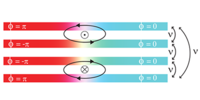
Nonlinear standing waves in an array of coherently coupled Bose-Einstein condensates

Christian Baals, Herwig Ott, Joachim Brand, and Antonio Muñoz Mateo

Phys. Rev. A 98, 053603 (2018) - Published 1 November, 2018

The dynamics of an array of linearly coupled one-dimensional Bose-Einstein condensates is studied by a mean-field method, which reveals that the coupling leads to the system’s evolution into a range of phase textures including Josephson vortices, vortex dipoles, half-dark solitons, and arrays of the like.

Quality of photon antibunching in two cavity-waveguide arrangements on a chip

Jiahua Li and Ying Wu

Phys. Rev. A 98, 053801 (2018) - Published 1 November, 2018

An exhaustive analysis of photon antibunching in different cavity QED architectures is provided. The study is relevant for improving the quality of on-chip single-photon sources.

Analysis of recent interpretations of the Abraham-Minkowski problem

Iver Brevik

Phys. Rev. A 98, 043847 (2018) - Published 25 October, 2018

An illuminating discussion on the controversy concerning the momentum of light is presented. Subtleties on the subject are analyzed and exemplified with a critical remark on recent experiments.

Continuous production of rovibronic-ground-state RbCs molecules via short-range photoassociation to the bΠ13–cΣ1+3–BΠ11 states

Toshihiko Shimasaki, Jin-Tae Kim, Yuqi Zhu, and David DeMille

Phys. Rev. A 98, 043423 (2018) - Published 16 October, 2018

Rovibronic levels of the mixed b3Π1-c3Σ1+-B1Π1 states of RbCs molecules are experimentally investigated with photoassociation, where the strong singlet-triplet mixing in the states facilitates a rate of 104 s−1 for producing rovibronic-ground-state molecules.

Quantum Hopfield neural network

Patrick Rebentrost, Thomas R. Bromley, Christian Weedbrook, and Seth Lloyd

Phys. Rev. A 98, 042308 (2018) - Published 5 October, 2018

Neural networks, ubiquitous in machine learning, are generalized to the quantum realm. The method results in a network that can be exploited to offer exponential speedup on many applications, such as image processing and optimization, thus with a wider interest in neuroscience and medicine.

Scaling behavior of Tan's contact for trapped Lieb-Liniger bosons: From two to many

Matteo Rizzi, Christian Miniatura, Anna Minguzzi, and Patrizia Vignolo

Phys. Rev. A 98, 043607 (2018) - Published 4 October, 2018

The contact parameter of harmonically trapped, interacting bosons at zero temperature in one dimension is obtained analytically by a simple rescaling of the exact two-boson solution, which further confirms that the ground-state properties of an interacting, one-dimensional Bose gas can be accurately described by an effective two-body contact interaction dressed by the other particles in the many-body system.

Experimental and theoretical investigation of the crossover from the ultracold to the quasiclassical regime of photodissociation

I. Majewska, S. S. Kondov, C.-H. Lee, M. McDonald, B. H. McGuyer, R. Moszynski, and T. Zelevinsky

Phys. Rev. A 98, 043404 (2018) - Published 2 October, 2018

Experiments track a simple molecule dissociating to find when the reaction can be described with a quantum model and when a semiclassical one will do.

Orientation-dependent hyperfine structure of polar molecules in a rare-gas matrix: A scheme for measuring the electron electric dipole moment

A. C. Vutha, M. Horbatsch, and E. A. Hessels

Phys. Rev. A 98, 032513 (2018) - Published 28 September, 2018

The Stark shift of the hyperfine states of polar molecules embedded in a solid rare-gas matrix is found to depend on the molecular orientation. This finding may significantly improve the measurements of the electron electric dipole moment by using large ensembles of polar molecules trapped in rare-gas matrices with orientation-dependent detections.

Measurement of the two-time intensity-correlation function of arbitrary states

Katarina Stensson and Gunnar Björk

Phys. Rev. A 98, 033812 (2018) - Published 10 September, 2018

A detailed analysis and recipe for measuring intensity correlation are provided and experimentally verified. The scheme allows the characterization of quantum light sources in the multiphoton regime.

Relativistic corrections to the Bethe logarithm for the 2S3 and 2P3 states of He

Vladimir A. Yerokhin, Vojtěch Patkóš, and Krzysztof Pachucki

Phys. Rev. A 98, 032503 (2018) - Published 7 September, 2018

Progress is made in calculating the QED contribution of the order α7m to the transition energy between the 23P and 23S states in helium atoms, where a calculation of the relativistic corrections to the Bethe logarithm for these states is performed.

Sign In to Your Journals Account

Filter

Section

Filter

Article Lookup

Enter a citation