Highlights

Interaction spectroscopy of a two-component Mott insulator

Jesse Amato-Grill, Niklas Jepsen, Ivana Dimitrova, William Lunden, and Wolfgang Ketterle

Phys. Rev. A 99, 033612 (2019) - Published 18 March, 2019

Ultracold atoms offer a controlled platform for investigating quantum magnetism; however, stepping into integer-spin territory is not trivial. Now an experimental technique to measure the relative interaction strength amongst hyperfine states is demonstrated, paving the way to study quantum phase transitions.

Complete temporal mode characterization of non-Gaussian states by a dual homodyne measurement

Kan Takase, Masanori Okada, Takahiro Serikawa, Shuntaro Takeda, Jun-ichi Yoshikawa, and Akira Furusawa

Phys. Rev. A 99, 033832 (2019) - Published 18 March, 2019

A method to reconstruct single and dual temporal modes of non-Gaussian states is devised and experimentally tested. The idea is based on principal component analysis and a dual homodyne measurement, allowing the measurement of complex temporal modes.

Quantum dynamics of disordered spin chains with power-law interactions

A. Safavi-Naini, M. L. Wall, O. L. Acevedo, A. M. Rey, and R. M. Nandkishore

Phys. Rev. A 99, 033610 (2019) - Published 15 March, 2019

A powerful numerical algorithm is used to characterize the emergence of many-body localization in long-range interacting systems. The interplay between disorder and power-law interactions is analyzed, confirming the existence of a transition from a thermal phase to a localized one.

Theory of Bose condensation of light via laser cooling of atoms

Chiao-Hsuan Wang, M. J. Gullans, J. V. Porto, William D. Phillips, and Jacob M. Taylor

Phys. Rev. A 99, 031801(R) (2019) - Published 14 March, 2019

A scheme to achieve Bose-Einstein condensation of photons through the Doppler cooling of an atomic ensemble is proposed. Interesting features of the approach include a controllable chemical potential and energy-dependent loss mechanisms.

Learning-with-errors problem is easy with quantum samples

Alex B. Grilo, Iordanis Kerenidis, and Timo Zijlstra

Phys. Rev. A 99, 032314 (2019) - Published 11 March, 2019

Most post-quantum-cryptography schemes rely on the fact that learning noisy functions is hard, even for quantum computers. However, this task is easy if quantum data is provided, which poses interesting consequences in the area of cryptography.

Quantum regression theorem for out-of-time-ordered correlation functions

Philip Daniel Blocher and Klaus Mølmer

Phys. Rev. A 99, 033816 (2019) - Published 7 March, 2019

Out-of-time-ordered correlation functions, relevant for, e.g., diagnosing scrambling and spreading of quantum information, are investigated in open quantum systems. A unified theoretical model is established to connect this quantity with feasible experimental observables.

Squeezed states of magnons and phonons in cavity magnomechanics

Jie Li, Shi-Yao Zhu, and G. S. Agarwal

Phys. Rev. A 99, 021801(R) (2019) - Published 21 February, 2019

A ferrimagnetic yttrium-iron-garnet sphere placed inside a cavity provides a platform for investigating macroscopic quantum phenomena. By exploring the strong coupling between magnons and cavity-polaritons, as well as the magnetostrictive interaction, a scheme to create squeezed states of magnons and phonons is proposed.

Early-time dynamics of Bose gases quenched into the strongly interacting regime

A. Muñoz de las Heras, M. M. Parish, and F. M. Marchetti

Phys. Rev. A 99, 023623 (2019) - Published 21 February, 2019

The crossover from shallow to deep interaction quenches of the very early-time dynamics of a degenerate Bose gas is analyzed by using a time-dependent variational formalism, which self-consistently describes the excitation of particles out of the condensate in pairs only. In the unitary regime, the model leads to a universal scaling behavior of the typical growth time of the momentum distribution in agreement with recent experimental observations.

Angularly resolved two-photon above-threshold ionization of helium

Diego I. R. Boll, Omar A. Fojón, C. W. McCurdy, and Alicia Palacios

Phys. Rev. A 99, 023416 (2019) - Published 14 February, 2019

Two-photon single ionization of helium is studied for photon energies from the two-photon ionization threshold up to 70 eV by numerically solving the full-dimensional time-dependent Schrödinger equation. Analysis of the photoelectron angular distributions reveals the dominant two-photon mechanisms and the relevance of radial and electron correlation terms as a function of energy and pulse parameters, as well as the breakdown of a single-active-electron picture, qualitatively valid at low photon energies, at energies above ca. 50 eV.

Perfect discrimination of nonorthogonal quantum states with posterior classical partial information

Seiseki Akibue, Go Kato, and Naoki Marumo

Phys. Rev. A 99, 020102(R) (2019) - Published 8 February, 2019

Some sets of nonorthogonal quantum states, ubiquitous in quantum cryptography, are shown to be perfectly discriminated if classical partial information about them is made available after they have been measured. Apart from deepening the understanding of quantum measurements, the results might help to strengthen the security of QKD protocols.

Three-dimensional force-field microscopy with optically levitated microspheres

Charles P. Blakemore, Alexander D. Rider, Sandip Roy, Qidong Wang, Akio Kawasaki, and Giorgio Gratta

Phys. Rev. A 99, 023816 (2019) - Published 8 February, 2019

A sensing element that explores the features of optical tweezers and atomic force microscopy is developed and tested. In contrast to traditional methods, vectorial force fields are fully characterized.

Cooling all external degrees of freedom of optically trapped chromium atoms using gray molasses

L. Gabardos, S. Lepoutre, O. Gorceix, L. Vernac, and B. Laburthe-Tolra

Phys. Rev. A 99, 023607 (2019) - Published 4 February, 2019

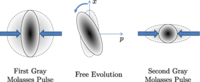
An experimental technique is developed to laser cool the motional and spatial degrees of freedom of chromium atoms leading to a trapped system with high phase-space density. The result is a step forward for studying dipolar quantum gases in the degenerate regime.

From single-particle excitations to sound waves in a box-trapped atomic Bose-Einstein condensate

Samuel J. Garratt, Christoph Eigen, Jinyi Zhang, Patrik Turzák, Raphael Lopes, Robert P. Smith, Zoran Hadzibabic, and Nir Navon

Phys. Rev. A 99, 021601(R) (2019) - Published 1 February, 2019

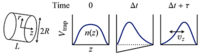
The low-energy collective excitations of a box-trapped Bose-Einstein condensate are probed in a textbooklike setting. The observed dynamics is relevant for deepening our understanding of quantum many-body systems.

Critical open-system dynamics in a one-dimensional optical-lattice clock

Loïc Henriet, James S. Douglas, Darrick E. Chang, and Andreas Albrecht

Phys. Rev. A 99, 023802 (2019) - Published 1 February, 2019

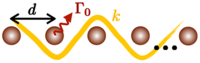
One possible route for improving the precision of optical clocks consists of using a set of them conveniently organized in an optical lattice. The presence of interaction, i.e., collective excitations, is thoroughly analyzed in a nonperturbative fashion, showing the consequences of subradiance in the dynamics of such an open, many-body system.

Geometrically asymmetric optical cavity for strong atom-photon coupling

Akio Kawasaki, Boris Braverman, Edwin Pedrozo-Peñafiel, Chi Shu, Simone Colombo, Zeyang Li, Özge Özel, Wenlan Chen, Leonardo Salvi, André Heinz, David Levonian, Daisuke Akamatsu, Yanhong Xiao, and Vladan Vuletić

Phys. Rev. A 99, 013437 (2019) - Published 31 January, 2019

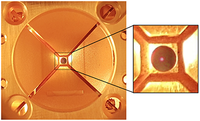
Achieving strong coupling between a single photon and a single atom typically means compromising optical access or mechanical stability. Here, a smart design that overcomes the problem is proposed and tested, showing promising results for the generation of entangled atomic states for precision measurements.

Fractal light from lasers

Hend Sroor, Darryl Naidoo, Steven W. Miller, John Nelson, Johannes Courtial, and Andrew Forbes

Phys. Rev. A 99, 013848 (2019) - Published 25 January, 2019

A long-lasting prediction on the formation of fractal light from lasers is verified. The investigation consists of a direct observation of self-similarity inside a cavity together with a detailed theoretical model for the three-dimensional distribution of light patterns.

Repeater-enhanced distributed quantum sensing based on continuous-variable multipartite entanglement

Yi Xia, Quntao Zhuang, William Clark, and Zheshen Zhang

Phys. Rev. A 99, 012328 (2019) - Published 17 January, 2019

A quantum repeater based on noiseless linear amplifiers is introduced and applied to an entanglement distribution setting used for sensing applications. The enhanced quantum sensor is a concrete application of quantum repeaters and can be implemented with current technology.

QED calculations of the n=2 to n=1 x-ray transition energies in middle-Z heliumlike ions

A. V. Malyshev, Y. S. Kozhedub, D. A. Glazov, I. I. Tupitsyn, and V. M. Shabaev

Phys. Rev. A 99, 010501(R) (2019) - Published 14 January, 2019

Ab initio QED calculations of the binding energies for n=1 and n=2 states of middle-Z He-like ions are performed with the screening potential incorporated into the zeroth-order QED approximation. The calculations find no possible explanation for the considerable disagreement between a previous measurement and theory for He-like titanium.

Alignment-dependent decay rate of an atomic dipole near an optical nanofiber

P. Solano, J. A. Grover, Y. Xu, P. Barberis-Blostein, J. N. Munday, L. A. Orozco, W. D. Phillips, and S. L. Rolston

Phys. Rev. A 99, 013822 (2019) - Published 14 January, 2019

The spontaneous emission of atoms in the proximity of an optical nanofiber is investigated. A better understanding of light-atom interaction in such an environment is relevant for controlling atomic properties on waveguide-based photonic platforms.

Engineering bilinear mode coupling in circuit QED: Theory and experiment

Yaxing Zhang, Brian J. Lester, Yvonne Y. Gao, Liang Jiang, R. J. Schoelkopf, and S. M. Girvin

Phys. Rev. A 99, 012314 (2019) - Published 10 January, 2019

Superconducting microwave cavities are a promising platform for realizing quantum computation. The conditions for performing fast SWAP gates are thoroughly explored and analyzed.

Sign In to Your Journals Account

Filter

Section

Filter

Article Lookup

Enter a citation