Recent Articles

High-Dimensional Quantum Key Distribution via Full Core-Mode Encoding over Deployed Multicore Fibers

G. H. dos Santos, K. B. Sawada, N. Villalba, C. Jara, N. Guerrero, C. Melo, M. H. Magiotto, D. Martinez, G. B. Xavier, J. Cariñe, G. Saavedra, E. S. Gómez, S. P. Walborn, and G. Lima

PRX Quantum 7, 043012 (2026) - Published 19 October, 2026

A four-dimensional quantum key distribution protocol utilizing full core-mode encoding over deployed multicore fibers is demonstrated, establishing a viable architecture for high-rate quantum-secure communications.

Heisenberg-Limited Hamiltonian Learning Without Short-Time Control

Myeongjin Shin, Junseo Lee, and Changhun Oh

PRX Quantum 7, 043011 (2026) - Published 16 October, 2026

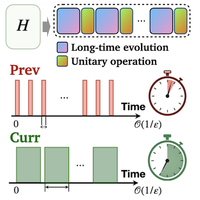
A new approach for learning Hamiltonians achieves the Heisenberg limit even when experiments cannot access short evolution times, easing a demanding control requirement.

Λ-Enhanced Gray-Molasses Loading and EIT Cooling of Neutral Atoms in Nanophotonic Traps

Lucas Pache, Antoine Glicenstein, Philipp Schneeweiss, Jürgen Volz, Arno Rauschenbeutel, and Riccardo Pennetta

PRX Quantum 7, 043010 (2026) - Published 15 October, 2026

Λ-enhanced gray molasses and electromagnetically induced transparency cooling enable efficient loading and longer storage times, improving the practicality of nanophotonic interfaces for neutral atoms.

Predicting Magic from Very Few Measurements

J. M. Varela, L. L. Keller, A. de Oliveira Junior, D. A. Moreira, R. Chaves, and R. A. Macêdo

PRX Quantum 7, 043009 (2026) - Published 14 October, 2026

A near-optimal method quantifies nonstabilizerness—the resource that enables universal quantum computation—from a small number of Pauli measurements, extending its estimation to system sizes beyond the reach of standard techniques.

Fast Gates for Bit-Flip Protected Superconducting Qubits

C. A. Siegele, A. A. Sokolova, L. N. Kapoor, F. Hassani, and J. M. Fink

PRX Quantum 7, 043008 (2026) - Published 14 October, 2026

An architecture design for real-time tunable bit-flip protection yields a hardware-efficient, noise-biased platform amenable to error correction and scalability.

Refinements of the Eigenstate Thermalization Hypothesis under Local Rotational Invariance via Free Probability

Elisa Vallini, Laura Foini, and Silvia Pappalardi

PRX Quantum 7, 043007 (2026) - Published 13 October, 2026

Using the mathematical language of free probability theory, researchers reveal how local rotational invariance structures matrix-element correlations, including their first subleading corrections.

Information-Theoretic Principle of Emergent 1-Form Symmetries

Yu-Jie Liu, Wen-Tao Xu, Frank Pollmann, and Michael Knap

PRX Quantum 7, 043006 (2026) - Published 9 October, 2026

Viewing emergent 1-form symmetries through the lens of quantum error correction(QEC) makes them detectable with QEC decoders, providing efficient protocols for revealing emergent symmetry structure and probing phase transitions in quantum many-body systems.

Erratum: Faster Quantum Chemistry Simulations on a Quantum Computer with Improved Tensor Factorization and Active Volume Compilation [PRX Quantum 6, 030337 (2025)]

Athena Caesura, Cristian L. Cortes, William Pol, Sukin Sim, Mark Steudtner, Gian-Luca R. Anselmetti, Matthias Degroote, Nikolaj Moll, Raffaele Santagati, Michael Streif, and Christofer S. Tautermann

PRX Quantum 7, 049901 (2026) - Published 8 October, 2026

Hole Spin Resilient to Dipole-Induced Thermal Effects

V. Champain, G. Boschetto, H. Niebojewski, B. Bertrand, L. Mauro, C. Haab, M. Bassi, V. Schmitt, X. Jehl, S. Zihlmann, R. Maurand, Y.-M. Niquet, C. B. Winkelmann, S. De Franceschi, B. Martinez, and B. Brun

PRX Quantum 7, 043005 (2026) - Published 7 October, 2026

A silicon hole spin unveils an electric origin of thermal frequency shifts and exhibits a magnetic-field sweet-spot immune to those, guiding the design of thermally robust semiconductor qubits.

Ising on the Donut: Regimes of Topological Quantum Error Correction from Statistical Mechanics

Lucas H. English, Sam Roberts, Stephen D. Bartlett, Andrew C. Doherty, and Dominic J. Williamson

PRX Quantum 7, 043004 (2026) - Published 6 October, 2026

An exact mapping to the 2D Ising model produces closed-form logical failure rates for the toric code, offering an analytic tool kit for benchmarking topological codes beyond current computational limits.

Free Cumulants in Full Eigenstate Thermalization from Boundary Scrambling

Felix Fritzsch, Gabriel O. Alves, Michael A. Rampp, and Pieter W. Claeys

PRX Quantum 7, 043003 (2026) - Published 5 October, 2026

The introduction of boundary scrambling as a solvable many-body quantum model yields an analytically tractable study of higher-order out-of-time-order correlation function dynamics and new insights into free probability and the emergence of random-matrix behavior.

Multiband Dispersion and Warped Vortices of Strongly Interacting Photons

Bankim Chandra Das, Dmytro Kiselov, Lee Drori, Ariel Nakav, Alexander Poddubny, and Ofer Firstenberg

PRX Quantum 7, 043002 (2026) - Published 2 October, 2026

A new study develops an analytical framework to understand and control nonlinear multiphoton processes in strongly interacting Rydberg media.

Asymptotically Solvable Quantum Circuits

Samuel H. Pickering and Bruno Bertini

PRX Quantum 7, 043001 (2026) - Published 1 October, 2026

A new family of quantum circuits gives rise to correlations that are chaotic at short scales yet exactly solvable at long scales.

Electrically Tunable Orbital Coupling and Quantum Light Emission from O-Band Quantum Dot Molecules

P. S. Avdienko, L. Hanschke, Q. Buchinger, N. Akhlaq, I. Lubianskii, E. Weber, H. Riedl, M. Kamp, T. Huber-Loyola, S. Höfling, A. T. Pfenning, K. Müller, and J. J. Finley

PRX Quantum 7, 033070 (2026) - Published 30 September, 2026

Telecom O-band InAs/InGaAs quantum dot molecules exhibit electrically tunable orbital coupling, opening a route toward 2D photonic cluster states.

Theory of Quantum-Enhanced Interferometry with General Markovian Light Sources

Erfan Abbasgholinejad, Daniel Malz, Ana Asenjo-Garcia, and Rahul Trivedi

PRX Quantum 7, 033069 (2026) - Published 29 September, 2026

A new framework for designing and evaluating quantum light sources clarifies where realistic devices can provide a quantum advantage in interferometry.

Protocols for a Many-Body Phase Microscope: From Coherences and d-Wave Superconductivity to Green’s Functions

Christof Weitenberg, Luca Asteria, Ola Carlsson, Annabelle Bohrdt, and Fabian Grusdt

PRX Quantum 7, 033068 (2026) - Published 28 September, 2026

New protocols allow extracting of relevant many-body observables, such as d-wave superconducting order parameters, using state-of-the-art quantum gas microscopes.

Experimental Neuromorphic Computing Based on Quantum Memristor

Mirela Selimović, Iris Agresti, Michał Siemaszko, Joshua Morris, Borivoje Dakić, Riccardo Albiero, Andrea Crespi, Francesco Ceccarelli, Roberto Osellame, Magdalena Stobińska-Moretto, and Philip Walther

PRX Quantum 7, 033067 (2026) - Published 25 September, 2026

A photonic neuromorphic architecture leverages a quantum memristor to enable nonlinear, memory-dependent processing for complex learning tasks such as vowel recognition.

Frequency- and Amplitude-Modulated Gates for Universal Quantum Control

Qi Ding, Shoumik D. Chowdhury, Agustin Di Paolo, Réouven Assouly, Alan V. Oppenheim, Jeffrey A. Grover, and William D. Oliver

PRX Quantum 7, 033066 (2026) - Published 24 September, 2026

A new theoretical framework based on Floquet analysis enables quantum gate optimization using frequency and amplitude modulations, finding high fidelity and fast gates in superconducting circuits.

Fermionic Non-Gaussianity via Bell Sampling: Monotones and Efficient Quantum Algorithms

Poetri Sonya Tarabunga

PRX Quantum 7, 033065 (2026) - Published 23 September, 2026

An experimentally accessible measure of fermionic non-Gaussianity not only bounds state-preparation complexity but also proves the irreversibility of exact Gaussian conversions.

Quantum Simulation with Rydberg Ions in a Penning Trap

Wilson S. Martins, Markus Hennrich, Ferdinand Schmidt-Kaler, and Igor Lesanovsky

PRX Quantum 7, 033064 (2026) - Published 22 September, 2026

Theoretical work tames the complicated dynamics of Rydberg ions in the high magnetic field of a Penning trap, showing large dipole-dipole interactions, which will enable quantum simulations in new regimes.

Sign In to Your Journals Account

Filter

Recent Issues

Vol. 7, Iss. 4
October - December 2026
Vol. 7, Iss. 3
July - September 2026
Vol. 7, Iss. 2
April - June 2026
Vol. 7, Iss. 1
January - March 2026
Category
Article Type

Filter

Article Lookup

Enter a citation