Browse by Subject

Effect of Electron Irradiation on Superconductivity in Single Crystals of Ba(Fe1−xRux)2As2 (x=0.24)

R. Prozorov, M. Kończykowski, M. A. Tanatar, A. Thaler, S. L. Bud’ko, P. C. Canfield, V. Mishra, and P. J. Hirschfeld

Phys. Rev. X 4, 041032 (2014) - Published 18 November, 2014

Irradiating superconductors with charged particles has been shown to alter the superconducting transition temperature Tc. New results show that using electrons as the bombarding particles on an Fe-based superconductor reduces Tc by significantly more than in previous studies.

Few-Electron Ultrastrong Light-Matter Coupling in a Quantum LC Circuit

Yanko Todorov and Carlo Sirtori

Phys. Rev. X 4, 041031 (2014) - Published 18 November, 2014

Future systems for quantum information processing will rely on coherent quantum phenomena, such as the coupling between light and matter. Using a quantum well within a capacitor to study how atomic physics and condensed matter physics are linked, researchers suggest a device architecture for semiconductor-based quantum processing.

Numerical Treatment of the Boltzmann Equation for Self-Propelled Particle Systems

Florian Thüroff, Christoph A. Weber, and Erwin Frey

Phys. Rev. X 4, 041030 (2014) - Published 14 November, 2014

The Boltzmann equation fundamentally connects macroscopic descriptions with particle microphysics. Researchers investigate numerical solutions to the Boltzmann equation describing active gases.

Coherent versus Measurement Feedback: Linear Systems Theory for Quantum Information

Naoki Yamamoto

Phys. Rev. X 4, 041029 (2014) - Published 14 November, 2014

Deciding whether to conduct a measurement is a fundamental tenant of quantum physics. A new analysis finds situations in the linear regime where measurement-based feedback control of a quantum system has no merit.

Local Convertibility and the Quantum Simulation of Edge States in Many-Body Systems

Fabio Franchini, Jian Cui, Luigi Amico, Heng Fan, Mile Gu, Vladimir Korepin, Leong Chuan Kwek, and Vlatko Vedral

Phys. Rev. X 4, 041028 (2014) - Published 13 November, 2014

Quantum simulators pave the way for quantum computers, which promise to be smaller and faster than current classical machines. Researchers show that Majorana edge states can result in genuinely quantum long-range correlations, which are a fundamental property of quantum machines.

New Type of Quantum Criticality in the Pyrochlore Iridates

Lucile Savary, Eun-Gook Moon, and Leon Balents

Phys. Rev. X 4, 041027 (2014) - Published 13 November, 2014

Quantum criticality in conducting materials has been studied since the 1970s. New renormalization group results show that a unique critical point occurs in a family of iridium pyrochlores.

Subgraph Covers: An Information-Theoretic Approach to Motif Analysis in Networks

Anatol E. Wegner

Phys. Rev. X 4, 041026 (2014) - Published 10 November, 2014

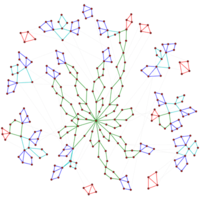
Many complex systems can be represented as networks of interacting elements. A new theoretical method identifies characteristics of the connectivity patterns of networks.

Optimizing the Choice of Spin-Squeezed States for Detecting and Characterizing Quantum Processes

Lee A. Rozema, Dylan H. Mahler, Robin Blume-Kohout, and Aephraim M. Steinberg

Phys. Rev. X 4, 041025 (2014) - Published 7 November, 2014

Quantum metrology is focused on making exquisitely precise measurements. New results show that different techniques are optimal for noise detection and noise characterization.

Tensor Networks for Lattice Gauge Theories with Continuous Groups

L. Tagliacozzo, A. Celi, and M. Lewenstein

Phys. Rev. X 4, 041024 (2014) - Published 6 November, 2014

Gauge theories have applications in fundamental interactions and superconductivity. Researchers use tensor networks to describe gauge theories, avoiding some of the drawbacks of Monte Carlo simulations.

Quantitative Temperature Dependence of Longitudinal Spin Seebeck Effect at High Temperatures

Ken-ichi Uchida, Takashi Kikkawa, Asuka Miura, Junichiro Shiomi, and Eiji Saitoh

Phys. Rev. X 4, 041023 (2014) - Published 5 November, 2014

The growing field of spintronics is partially propelled by the spin Seebeck effect, in which a spin current results from a temperature gradient. Researchers report temperature-dependent measurements of the spin Seebeck effect in a previously unexplored temperature regime.

Phase Coherence and Andreev Reflection in Topological Insulator Devices

A. D. K. Finck, C. Kurter, Y. S. Hor, and D. J. Van Harlingen

Phys. Rev. X 4, 041022 (2014) - Published 4 November, 2014

Fabry-Pérot interference, measured as conductance oscillations, can be used to search for anyons such as Majorana bound states. The first observation of Fabry-Pérot interference in a topological insulator has now been reported.

Analyzing Many-Body Localization with a Quantum Computer

Bela Bauer and Chetan Nayak

Phys. Rev. X 4, 041021 (2014) - Published 3 November, 2014

A small quantum computer with a limited number of qubits seems feasible in the coming years. By emulating quantum simulation on such a computer, researchers show that it can be used to resolve long-standing questions about disordered interacting electrons.

Double Percolation Phase Transition in Clustered Complex Networks

Pol Colomer-de-Simón and Marián Boguñá

Phys. Rev. X 4, 041020 (2014) - Published 30 October, 2014

The percolation properties of networks are strongly affected by their topological features. A new study shows that percolation can proceed at different rates in the core and periphery of a complex, clustered network.

Random Strain Fluctuations as Dominant Disorder Source for High-Quality On-Substrate Graphene Devices

Nuno J. G. Couto, Davide Costanzo, Stephan Engels, Dong-Keun Ki, Kenji Watanabe, Takashi Taniguchi, Christoph Stampfer, Francisco Guinea, and Alberto F. Morpurgo

Phys. Rev. X 4, 041019 (2014) - Published 30 October, 2014

Futuristic electronic devices will rely on high electron speeds in graphene. A new investigation shows that random strain in the carbon honeycomb lattice limits the speed of electrons.

xTRAM: Estimating Equilibrium Expectations from Time-Correlated Simulation Data at Multiple Thermodynamic States

Antonia S. J. S. Mey, Hao Wu, and Frank Noé

Phys. Rev. X 4, 041018 (2014) - Published 29 October, 2014

Determining the equilibrium configurations of biological molecules can be prohibitively computationally expensive. A new analysis method for computing equilibrium configurations significantly outperforms previous analysis tools.

Cellular Signaling Networks Function as Generalized Wiener-Kolmogorov Filters to Suppress Noise

Michael Hinczewski and D. Thirumalai

Phys. Rev. X 4, 041017 (2014) - Published 29 October, 2014

Noise is inherent in all biological systems. New results reveal how mathematical frameworks describe bounds on noise in stochastic enzymatic reactions.

Existence of a Thermodynamic Spin-Glass Phase in the Zero-Concentration Limit of Anisotropic Dipolar Systems

Juan Carlos Andresen, Helmut G. Katzgraber, Vadim Oganesyan, and Moshe Schechter

Phys. Rev. X 4, 041016 (2014) - Published 28 October, 2014

Previous studies have focused on investigating how dipolar systems order at small magnetic ion concentrations, but they were hindered by long equilibrium time scales. New results show that a spin-glass state persists even for extremely low ion concentrations.

Odor Landscapes in Turbulent Environments

Antonio Celani, Emmanuel Villermaux, and Massimo Vergassola

Phys. Rev. X 4, 041015 (2014) - Published 28 October, 2014

A statistical-physics model provides an accurate description of how animals communicate via pheromones in a turbulent atmospheric environment.

Photonic Hypercrystals

Evgenii E. Narimanov

Phys. Rev. X 4, 041014 (2014) - Published 27 October, 2014

A design for a photonic crystal made with so-called hyperbolic metamaterials could provide unprecedented control of light waves confined to the surface.

Sign In to Your Journals Account

Filter

Subject

Filter

Article Lookup

Enter a citation