Browse by Subject

Broadband Reflectionless Metasheets: Frequency-Selective Transmission and Perfect Absorption

V. S. Asadchy, I. A. Faniayeu, Y. Ra’di, S. A. Khakhomov, I. V. Semchenko, and S. A. Tretyakov

Phys. Rev. X 5, 031005 (2015) - Published 14 July, 2015

An array of helical elements absorbs radiation of a certain frequency while casting no shadow in light over a range of other frequencies.

Time- and Site-Resolved Dynamics in a Topological Circuit

Jia Ningyuan, Clai Owens, Ariel Sommer, David Schuster, and Jonathan Simon

Phys. Rev. X 5, 021031 (2015) - Published 22 June, 2015

The surface states of topological insulators are protected from backscattering, making them a promising resource for computing and materials science. This topological protection is now demonstrated in a radio-frequency circuit.

Hall-Effect Sign Inversion in a Realizable 3D Metamaterial

Muamer Kadic, Robert Schittny, Tiemo Bückmann, Christian Kern, and Martin Wegener

Phys. Rev. X 5, 021030 (2015) - Published 22 June, 2015

Porous metamaterials exhibit dramatic changes in their Hall voltage relative to their bulk material. Researchers theoretically investigate this result and suggest techniques for experimental verification.

Anomalously Weak Scattering in Metal-Semiconductor Multilayer Hyperbolic Metamaterials

Hao Shen, Dylan Lu, Bryan VanSaders, Jimmy J. Kan, Hongxing Xu, Eric E. Fullerton, and Zhaowei Liu

Phys. Rev. X 5, 021021 (2015) - Published 29 May, 2015

Electromagnetic scattering has applications in astrophysics, atmospheric science, and medical imaging. Researchers design a metamaterial that exhibits anomalously weak scattering over a band of optical frequencies.

Dielectric Metamaterials with Toroidal Dipolar Response

Alexey A. Basharin, Maria Kafesaki, Eleftherios N. Economou, Costas M. Soukoulis, Vassili A. Fedotov, Vassili Savinov, and Nikolay I. Zheludev

Phys. Rev. X 5, 011036 (2015) - Published 27 March, 2015

Many biological structures, from macromolecules to proteins, as well as a number of solid-state systems including ferroelectric and ferro nano- and microstructures, possess static toroidal shapes. A theoretical study shows that the dynamic toroidal dipoles constructed from ionic crystals can be used to engineer metamaterials to control how electromagnetic radiation is scattered and transmitted.

Optical Huygens’ Metasurfaces with Independent Control of the Magnitude and Phase of the Local Reflection Coefficients

Minseok Kim, Alex M. H. Wong, and George V. Eleftheriades

Phys. Rev. X 4, 041042 (2014) - Published 9 December, 2014

Surfaces that offer arbitrary control of reflected light have enormous implications in the field of nanophotonics. New metasurfaces consisting of gold nanorods are used to fully control the reflective properties of electromagnetic radiation.

Anisotropic Complementary Acoustic Metamaterial for Canceling out Aberrating Layers

Chen Shen, Jun Xu, Nicholas X. Fang, and Yun Jing

Phys. Rev. X 4, 041033 (2014) - Published 19 November, 2014

Medical techniques such as transcranial ultrasound beam focusing suffer from energy losses and distorted acoustic fields. Researchers show how metamaterials can be used to enhance acoustic transmission.

Photonic Hypercrystals

Evgenii E. Narimanov

Phys. Rev. X 4, 041014 (2014) - Published 27 October, 2014

A design for a photonic crystal made with so-called hyperbolic metamaterials could provide unprecedented control of light waves confined to the surface.

Giant Photogalvanic Effect in Noncentrosymmetric Plasmonic Nanoparticles

Sergei V. Zhukovsky, Viktoriia E. Babicheva, Andrey B. Evlyukhin, Igor E. Protsenko, Andrei V. Lavrinenko, and Alexander V. Uskov

Phys. Rev. X 4, 031038 (2014) - Published 3 September, 2014

Photovoltaics are garnering new attention given rising energy costs. A numerical model shows how metallic nanoparticles in a uniform semiconductor matrix can efficiently produce a directional current from a uniform light source.

Controlling the Polarization State of Light with a Dispersion-Free Metastructure

Shang-Chi Jiang, Xiang Xiong, Yuan-Sheng Hu, Yu-Hui Hu, Guo-Bin Ma, Ru-Wen Peng, Cheng Sun, and Mu Wang

Phys. Rev. X 4, 021026 (2014) - Published 15 May, 2014

Metamaterials, artificial structures with unexpected properties, only function over a limited spectral window. Scientists have recently determined that the technique of combining a metallic metamaterial with a dielectric interlayer creates a device that modulates light over a wide range of frequencies.

Independent Manipulation of Heat and Electrical Current via Bifunctional Metamaterials

Massimo Moccia, Giuseppe Castaldi, Salvatore Savo, Yuki Sato, and Vincenzo Galdi

Phys. Rev. X 4, 021025 (2014) - Published 12 May, 2014

Artificially engineered materials—metamaterials—typically alter only one heat or electromagnetic parameter at once. Researchers test a metamaterial that behaves simultaneously like a thermal concentrator and an electrical invisibility cloak.

Surface Impedance and Bulk Band Geometric Phases in One-Dimensional Systems

Meng Xiao, Z. Q. Zhang, and C. T. Chan

Phys. Rev. X 4, 021017 (2014) - Published 25 April, 2014

Surface impedance of a photonic material governs how an impinging light wave behaves at its surface, whereas its bulk “band structure” determines what wave modes can propagate in it. Is there a surface-to-bulk correspondence? A new study of one-dimensional photonic crystals indeed uncovers a rigorous fundamental relationship between the two.

Magnetic Localized Surface Plasmons

Paloma A. Huidobro, Xiaopeng Shen, J. Cuerda, Esteban Moreno, L. Martin-Moreno, F. J. Garcia-Vidal, Tie Jun Cui, and J. B. Pendry

Phys. Rev. X 4, 021003 (2014) - Published 3 April, 2014

Surface plasmons, electromagnetic fields generated by the charge oscillations at the surface of a light-illuminated metallic nanoparticle, are typically described in terms of effective electric dipoles and their dynamics. Scientists discover that adding periodic grooves to the surface of subwavelength metallic disks creates localized surface plasmons of magnetic character in addition to the typical electric ones.

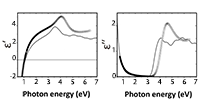
Optical Properties of Gallium-Doped Zinc Oxide—A Low-Loss Plasmonic Material: First-Principles Theory and Experiment

Jongbum Kim, Gururaj V. Naik, Alexander V. Gavrilenko, Krishnaveni Dondapati, Vladimir I. Gavrilenko, S. M. Prokes, Orest J. Glembocki, Vladimir M. Shalaev, and Alexandra Boltasseva

Phys. Rev. X 3, 041037 (2013) - Published 31 December, 2013

Heavily doped transparent conducting oxides are believed to be promising alternatives to noble metals in low-loss plasmonic applications in the technologically important near-infrared range of light. Scientists now report a timely study of the optical properties of doped zinc oxide, assessing its performance in plasmonic devices and establishing a hitherto unrealized connection from doping to crystal structure and optical properties.

Realization and Modeling of Metamaterials Made of rf Superconducting Quantum-Interference Devices

M. Trepanier, Daimeng Zhang, Oleg Mukhanov, and Steven M. Anlage

Phys. Rev. X 3, 041029 (2013) - Published 18 December, 2013

A radio receiver that can tune to and digitize millions of frequencies per second, even if the signals are very weak, requires isolating the desired signal from stronger, unwanted noise. Scientists demonstrate a new kind of metamaterial, built with individual radio-frequency superconducting quantum-interference devices (rf SQUIDs), that allows such fast and long-range tuning by exploiting the large tunability of the nonlinear effective inductance of the Josephson junction in each SQUID.

Experimental Demonstration of Active Electromagnetic Cloaking

Michael Selvanayagam and George V. Eleftheriades

Phys. Rev. X 3, 041011 (2013) - Published 12 November, 2013

An “active” invisibility cloak achieves its goal by canceling the electromagnetic field scattered by the cloaked object, thus making it invisible. Scientists demonstrate the first experimental realization of such a cloak for microwaves using thin layers of antennas and phase shifters that can be tuned for field cancellation on demand.

Do Cloaked Objects Really Scatter Less?

Francesco Monticone and Andrea Alù

Phys. Rev. X 3, 041005 (2013) - Published 21 October, 2013

Known metamaterial-based “invisibility cloaks” have been observed to work only for narrow ranges of electromagnetic waves, for example, making an object invisible to red light, but highly visible to blue light. With a comprehensive and quantitative theoretical analysis, researchers now provide a concrete understanding of the observations and also propose a design for broadband cloaks using diamagnetic or superconducting thin cloaking layers.

Vanadium Dioxide as a Natural Disordered Metamaterial: Perfect Thermal Emission and Large Broadband Negative Differential Thermal Emittance

Mikhail A. Kats, Romain Blanchard, Shuyan Zhang, Patrice Genevet, Changhyun Ko, Shriram Ramanathan, and Federico Capasso

Phys. Rev. X 3, 041004 (2013) - Published 21 October, 2013

Thermal radiation from conventional emitters, such as the warm glow of a light bulb, increases with temperature: the hotter the bulb, the more it glows. Thermal emitters that buck this trend could lead to many unconventional thermal devices. Researchers have engineered such a (meta)material by exploiting the unique structural and electronic phase changes of vanadium oxide at around 70∘C.

Pinholes Meet Fabry-Pérot: Perfect and Imperfect Transmission of Waves through Small Apertures

R. Merlin

Phys. Rev. X 2, 031015 (2012) - Published 5 September, 2012

Getting electromagnetic waves through an aperture whose size is significantly smaller than the wavelength is very difficult. Roberto Merlin from University of Michigan shows how this difficulty can be overcome by coupling such a subwavelength aperture to an electromagnetic resonant device.

Tailoring Enhanced Optical Chirality: Design Principles for Chiral Plasmonic Nanostructures

Martin Schäferling, Daniel Dregely, Mario Hentschel, and Harald Giessen

Phys. Rev. X 2, 031010 (2012) - Published 14 August, 2012

A plasmonics group at University of Stuttgart discover optimal designs for nanoscale metallic structures that can enable sensitive detection or discrimination of chiral molecules.

Sign In to Your Journals Account

Filter

Filter

Article Lookup

Enter a citation