Recent Articles

Symmetry Breaking in Coupled SYK or Tensor Models

Jaewon Kim, Igor R. Klebanov, Grigory Tarnopolsky, and Wenli Zhao

Phys. Rev. X 9, 021043 (2019) - Published 31 May, 2019

A new analysis of quantum-mechanical models that describe interactions in large ensembles of Majorana fermions reveals richer phenomena in these complex systems, providing a potential path towards physical applications.

Materials Informatics Approach to the Identification of One-Band Correlated Materials Analogous to the Cuprates

Eric B. Isaacs and Chris Wolverton

Phys. Rev. X 9, 021042 (2019) - Published 30 May, 2019

A deep search of a large materials database turns up 14 strongly correlated materials with electronic properties similar to cuprates, a key step toward the design and discovery of compounds with exotic behaviors such as superconductivity.

2D Compass Codes

Muyuan Li, Daniel Miller, Michael Newman, Yukai Wu, and Kenneth R. Brown

Phys. Rev. X 9, 021041 (2019) - Published 29 May, 2019

An analysis of a family of quantum error-correcting codes provides fundamental properties and behaviors that will help in developing such codes for future robust quantum computing applications.

Erratum: Phase-Matching Quantum Key Distribution [Phys. Rev. X 8, 031043 (2018)]

Xiongfeng Ma, Pei Zeng, and Hongyi Zhou

Phys. Rev. X 9, 029901 (2019) - Published 28 May, 2019

Continuous Tensor Network States for Quantum Fields

Antoine Tilloy and J. Ignacio Cirac

Phys. Rev. X 9, 021040 (2019) - Published 28 May, 2019

An extension of tensor networks—mathematical tools that simplify the study of complex quantum systems—could allow their application to a broad range of quantum field theory problems.

Molecular Assembly of Ground-State Cooled Single Atoms

L. R. Liu, J. D. Hood, Y. Yu, J. T. Zhang, K. Wang, Y.-W. Lin, T. Rosenband, and K.-K. Ni

Phys. Rev. X 9, 021039 (2019) - Published 24 May, 2019

Researchers have created a molecule in a single, precisely characterized quantum state by merging two carefully prepared atoms.

Relating Chain Conformation to the Density of States and Charge Transport in Conjugated Polymers: The Role of the β-phase in Poly(9,9-dioctylfluorene)

Xingyuan Shi (侍兴源), Vojtech Nádaždy, Aleksandr Perevedentsev, Jarvist M. Frost, Xuhua Wang, Elizabeth von Hauff, Roderick C. I. MacKenzie, and Jenny Nelson

Phys. Rev. X 9, 021038 (2019) - Published 24 May, 2019

Experiments and multilevel modeling combine to reveal how different geometrical configurations of molecular units in a semiconducting polymer impact the electronic properties of the material.

Flow Equation Approach to Periodically Driven Quantum Systems

Michael Vogl, Pontus Laurell, Aaron D. Barr, and Gregory A. Fiete

Phys. Rev. X 9, 021037 (2019) - Published 23 May, 2019

New techniques for analyzing the response of quantum many-body systems to time-varying, periodic external fields extend current methods to the low-frequency regime, a critical step for predicting emergent novel phases.

Light-Induced Subpicosecond Lattice Symmetry Switch in MoTe2

M. Y. Zhang, Z. X. Wang, Y. N. Li, L. Y. Shi, D. Wu, T. Lin, S. J. Zhang, Y. Q. Liu, Q. M. Liu, J. Wang, T. Dong, and N. L. Wang

Phys. Rev. X 9, 021036 (2019) - Published 22 May, 2019

Rapid pulses of laser light trigger subpicosecond phase transitions in the layered transition-metal dichalcogenide MoTe2, pointing to potential realizations of ultrafast topological switches.

Dynamical Symmetry and Breathers in a Two-Dimensional Bose Gas

R. Saint-Jalm, P. C. M. Castilho, É. Le Cerf, B. Bakkali-Hassani, J.-L. Ville, S. Nascimbene, J. Beugnon, and J. Dalibard

Phys. Rev. X 9, 021035 (2019) - Published 21 May, 2019

The ways in which 2D Bose gases evolve from different initial conditions are related to each other through a subtle type of symmetry, which also reveals the existence of “breathing” geometric shapes in the gas.

Adventure in Topological Phase Transitions in 3+1-D: Non-Abelian Deconfined Quantum Criticalities and a Possible Duality

Zhen Bi and T. Senthil

Phys. Rev. X 9, 021034 (2019) - Published 20 May, 2019

A new theoretical analysis explores quantum phase transitions in the absence of symmetry breaking and identifies several strange and surprising quantum critical phenomena.

Entanglement Spreading in a Minimal Model of Maximal Many-Body Quantum Chaos

Bruno Bertini, Pavel Kos, and Tomaž Prosen

Phys. Rev. X 9, 021033 (2019) - Published 17 May, 2019

A mathematical analysis provides the first exact computation of entanglement dynamics in chaotic quantum systems and offers a potential way to describe how entanglement spreads more generally in many-body systems.

Large-Scale Optical Neural Networks Based on Photoelectric Multiplication

Ryan Hamerly, Liane Bernstein, Alexander Sludds, Marin Soljačić, and Dirk Englund

Phys. Rev. X 9, 021032 (2019) - Published 16 May, 2019

A scheme for implementing optical neural networks offers the energy benefits of optical components while being scalable to large systems, promising low-energy processing with order-of-magnitude improvements in network performance.

Mixing the Light Spin with Plasmon Orbit by Nonlinear Light-Matter Interaction in Gold

G. Spektor, D. Kilbane, A. K. Mahro, M. Hartelt, E. Prinz, M. Aeschlimann, and M. Orenstein

Phys. Rev. X 9, 021031 (2019) - Published 15 May, 2019

Complex patterns of electron emission from a metal surface are controlled by exotic interactions of two forms of light carrying spin and orbital “rotations,” and they reveal internal quantum transitions within the metal.

Macroscopic Electron Quantum Coherence in a Solid-State Circuit

H. Duprez, E. Sivre, A. Anthore, A. Aassime, A. Cavanna, A. Ouerghi, U. Gennser, and F. Pierre

Phys. Rev. X 9, 021030 (2019) - Published 14 May, 2019

A nanoengineered circuit provides a way to increase the electron coherence length to 0.25 mm—well above previous studies—thereby setting the stage for quantum manipulation of electrons at the macroscopic scale.

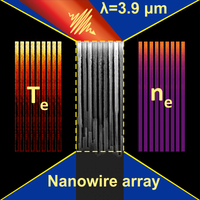
Relativistic Interaction of Long-Wavelength Ultrashort Laser Pulses with Nanowires

Zhanna Samsonova, Sebastian Höfer, Vural Kaymak, Skirmantas Ališauskas, Valentina Shumakova, Audrius Pugžlys, Andrius Baltuška, Thomas Siefke, Stefanie Kroker, Alexander Pukhov, Olga Rosmej, Ingo Uschmann, Christian Spielmann, and Daniil Kartashov

Phys. Rev. X 9, 021029 (2019) - Published 14 May, 2019

A novel regime of laser-matter interaction that combines ultrashort mid-infrared laser pulses and silicon nanowires represents a promising way for producing extreme states of matter in the laboratory.

Controlling Spin-Orbit Interactions in Silicon Quantum Dots Using Magnetic Field Direction

Tuomo Tanttu, Bas Hensen, Kok Wai Chan, Chih Hwan Yang, Wister Wei Huang, Michael Fogarty, Fay Hudson, Kohei Itoh, Dimitrie Culcer, Arne Laucht, Andrea Morello, and Andrew Dzurak

Phys. Rev. X 9, 021028 (2019) - Published 10 May, 2019

Experiments show how to control the spin-orbit interaction in a double quantum-dot structure, providing a possible way to produce quantum bits with greater uniformity and improved performance.

Prethermalization and Thermalization in Isolated Quantum Systems

Krishnanand Mallayya, Marcos Rigol, and Wojciech De Roeck

Phys. Rev. X 9, 021027 (2019) - Published 9 May, 2019

A new theoretical framework provides a simple yet general mechanism for understanding prethermalization, a common but poorly understood two-step process through which some quantum gases reach thermal equilibrium.

Attractive Dipolar Coupling between Stacked Exciton Fluids

Colin Hubert, Yifat Baruchi, Yotam Mazuz-Harpaz, Kobi Cohen, Klaus Biermann, Mikhail Lemeshko, Ken West, Loren Pfeiffer, Ronen Rapaport, and Paulo Santos

Phys. Rev. X 9, 021026 (2019) - Published 8 May, 2019

Experiments reveal attractive dipolar interactions between two exciton fluids for the first time, establishing the anisotropic nature of the dipolar interaction between excitons—a step toward engineering and observing more complex and exotic collective quantum effects.

Quantum FFLO State in Clean Layered Superconductors

Kok Wee Song and Alexei E. Koshelev

Phys. Rev. X 9, 021025 (2019) - Published 7 May, 2019

An updated theoretical framework of a superconducting phase known as the Fulde-Ferrell-Larkin-Ovchinnikov state adds quantum-mechanical considerations that flesh out ideas about how superconductors behave in strong magnetic fields.

Sign In to Your Journals Account

Filter

Recent Issues

Vol. 16, Iss. 4
October - December 2026
Vol. 16, Iss. 3
July - September 2026
Vol. 16, Iss. 2
April - June 2026
Vol. 16, Iss. 1
January - March 2026
Category
Article Type

Filter

Article Lookup

Enter a citation