Recent Articles

Topological Superconductivity in an Extended s-Wave Superconductor and Its Implication to Iron-Based Superconductors

Shengshan Qin, Chen Fang, Fu-Chun Zhang, and Jiangping Hu

Phys. Rev. X 12, 011030 (2022) - Published 15 February, 2022

Topological properties of iron chalcogenides provide a way to distinguish the ways in which their electrons form superconducting pairs, offering a possible path to classifying topological superconductors.

Observation of a Novel Lattice Instability in Ultrafast Photoexcited SnSe

Yijing Huang, Shan Yang, Samuel Teitelbaum, Gilberto De la Peña, Takahiro Sato, Matthieu Chollet, Diling Zhu, Jennifer L. Niedziela, Dipanshu Bansal, Andrew F. May, Aaron M. Lindenberg, Olivier Delaire, David A. Reis, and Mariano Trigo

Phys. Rev. X 12, 011029 (2022) - Published 14 February, 2022

X-ray diffraction reveals a novel high-symmetry arrangement of atoms in tin selenide upon excitation with an ultrafast optical laser, a useful insight for tuning material properties with light.

Symmetry, Thermodynamics, and Topology in Active Matter

Mark J. Bowick, Nikta Fakhri, M. Cristina Marchetti, and Sriram Ramaswamy

Phys. Rev. X 12, 010501 (2022) - Published 11 February, 2022

The inaugural PRX Perspective offers an informative, inspiring, and forward-looking view on the vibrant field of active matter.

Announcement: PRX Launches Perspectives

Phys. Rev. X 12, 010001 (2022) - Published 11 February, 2022

Giant and Tunneling Magnetoresistance in Unconventional Collinear Antiferromagnets with Nonrelativistic Spin-Momentum Coupling

Libor Šmejkal, Anna Birk Hellenes, Rafael González-Hernández, Jairo Sinova, and Tomas Jungwirth

Phys. Rev. X 12, 011028 (2022) - Published 10 February, 2022

Unconventional antiferromagnets exhibit spin-dependent ohmic and tunneling transport effects that are crucial for information readout in spintronics devices and that, so far, were reserved exclusively to ferromagnets.

Anyonic Defect Braiding and Spontaneous Chiral Symmetry Breaking in Dihedral Liquid Crystals

Alexander Mietke and Jörn Dunkel

Phys. Rev. X 12, 011027 (2022) - Published 9 February, 2022

A mathematical analysis of dihedral liquid crystals shows that certain defects have braiding properties analogous to those of anyons, thus offering a roadmap for creating anyonic behavior in soft-matter systems.

Ultrasensitive Calorimetric Detection of Single Photons from Qubit Decay

Jukka P. Pekola and Bayan Karimi

Phys. Rev. X 12, 011026 (2022) - Published 8 February, 2022

A mathematical model of a qubit coupled to a heat bath of oscillators provides insight into how to improve the detection of low-energy photons from quantum circuits.

Direct Observation of the Electrically Triggered Insulator-Metal Transition in V3O5 Far below the Transition Temperature

Coline Adda, Min-Han Lee, Yoav Kalcheim, Pavel Salev, Rodolfo Rocco, Nicolas M. Vargas, Nareg Ghazikhanian, Chung-Pang Li, Grant Albright, Marcelo Rozenberg, and Ivan K. Schuller

Phys. Rev. X 12, 011025 (2022) - Published 7 February, 2022

Experiments reveal a strong connection between room-temperature resistive switching and a temperature-dependent insulator-to-metal transition in V3O5, making it a new material for potential neuromorphic computing applications.

Leggett Modes Accompanying Crystallographic Phase Transitions

Quintin N. Meier, Daniel Hickox-Young, Geneva Laurita, Nicola A. Spaldin, James M. Rondinelli, and Michael R. Norman

Phys. Rev. X 12, 011024 (2022) - Published 4 February, 2022

Below the critical temperature of crystallographic phase transitions, new collective vibrations—such as a structural analog to Leggett’s mode in multiband superconductors—emerge as remnants of the broken symmetry.

Possible Quadrupole Density Wave in the Superconducting Kondo Lattice CeRh2As2

D. Hafner, P. Khanenko, E.-O. Eljaouhari, R. Küchler, J. Banda, N. Bannor, T. Lühmann, J. F. Landaeta, S. Mishra, I. Sheikin, E. Hassinger, S. Khim, C. Geibel, G. Zwicknagl, and M. Brando

Phys. Rev. X 12, 011023 (2022) - Published 3 February, 2022

Experiments show that the unconventional superconductor CeRh2As2 may host a “quadrupole density wave”—a theorized complex ordering pattern among free electrons that has not yet been observed.

Neutron Spectroscopy Evidence on the Dual Nature of Magnetic Excitations in a van der Waals Metallic Ferromagnet Fe2.72GeTe2

Song Bao, Wei Wang, Yanyan Shangguan, Zhengwei Cai, Zhao-Yang Dong, Zhentao Huang, Wenda Si, Zhen Ma, Ryoichi Kajimoto, Kazuhiko Ikeuchi, Shin-ichiro Yano, Shun-Li Yu, Xiangang Wan, Jian-Xin Li, and Jinsheng Wen

Phys. Rev. X 12, 011022 (2022) - Published 2 February, 2022

Neutron-scattering experiments reveal two types of spin excitations and an unusual temperature effect in a transition-metal ferromagnet—direct evidence for the coexistence of and interplay between localized and itinerant electrons.

Symmetry-Based Approach to Superconducting Nodes: Unification of Compatibility Conditions and Gapless Point Classifications

Seishiro Ono and Ken Shiozaki

Phys. Rev. X 12, 011021 (2022) - Published 1 February, 2022

A new theoretical framework for classifying superconducting nodes—key observational markers of how the constituent electrons pair up—can offer deeper understanding into unconventional superconductivity.

Coherent Feedback Cooling of a Nanomechanical Membrane with Atomic Spins

Gian-Luca Schmid, Chun Tat Ngai, Maryse Ernzer, Manel Bosch Aguilera, Thomas M. Karg, and Philipp Treutlein

Phys. Rev. X 12, 011020 (2022) - Published 31 January, 2022

A cloud of cold atoms can coherently control the vibrations of a millimeter-scale membrane.

Polarization-Modulated Angle-Resolved Photoemission Spectroscopy: Toward Circular Dichroism without Circular Photons and Bloch Wave-function Reconstruction

Michael Schüler, Tommaso Pincelli, Shuo Dong, Thomas P. Devereaux, Martin Wolf, Laurenz Rettig, Ralph Ernstorfer, and Samuel Beaulieu

Phys. Rev. X 12, 011019 (2022) - Published 28 January, 2022

Complete characterization of certain quantum materials requires knowledge of the complex wave functions that describe electrons in the solid. A new measurement methodology provides deep insights into that information.

Probing Many-Body Quantum Chaos with Quantum Simulators

Lata Kh Joshi, Andreas Elben, Amit Vikram, Benoît Vermersch, Victor Galitski, and Peter Zoller

Phys. Rev. X 12, 011018 (2022) - Published 27 January, 2022

A class of observables known as partial spectral form factors can efficiently measure signatures of chaos in existing quantum simulators, opening the door to future insights into chaos and thermalization.

CaCu3Ru4O12: A High-Kondo-Temperature Transition-Metal Oxide

D. Takegami et al.

Phys. Rev. X 12, 011017 (2022) - Published 26 January, 2022

Evidence of the Kondo effect—a hallmark of interacting electrons—in a transition-metal oxide provides new insight into the rich electronic behavior of these materials and a new platform for studying correlated physics.

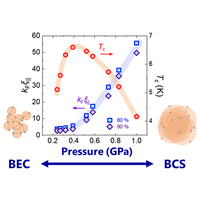
Mott-Driven BEC-BCS Crossover in a Doped Spin Liquid Candidate κ−(BEDT−TTF)4Hg2.89Br8

Y. Suzuki, K. Wakamatsu, J. Ibuka, H. Oike, T. Fujii, K. Miyagawa, H. Taniguchi, and K. Kanoda

Phys. Rev. X 12, 011016 (2022) - Published 25 January, 2022

A doped quantum spin-liquid candidate transitions from one regime of superconductor electron pairing to another as pressure increases, thus widening the potential hosts of unconventional superconductivity.

Reservoir-Engineered Spin Squeezing: Macroscopic Even-Odd Effects and Hybrid-Systems Implementations

Peter Groszkowski, Martin Koppenhöfer, Hoi-Kwan Lau, and A. A. Clerk

Phys. Rev. X 12, 011015 (2022) - Published 24 January, 2022

A new way to stabilize highly entangled spin-squeezed states for precision sensing is simpler to implement and exhibits an unusual sensitivity to the number of spins as well as emergent slow timescales.

Specific Heat of the Kagome Antiferromagnet Herbertsmithite in High Magnetic Fields

Quentin Barthélemy, Albin Demuer, Christophe Marcenat, Thierry Klein, Bernard Bernu, Laura Messio, Matias Velázquez, Edwin Kermarrec, Fabrice Bert, and Philippe Mendels

Phys. Rev. X 12, 011014 (2022) - Published 21 January, 2022

New measurements of herbertsmithite isolate the role of spins on the vertices of its triangular kagome atomic lattice to its quantum spin-liquid ground state.

Ultrafast Renormalization of the On-Site Coulomb Repulsion in a Cuprate Superconductor

Denitsa R. Baykusheva, Hoyoung Jang, Ali A. Husain, Sangjun Lee, Sophia F. R. TenHuisen, Preston Zhou, Sunwook Park, Hoon Kim, Jin-Kwang Kim, Hyeong-Do Kim, Minseok Kim, Sang-Youn Park, Peter Abbamonte, B. J. Kim, G. D. Gu, Yao Wang, and Matteo Mitrano

Phys. Rev. X 12, 011013 (2022) - Published 20 January, 2022

Ultrafast pulses from an infrared laser reduce the effective repulsion between electrons in a high-temperature superconductor, showcasing a new way to manipulate electronic interactions using light.

Sign In to Your Journals Account

Filter

Recent Issues

Vol. 16, Iss. 4
October - December 2026
Vol. 16, Iss. 3
July - September 2026
Vol. 16, Iss. 2
April - June 2026
Vol. 16, Iss. 1
January - March 2026
Category
Article Type

Filter

Article Lookup

Enter a citation