Recent Articles

Coherent Spin-Spin Coupling Mediated by Virtual Microwave Photons

Patrick Harvey-Collard, Jurgen Dijkema, Guoji Zheng, Amir Sammak, Giordano Scappucci, and Lieven M. K. Vandersypen

Phys. Rev. X 12, 021026 (2022) - Published 2 May, 2022

Coupling between remote spins on a chip via virtual photons exchanged through a superconducting resonator could lead to gate operations between distant spin qubits.

Evidence of a Phonon Hall Effect in the Kitaev Spin Liquid Candidate α−RuCl3

É. Lefrançois, G. Grissonnanche, J. Baglo, P. Lampen-Kelley, J.-Q. Yan, C. Balz, D. Mandrus, S. E. Nagler, S. Kim, Young-June Kim, N. Doiron-Leyraud, and Louis Taillefer

Phys. Rev. X 12, 021025 (2022) - Published 29 April, 2022

Thermal Hall conductivity measurements attribute heat conduction in one spin liquid candidate to phonons scattering off spins and find no evidence for predicted Majorana fermions.

Nonlinear Elongation Flows in Associating Polymer Melts: From Homogeneous to Heterogeneous Flow

Supun S. Mohottalalage, Manjula Senanayake, Joel T. Clemmer, Dvora Perahia, Gary S. Grest, and Thomas O’Connor

Phys. Rev. X 12, 021024 (2022) - Published 28 April, 2022

Numerical simulations explore how material properties of polymers are altered as clusters of strongly interacting groups along the chain break apart and reform under flow, an insight that can help control complex fluids.

Adjoint Kirchhoff’s Law and General Symmetry Implications for All Thermal Emitters

Cheng Guo, Bo Zhao, and Shanhui Fan

Phys. Rev. X 12, 021023 (2022) - Published 28 April, 2022

By extending Kirchhoff’s law of thermal radiation to nonreciprocal objects, a new framework describes the relationships between absorptivity and emissivity for an arbitrary thermal emitter.

Exponential Clustering of Bipartite Quantum Entanglement at Arbitrary Temperatures

Tomotaka Kuwahara and Keiji Saito

Phys. Rev. X 12, 021022 (2022) - Published 27 April, 2022

New theorems provide a test of what types of long-range quantum entanglement can survive at nonzero temperatures, revealing a fundamental aspect of macroscopic quantum phenomena.

Efficient Classical Simulation of Random Shallow 2D Quantum Circuits

John C. Napp, Rolando L. La Placa, Alexander M. Dalzell, Fernando G. S. L. Brandão, and Aram W. Harrow

Phys. Rev. X 12, 021021 (2022) - Published 27 April, 2022

Programming a quantum computer with a random sequence of gates was thought to achieve the largest speedups over classical computers. A new analysis shows that this is not true.

Quantum Critical Magnetic Excitations in Spin-1/2 and Spin-1 Chain Systems

Y. Xu, L. S. Wang, Y. Y. Huang, J. M. Ni, C. C. Zhao, Y. F. Dai, B. Y. Pan, X. C. Hong, P. Chauhan, S. M. Koohpayeh, N. P. Armitage, and S. Y. Li

Phys. Rev. X 12, 021020 (2022) - Published 26 April, 2022

The thermal conductivity of CoNb2O6 is suppressed around its quantum critical point whereas the specific heat is enhanced, highlighting the role of frustration in determining quantum critical magnetic excitations.

Dimensional Crossover in the Superfluid-Supersolid Quantum Phase Transition

Giulio Biagioni, Nicolò Antolini, Aitor Alaña, Michele Modugno, Andrea Fioretti, Carlo Gabbanini, Luca Tanzi, and Giovanni Modugno

Phys. Rev. X 12, 021019 (2022) - Published 26 April, 2022

The quantum phase transition from superfluid to supersolid resembles ordinary crystallization transitions but with important distinctions that reflect peculiarities of supersolids.

Correlated Insulators, Semimetals, and Superconductivity in Twisted Trilayer Graphene

Maine Christos, Subir Sachdev, and Mathias S. Scheurer

Phys. Rev. X 12, 021018 (2022) - Published 25 April, 2022

A numerical and analytical study of the phase diagram of mirror-symmetric twisted trilayer graphene provides a guide for interpreting experiments on the complex correlated physics observed in this system.

Mechanical Properties of Acoustically Levitated Granular Rafts

Melody X. Lim, Bryan VanSaders, Anton Souslov, and Heinrich M. Jaeger

Phys. Rev. X 12, 021017 (2022) - Published 22 April, 2022

A disk of plastic particles levitated by sound waves could provide a model for other examples of particle clumps in the physical world.

Spin-Group Symmetry in Magnetic Materials with Negligible Spin-Orbit Coupling

Pengfei Liu, Jiayu Li, Jingzhi Han, Xiangang Wan, and Qihang Liu

Phys. Rev. X 12, 021016 (2022) - Published 21 April, 2022

A theoretical analysis of nonrelativistic magnetic materials applies a symmetry description beyond magnetic groups to explore material properties and reveal new topological phases.

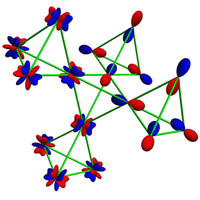
Case for a U(1)π Quantum Spin Liquid Ground State in the Dipole-Octupole Pyrochlore Ce2Zr2O7

E. M. Smith, O. Benton, D. R. Yahne, B. Placke, R. Schäfer, J. Gaudet, J. Dudemaine, A. Fitterman, J. Beare, A. R. Wildes, S. Bhattacharya, T. DeLazzer, C. R. C. Buhariwalla, N. P. Butch, R. Movshovich, J. D. Garrett, C. A. Marjerrison, J. P. Clancy, E. Kermarrec, G. M. Luke, A. D. Bianchi, K. A. Ross, and B. D. Gaulin

Phys. Rev. X 12, 021015 (2022) - Published 20 April, 2022

By measuring how Ce3+ spins interact in Ce2Zr2O7, new experimental work lays out a detailed case for a novel quantum spin liquid phase at low temperature in this material.

Formation of Spontaneous Density-Wave Patterns in dc Driven Lattices

H. P. Zahn, V. P. Singh, M. N. Kosch, L. Asteria, L. Freystatzky, K. Sengstock, L. Mathey, and C. Weitenberg

Phys. Rev. X 12, 021014 (2022) - Published 19 April, 2022

Strongly tilting a Bose-Einstein condensate in a triangular lattice of ultracold atoms induces the formation of pronounced density waves, which provide a prime example of spontaneous symmetry breaking.

Characterizing Symmetry-Protected Thermal Equilibrium by Work Extraction

Yosuke Mitsuhashi, Kazuya Kaneko, and Takahiro Sagawa

Phys. Rev. X 12, 021013 (2022) - Published 18 April, 2022

An analysis of the thermodynamics of quantum systems establishes a generalized notion of thermal equilibrium, applicable to ensembles that obey certain symmetries.

Quantum Error Correction Thresholds for the Universal Fibonacci Turaev-Viro Code

Alexis Schotte, Guanyu Zhu, Lander Burgelman, and Frank Verstraete

Phys. Rev. X 12, 021012 (2022) - Published 15 April, 2022

Quantum error correcting codes are key to guarding against errors in quantum computation. A new analysis provides the first performance estimates for one type of these codes.

Roller Coaster in a Flatland: Magnetoresistivity in Eu-Intercalated Graphite

A. L. Chernyshev and O. A. Starykh

Phys. Rev. X 12, 021010 (2022) - Published 14 April, 2022

The resistivity of the graphite compound EuC6 has an unusual highly nonmonotonic dependence on magnetic field. A theoretical study explains this behavior as arising from electrons scattering on magnons.

Hydrodynamic Theory of the Connected Spectral form Factor

Michael Winer and Brian Swingle

Phys. Rev. X 12, 021009 (2022) - Published 13 April, 2022

The spectral form factor is powerful tool for characterizing spectral statistics that relate to big picture properties of a system. A new analysis provides new tools for calculating this quantity.

Very-High-Energy Collective States of Partons in Fractional Quantum Hall Liquids

Ajit C. Balram, Zhao Liu, Andrey Gromov, and Zlatko Papić

Phys. Rev. X 12, 021008 (2022) - Published 12 April, 2022

At very high energies, an exotic state of matter known as a fractional quantum Hall liquid may produce a new type of quasiparticle called a parton, which behaves like a fraction of an electron.

Incoherent Branched Flow of Light

Anatoly Patsyk, Yonatan Sharabi, Uri Sivan, and Mordechai Segev

Phys. Rev. X 12, 021007 (2022) - Published 11 April, 2022

To date, only coherent waves have been used to study branched flow in experiments, where waves follow branching paths in a disordered medium. The first experimental study with incoherent waves shows qualitative differences.

Emission of Photon Multiplets by a dc-Biased Superconducting Circuit

G. C. Ménard, A. Peugeot, C. Padurariu, C. Rolland, B. Kubala, Y. Mukharsky, Z. Iftikhar, C. Altimiras, P. Roche, H. le Sueur, P. Joyez, D. Vion, D. Esteve, J. Ankerhold, and F. Portier

Phys. Rev. X 12, 021006 (2022) - Published 8 April, 2022

An electrical circuit tailored to exhibit a strong charge-light coupling demonstrates a greater efficiency of emitting several photons at once, thus providing a versatile testbed for many aspects of quantum physics.

Sign In to Your Journals Account

Filter

Recent Issues

Vol. 16, Iss. 4
October - December 2026
Vol. 16, Iss. 3
July - September 2026
Vol. 16, Iss. 2
April - June 2026
Vol. 16, Iss. 1
January - March 2026
Category
Article Type

Filter

Article Lookup

Enter a citation