Recent Articles

Deterministic Enhancement of Coherent Photon Generation from a Nitrogen-Vacancy Center in Ultrapure Diamond

Daniel Riedel, Immo Söllner, Brendan J. Shields, Sebastian Starosielec, Patrick Appel, Elke Neu, Patrick Maletinsky, and Richard J. Warburton

Phys. Rev. X 7, 031040 (2017) - Published 7 September, 2017

Nitrogen-vacancy centers—a type of atom-sized defect in diamonds—have potential for use as quantum bits in quantum information technologies. However, low rates of entanglement between the defect spin and the photons they produce hamper the mediation of long-distance connections. A new experiment shows a way around this limitation by employing a tunable, miniaturized Fabry-Pérot microcavity.

Topological Sound and Flocking on Curved Surfaces

Suraj Shankar, Mark J. Bowick, and M. Cristina Marchetti

Phys. Rev. X 7, 031039 (2017) - Published 7 September, 2017

A flocking model that describes birds and cells exhibits topological features when the moving entities are confined to a curved surface.

Machine Learning Phases of Strongly Correlated Fermions

Kelvin Ch’ng, Juan Carrasquilla, Roger G. Melko, and Ehsan Khatami

Phys. Rev. X 7, 031038 (2017) - Published 30 August, 2017

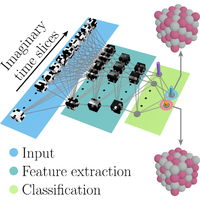
Machine learning has strong potential as a tool for understanding how to classify phases in condensed matter physics. A new investigation shows that an artificial neural network can be trained to identify changes in the collective magnetic properties of electrons on a lattice and predict trends in the transition when some of the electrons are removed.

Fluxonium-Based Artificial Molecule with a Tunable Magnetic Moment

A. Kou, W. C. Smith, U. Vool, R. T. Brierley, H. Meier, L. Frunzio, S. M. Girvin, L. I. Glazman, and M. H. Devoret

Phys. Rev. X 7, 031037 (2017) - Published 29 August, 2017

Artificial molecules built from superconducting circuits can potentially be used as probes of external fields that cannot be studied with devices built from naturally occurring atoms. A new study demonstrates how the magnetic moment of a molecule built from two artificial fluxonium atoms changes in response to an external magnetic field.

Extreme-Ultraviolet Vortices from a Free-Electron Laser

Primož Rebernik Ribič, Benedikt Rösner, David Gauthier, Enrico Allaria, Florian Döring, Laura Foglia, Luca Giannessi, Nicola Mahne, Michele Manfredda, Claudio Masciovecchio, Riccardo Mincigrucci, Najmeh Mirian, Emiliano Principi, Eléonore Roussel, Alberto Simoncig, Simone Spampinati, Christian David, and Giovanni De Ninno

Phys. Rev. X 7, 031036 (2017) - Published 28 August, 2017

Researchers have used a free-electron laser to produce vortex radiation at extreme-ultraviolet wavelengths.

On the Mass of Atoms in Molecules: Beyond the Born-Oppenheimer Approximation

Arne Scherrer, Federica Agostini, Daniel Sebastiani, E. K. U. Gross, and Rodolphe Vuilleumier

Phys. Rev. X 7, 031035 (2017) - Published 25 August, 2017

The Born-Oppenheimer approximation, used to predict atomic motions in quantum mechanics, leads to well-known inconsistencies caused by neglecting the effect of electron motion induced by nuclear evolution. A new theoretical paradigm resolves this problem, paving the way for high-precision predictions of vibrational frequencies of complex molecules.

Aperiodically Driven Integrable Systems and Their Emergent Steady States

Sourav Nandy, Arnab Sen, and Diptiman Sen

Phys. Rev. X 7, 031034 (2017) - Published 22 August, 2017

Driving of many-body quantum systems leads to steady-state behavior not seen when the system is at equilibrium. While the outcome of a periodic drive is well explored, the same can’t be said for aperiodic drives. A new analysis shows that aperiodic drives can lead to novel steady-state behavior not seen in periodically driven systems.

Polariton Pattern Formation and Photon Statistics of the Associated Emission

C. E. Whittaker, B. Dzurnak, O. A. Egorov, G. Buonaiuto, P. M. Walker, E. Cancellieri, D. M. Whittaker, E. Clarke, S. S. Gavrilov, M. S. Skolnick, and D. N. Krizhanovskii

Phys. Rev. X 7, 031033 (2017) - Published 21 August, 2017

New experiments reveal a diverse family of polygon patterns forming spontaneously in a fluid of polaritons—quasiparticles comprised of photons coupled to electric dipoles. The observations could lead to new insights in pattern formation in nonlinear optical systems as well as in quantum statistics.

Optical Interface States Protected by Synthetic Weyl Points

Qiang Wang, Meng Xiao, Hui Liu, Shining Zhu, and C. T. Chan

Phys. Rev. X 7, 031032 (2017) - Published 16 August, 2017

Weyl points, characterized as nodal points in the band structure of solids, can give rise to novel physical properties but are difficult to investigate experimentally. A new analysis expands the scope of Weyl points using synthetic dimensions, paving the way for greater flexibility in future investigations.

Coexistence of Multiple Nonlinear States in a Tristable Passive Kerr Resonator

Miles Anderson, Yadong Wang, François Leo, Stéphane Coen, Miro Erkintalo, and Stuart G. Murdoch

Phys. Rev. X 7, 031031 (2017) - Published 15 August, 2017

Pattern formation in optical devices known as passive Kerr resonators has been studied for decades, but recent theoretical work has suggested the existence of entirely new dynamics when operated in the highly nonlinear regime. New experiments confirm these predictions, which could lead to innovative new sources of laser-like light and provide new insight into nonlinear dynamics and pattern formation.

High-Resolution Two-Dimensional Optical Spectroscopy of Electron Spins

M. Salewski, S. V. Poltavtsev, I. A. Yugova, G. Karczewski, M. Wiater, T. Wojtowicz, D. R. Yakovlev, I. A. Akimov, T. Meier, and M. Bayer

Phys. Rev. X 7, 031030 (2017) - Published 14 August, 2017

Multidimensional coherent optical spectroscopy is currently one of the most powerful tools for investigating complex quantum-mechanical systems, but resolving energy splitting on megahertz scales remains a challenge. A new investigation shows how two-dimensional Fourier transform spectroscopy can be adapted to evaluate spin splitting of ground-state electrons.

Particle-Hole Symmetry in the Fermion-Chern-Simons and Dirac Descriptions of a Half-Filled Landau Level

Chong Wang, Nigel R. Cooper, Bertrand I. Halperin, and Ady Stern

Phys. Rev. X 7, 031029 (2017) - Published 14 August, 2017

Multiple descriptions of the half-filled Landau level, an exotic phase of matter seen in two-dimensional electron gases, have led to incompatible pictures that are widely believed to represent two distinct phases of matter. A new analysis suggests that this is not the case and that these descriptions are functionally equivalent.

Nonequilibrium Phase Transition in an Atomistic Glassformer: The Connection to Thermodynamics

Francesco Turci, C. Patrick Royall, and Thomas Speck

Phys. Rev. X 7, 031028 (2017) - Published 11 August, 2017

Computer simulations are used to model the phase change that occurs as glasses transition from a liquid phase to a so-called “ideal glass phase.”

Equilibration Time Scales of Physically Relevant Observables

Luis Pedro García-Pintos, Noah Linden, Artur S. L. Malabarba, Anthony J. Short, and Andreas Winter

Phys. Rev. X 7, 031027 (2017) - Published 10 August, 2017

The tendency for a macroscopic system to reach equilibrium could depend on underlying quantum behaviors, but showing that this can happen in a reasonable time is difficult. A new analysis demonstrates that for certain classes of physically relevant observables, conditions exist where this is possible.

Unitary Dynamics of Strongly Interacting Bose Gases with the Time-Dependent Variational Monte Carlo Method in Continuous Space

Giuseppe Carleo, Lorenzo Cevolani, Laurent Sanchez-Palencia, and Markus Holzmann

Phys. Rev. X 7, 031026 (2017) - Published 8 August, 2017

Predicting the motions of quantum particles in large ensembles is mathematically complex and computationally expensive. A new theoretical method shows promise for predicting the dynamics of a gas of quantum particles by accurately describing the dynamics of one-dimensional strongly interacting bosons.

Erratum: Ultralow-Noise SiN Trampoline Resonators for Sensing and Optomechanics [Phys. Rev. X 6, 021001 (2016)]

Christoph Reinhardt, Tina Müller, Alexandre Bourassa, and Jack C. Sankey

Phys. Rev. X 7, 039901 (2017) - Published 7 August, 2017

Measuring Entropy and Short-Range Correlations in the Two-Dimensional Hubbard Model

E. Cocchi, L. A. Miller, J. H. Drewes, C. F. Chan, D. Pertot, F. Brennecke, and M. Köhl

Phys. Rev. X 7, 031025 (2017) - Published 4 August, 2017

The physics of strongly correlated matter, where interactions among atoms and particles can lead to exotic macroscopic properties, is difficult to understand theoretically. A realization of the leading theoretical model provides insight into these correlations from thermodynamic measurements.

Exponential Improvement in Photon Storage Fidelities Using Subradiance and “Selective Radiance” in Atomic Arrays

A. Asenjo-Garcia, M. Moreno-Cardoner, A. Albrecht, H. J. Kimble, and D. E. Chang

Phys. Rev. X 7, 031024 (2017) - Published 3 August, 2017

Light interacting with an ensemble of atoms can be used in quantum information processing, but the efficiency of performing any given task is limited by spontaneous emission of photons into channels that are not usable. A new analysis shows how interference among light emitted by nearby atoms can dramatically improve this efficiency and provide a much more powerful platform.

Observing Topological Invariants Using Quantum Walks in Superconducting Circuits

E. Flurin, V. V. Ramasesh, S. Hacohen-Gourgy, L. S. Martin, N. Y. Yao, and I. Siddiqi

Phys. Rev. X 7, 031023 (2017) - Published 3 August, 2017

Topological invariants, properties of a system that remain unchanged by small deformations, are key to modern understanding of phases of matter but have yet to be directly detected by experiment. A new quantum simulation shows how quantum walks can be used to measure topological invariants for the first time.

Autonomous Quantum Clocks: Does Thermodynamics Limit Our Ability to Measure Time?

Paul Erker, Mark T. Mitchison, Ralph Silva, Mischa P. Woods, Nicolas Brunner, and Marcus Huber

Phys. Rev. X 7, 031022 (2017) - Published 2 August, 2017

A simple model of an autonomous quantum clock yields a quantitative connection between the clock’s thermodynamic cost and its accuracy and resolution.

Sign In to Your Journals Account

Filter

Recent Issues

Vol. 16, Iss. 4
October - December 2026
Vol. 16, Iss. 3
July - September 2026
Vol. 16, Iss. 2
April - June 2026
Vol. 16, Iss. 1
January - March 2026
Category
Article Type

Filter

Article Lookup

Enter a citation