

- Open Access
Critical Transition between Intensive and Extensive Active Droplets
Phys. Rev. X 15, 041027 – Published 12 November, 2025
DOI: https://doi.org/10.1103/4nnd-tdky
Abstract
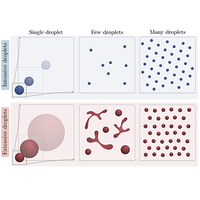
Most emulsions ripen with an average droplet size increasing in time. In chemically active emulsions, coarsening can be absent, leading to a nonequilibrium steady state with monodisperse droplet sizes. By considering a minimal model for phase separation and chemical reactions maintained away from equilibrium, we show that there is a supercritical transition controlled by the conserved quantity between two classes of chemically active droplets: intensive and extensive active droplets. While intensive droplets reach a stationary size mainly controlled by the interplay between reactions and diffusion, the size of an extensive active droplet scales with the system size. For intensive droplets, growth arrests at a finite size. Thus, they can be far apart from each other and evolve independently from other droplets in an active emulsion. The growth of extensive droplets, however, arrests due to the presence of other droplets in the emulsion. In both cases, monodisperse emulsions can emerge. We show how the supercritical transition between intensive and extensive active droplets affects shape instabilities, including the division of active droplets, paving the way for the observation of successive division events in chemically active emulsions.
Physics Subject Headings (PhySH)
Popular Summary
Inside living cells, tiny liquidlike droplets made of proteins and other biomolecules can appear, grow, and disappear as a result of ongoing chemical reactions. These “active droplets” are believed to help organize the cell and support essential biological functions, but the physical rules that determine how they form and behave under chemical activity have remained unclear. In this study, we use analytical calculations to uncover two fundamentally different ways such droplets might exist and evolve.
We find that active droplets can follow one of two regimes. In the first, called the intensive regime, each droplet stabilizes at a fixed size that depends only on the balance between chemical reactions and molecular diffusion—not on the overall size of the system. In the second, called the extensive regime, droplets continue to grow indefinitely when the system is effectively infinite, behaving much like ordinary, passive emulsions. Whether a system falls into one regime or the other depends on how the underlying chemical reactions conserve material. Numerical simulations with many droplets confirm these predictions and show how the two regimes affect droplet interactions and division behavior in active emulsions.
These results reveal simple physical principles behind how living cells might control the size and number of biomolecular droplets. Beyond biology, our framework suggests strategies for designing synthetic emulsions whose properties can be tuned through chemical activity, potentially advancing applications in materials science and bioengineering.
Article Text
Supplemental Material
References (77)
- L. A. Williamson and P. B. Blakie, Universal coarsening dynamics of a quenched ferromagnetic spin-1 condensate, Phys. Rev. Lett. 116, 025301 (2016).
- Jérôme Bibette, F. Leal Calderon, and P. Poulin, Emulsions: Basic principles, Rep. Prog. Phys. 62, 969 (1999).
- Tresa M. Pollock and Ali S. Argon, Directional coarsening in nickel-base single crystals with high volume fractions of coherent precipitates, Acta Metall. Mater. 42, 1859 (1994).
- Carl Wagner, Theorie der alterung von niederschlägen durch umlösen (Ostwald-reifung), Z. Elektrochem. Ber. Bunsengesellschaft Phys. Chem. 65, 581 (1961).
- Ilya M. Lifshitz and Vitaly V. Slyozov, The kinetics of precipitation from supersaturated solid solutions, J. Phys. Chem. Solids 19, 35 (1961).
- Peter W. Voorhees, The theory of Ostwald ripening, J. Stat. Phys. 38, 231 (1985).
- O. Krichevsky and J. Stavans, Correlated Ostwald ripening in two dimensions, Phys. Rev. Lett. 70, 1473 (1993).
- M. C. Marchetti, J. F. Joanny, S. Ramaswamy, T. B. Liverpool, J. Prost, Madan Rao, and R. Aditi Simha, Hydrodynamics of soft active matter, Rev. Mod. Phys. 85, 1143 (2013).
- Amin Doostmohammadi, Jordi Ignés-Mullol, Julia M. Yeomans, and Francesc Sagués, Active nematics, Nat. Commun. 9, 3246 (2018).
- Suraj Shankar, Anton Souslov, Mark J. Bowick, M. Cristina Marchetti, and Vincenzo Vitelli, Topological active matter, Nat. Rev. Phys. 4, 380 (2022).
- Christoph A. Weber, David Zwicker, Frank Jülicher, and Chiu Fan Lee, Physics of active emulsions, Rep. Prog. Phys. 82, 064601 (2019).
- S. C. Glotzer, D. Stauffer, and N. Jan, Monte Carlo simulations of phase separation in chemically reactive binary mixtures, Phys. Rev. Lett. 72, 4109 (1994).
- D. Zwicker, A. A. Hyman, and F. Jülicher, Suppression of Ostwald ripening in active emulsions, Phys. Rev. E 92, 012317 (2015).
- Elsen Tjhung, Cesare Nardini, and Michael E. Cates, Cluster phases and bubbly phase separation in active fluids: Reversal of the Ostwald process, Phys. Rev. X 8, 031080 (2018).
- F. Brauns, H. Weyer, J. Halatek, J. Yoon, and E. Frey, Wavelength selection by interrupted coarsening in reaction-diffusion systems, Phys. Rev. Lett. 126, 104101 (2021).
- H. Weyer, F. Brauns, and E. Frey, Coarsening and wavelength selection far from equilibrium: A unifying framework based on singular perturbation theory, Phys. Rev. E 108, 064202 (2023).
- M. E. Cates and C. Nardini, Active phase separation: New phenomenology from non-equilibrium physics, Rep. Prog. Phys. 88, 056601 (2025).
- James S. Langer, Instabilities and pattern formation in crystal growth, Rev. Mod. Phys. 52, 1 (1980).
- Mark C. Cross and Pierre C. Hohenberg, Pattern formation outside of equilibrium, Rev. Mod. Phys. 65, 851 (1993).
- Erwin Frey, Jacob Halatek, Simon Kretschmer, and Petra Schwille, Protein pattern formation, Physics of biological membranes (Springer, 2018), pp. 229–260, 10.1007/978-3-030-00630-3.
- Raphael Wittkowski, Adriano Tiribocchi, Joakim Stenhammar, Rosalind J. Allen, Davide Marenduzzo, and Michael E. Cates, Scalar 4 field theory for active-particle phase separation, Nat. Commun. 5, 4351 (2014).
- Michael E. Cates, Active field theories, Active Matter and Nonequilibrium Statistical Physics: Lecture Notes of the Les Houches Summer School 2018 (Oxford University Press, 2022), pp. 180–216, https://academic.oup.com/book/45056/chapter-abstract/385614800?redirectedFrom=fulltext&login=false.
- Jean David Wurtz and Chiu Fan Lee, Chemical-reaction-controlled phase separated drops: Formation, size selection, and coarsening, Phys. Rev. Lett. 120, 078102 (2018).
- Leonardo Demarchi, Andriy Goychuk, Ivan Maryshev, and Erwin Frey, Enzyme-enriched condensates show self-propulsion, positioning, and coexistence, Phys. Rev. Lett. 130, 128401 (2023).
- David Zwicker, Chemically active droplets, arXiv:2407.09859.
- Frank Jülicher and Christoph A. Weber, Droplet physics and intracellular phase separation, Annu. Rev. Condens. Matter Phys. 15, 237 (2024).
- Jonas Heckel, Fabio Batti, Robert T. Mathers, and Andreas Walther, Spinodal decomposition of chemically fueled polymer solutions, Soft Matter 17, 5401 (2021).
- Patrick S. Schwarz, Sudarshana Laha, Jacqueline Janssen, Tabea Huss, Job Boekhoven, and Christoph A. Weber, Parasitic behavior in competing chemically fueled reaction cycles, Chem. Sci. 12, 7554 (2021).
- Karina K. Nakashima, Merlijn HI van Haren, Alain A. M. André, Irina Robu, and Evan Spruijt, Active coacervate droplets are protocells that grow and resist Ostwald ripening, Nat. Commun. 12, 3819 (2021).
- Alexander M. Bergmann, Jonathan Bauermann, Giacomo Bartolucci, Carsten Donau, Michele Stasi, Anna-Lena Holtmannspötter, Frank Jülicher, Christoph A. Weber, and Job Boekhoven, Liquid spherical shells are a non-equilibrium steady state of active droplets, Nat. Commun. 14, 6552 (2023).
- Jiahua Wang, Manzar Abbas, Junyou Wang, and Evan Spruijt, Selective amide bond formation in redox-active coacervate protocells, Nat. Commun. 14, 8492 (2023).
- Judit Sastre, Advait Thatte, Alexander M. Bergmann, Michele Stasi, Marta Tena-Solsona, Christoph A. Weber, and Job Boekhoven, Size control and oscillations of active droplets in synthetic cells, Nat. Commun. 16, 2003 (2025).
- Clifford P. Brangwynne, Christian R. Eckmann, David S. Courson, Agata Rybarska, Carsten Hoege, Jöbin Gharakhani, Frank Jülicher, and Anthony A. Hyman, Germline P granules are liquid droplets that localize by controlled dissolution/condensation, Science 324, 1729 (2009).
- Marina Feric, Nilesh Vaidya, Tyler S. Harmon, Diana M. Mitrea, Lian Zhu, Tiffany M. Richardson, Richard W. Kriwacki, Rohit V. Pappu, and Clifford P. Brangwynne, Coexisting liquid phases underlie nucleolar subcompartments, Cell 165, 1686 (2016).
- Yongdae Shin and Clifford P. Brangwynne, Liquid phase condensation in cell physiology and disease, Science 357, eaaf4382 (2017).
- Steven Boeynaems, Simon Alberti, Nicolas L. Fawzi, Tanja Mittag, Magdalini Polymenidou, Frederic Rousseau, Joost Schymkowitz, James Shorter, Benjamin Wolozin, Ludo Van Den Bosch, Peter Tompa, and Monika Fuxreiter, Protein phase separation: A new phase in cell biology, Trends Cell Biol. 28, 420 (2018).
- P. C. Matthews and S. M. Cox, Pattern formation with a conservation law, Nonlinearity 13, 1293 (2000).
- Tohru Okuzono and Takao Ohta, Traveling waves in phase-separating reactive mixtures, Phys. Rev. E 67 (2003).
- Mikiya Otsuji, Shuji Ishihara, Carl Co, Kozo Kaibuchi, Atsushi Mochizuki, and Shinya Kuroda, A mass conserved reaction–diffusion system captures properties of cell polarity, PLoS Comput. Biol. 3, e108 (2007).
- Shuji Ishihara, Mikiya Otsuji, and Atsushi Mochizuki, Transient and steady state of mass-conserved reaction-diffusion systems, Phys. Rev. E 75 (2007).
- Jacob Halatek and Erwin Frey, Rethinking pattern formation in reaction-diffusion systems, Nat. Phys. 14, 507 (2018).
- Tom Burkart, Manon C. Wigbers, Laeschkir Würthner, and Erwin Frey, Control of protein-based pattern formation via guiding cues, Nat. Rev. Phys. 4, 511 (2022).
- David Zwicker, Rabea Seyboldt, Christoph A. Weber, Anthony A. Hyman, and Frank Jülicher, Growth and division of active droplets provides a model for protocells, Nat. Phys. 13, 408 (2017).
- Rabea Seyboldt and Frank Jülicher, Role of hydrodynamic flows in chemically driven droplet division, New J. Phys. 20, 105010 (2018).
- Jonathan Bauermann, Christoph A. Weber, and Frank Jülicher, Energy and matter supply for active droplets, Ann. Phys. (Berlin) 534, 2200132 (2022).
- Giacomo Bartolucci, Omar Adame-Arana, Xueping Zhao, and Christoph A. Weber, Controlling composition of coexisting phases via molecular transitions, Biophys. J. 120, 4682 (2021).
- J. Bauermann, G. Bartolucci, J. Boekhoven, C. A. Weber, and F. Jülicher, Formation of liquid shells in active droplet systems, Phys. Rev. Res. 5, 043246 (2023).
- Chaohui Tong and Yuliang Yang, Phase-separation dynamics of a ternary mixture coupled with reversible chemical reaction, J. Chem. Phys. 116, 1519 (2002).
- Jan Kirschbaum and David Zwicker, Controlling biomolecular condensates via chemical reactions, J. R. Soc. Interface 18, 20210255 (2021).
- P. C. Hohenberg and B. I. Halperin, Theory of dynamic critical phenomena, Rev. Mod. Phys. 49, 435 (1977).
- Jonathan Bauermann, Sudarshana Laha, Patrick M. McCall, Frank Jülicher, and Christoph A. Weber, Chemical kinetics and mass action in coexisting phases, J. Am. Chem. Soc. 144, 19294 (2022).
- R. Lefever, D. Carati, and N. Hassani, Comment on “Monte Carlo simulations of phase separation in chemically reactive binary mixtures”, Phys. Rev. Lett. 75, 1674 (1995).
- Sharon C. Glotzer, Dietrich Stauffer, and Naeem Jan, Glotzer, Stauffer, and Jan reply, Phys. Rev. Lett. 75, 1675 (1995).
- Samuel Safran, Statistical Thermodynamics of Surfaces, Interfaces, and Membranes (CRC Press, Boca Raton, FL, 2019).
- Mehran Kardar, Statistical Physics of Fields (Cambridge University Press, Cambridge, England, 2007).
- Dan Deviri and Samuel A. Safran, Physical theory of biological noise buffering by multicomponent phase separation, Proc. Natl. Acad. Sci. U.S.A. 118, e2100099118 (2021).
- Xiangze Zeng and Rohit V. Pappu, Developments in describing equilibrium phase transitions of multivalent associative macromolecules, Curr. Opin. Struct. Biol. 79, 102540 (2023).
- F. C. Thewes, M. Krüger, and P. Sollich, Composition dependent instabilities in mixtures with many components, Phys. Rev. Lett. 131, 058401 (2023).
- Joshua A. Riback, Lian Zhu, Mylene C. Ferrolino, Michele Tolbert, Diana M. Mitrea, David W. Sanders, Ming-Tzo Wei, Richard W. Kriwacki, and Clifford P. Brangwynne, Composition-dependent thermodynamics of intracellular phase separation, Nature (London) 581, 209 (2020).
- Sudarshana Laha, Jonathan Bauermann, Frank Jülicher, Thomas C. T. Michaels, and Christoph A. Weber, Chemical reactions regulated by phase-separated condensates, Phys. Rev. Res. 6 (2024).
- M. Bestehorn and D. Merkt, Regular surface patterns on Rayleigh-Taylor unstable evaporating films heated from below, Phys. Rev. Lett. 97, 127802 (2006).
- U. Oono and Y. Shiwa, Computationally efficient modeling of block copolymer and Benard pattern formations, Mod. Phys. Lett. B 01, 49 (1987).
- Y. Oono and S. Puri, Study of phase-separation dynamics by use of cell dynamical systems. I. Modeling, Phys. Rev. A 38, 434 (1988).
- Pierluigi Colli, Gianni Gilardi, Elisabetta Rocca, and Jürgen Sprekels, Well-posedness and optimal control for a Cahn-Hilliard-Oono system with control in the mass term, arXiv:2108.03165.
- A. J. Bray, Theory of phase-ordering kinetics, Adv. Phys. 43, 357 (1994).
- Michael Cross and Henry Greenside, Pattern Formation and Dynamics in Nonequilibrium Systems (Cambridge University Press, Cambridge, England, 2009).
- Jonathan Bauermann, Giacomo Bartolucci, Christoph A. Weber, and Frank Jülicher, The droplet size distribution and its dynamics in chemically active emulsions, Phys. Rev. Lett. 135, 148201 (2025).
- See Supplemental Material at http://link.aps.org/supplemental/10.1103/4nnd-tdky for a movies of the corresponding ripening dynamics.
- M. E. Cates and C. Nardini, Classical nucleation theory for active fluid phase separation, Phys. Rev. Lett. 130, 098203 (2023).
- N. Ziethen, J. Kirschbaum, and D. Zwicker, Nucleation of chemically active droplets, Phys. Rev. Lett. 130, 248201 (2023).
- Carsten Donau, Fabian Späth, Marilyne Sosson, Brigitte A. K. Kriebisch, Fabian Schnitter, Marta Tena-Solsona, Hyun-Seo Kang, Elia Salibi, Michael Sattler, Hannes Mutschler, and Job Boekhoven, Active coacervate droplets as a model for membraneless organelles and protocells, Nat. Commun. 11, 5167 (2020).
- Elsen Tjhung, Cesare Nardini, and Michael E. Cates, Cluster phases and bubbly phase separation in active fluids: Reversal of the Ostwald process, Phys. Rev. X 8, 031080 (2018).
- Fabian Bergmann, Lisa Rapp, and Walter Zimmermann, Active phase separation: A universal approach, Phys. Rev. E 98 (2018).
- Suropriya Saha, Jaime Agudo-Canalejo, and Ramin Golestanian, Scalar active mixtures: The nonreciprocal Cahn-Hilliard model, Phys. Rev. X 10, 041009 (2020).
- T. Frohoff-Hülsmann and U. Thiele, Nonreciprocal Cahn-Hilliard model emerges as a universal amplitude equation, Phys. Rev. Lett. 131, 107201 (2023).
- T. Suchanek, K. Kroy, and S. A. M. Loos, Entropy production in the nonreciprocal Cahn-Hilliard model, Phys. Rev. E 108, 064610 (2023).
- F. Brauns and M. C. Marchetti, Nonreciprocal pattern formation of conserved fields, Phys. Rev. X 14, 021014 (2024).

