Recent Articles

Generalizable machine-learned interatomic potential for all-inorganic halide double perovskites

Zachary J. L. Bare, Nima Karimitari, John T. Barber, Charles B. Musgrave, and Christopher Sutton

Phys. Rev. Materials 10, 055401 (2026) - Published 1 May, 2026

Thermodynamic and electronic properties of the solid Na2O−MoO3−UO3 system: A combined experimental and first-principles study

Gleb Chichevatov, Sergei Artobolevskii, Ilya Taydakov, Liubov Podrezova, and Vladimir Stegailov

Phys. Rev. Materials 10, 055801 (2026) - Published 1 May, 2026

β-Ga2O3(001) surface reconstructions from first principles and experiment

Konstantin Lion, Piero Mazzolini, Kingsley Egbo, Toni Markurt, Oliver Bierwagen, Martin Albrecht, and Claudia Draxl

Phys. Rev. Materials 10, 043603 (2026) - Published 30 April, 2026

Understanding how atoms arrange on semiconductor surfaces is critical for growing high-quality thin films for electronic devices. Using quantum-mechanical simulations combined with high-resolution electron microscopy, we discover a previously unknown 1 x 2 surface reconstruction of β-Ga2O3(001), a leading candidate for next-generation power electronics. In this structure, gallium and oxygen atoms form edge-sharing tetrahedral units on the surface, exhibiting remarkable stability across a wide range of experimental growth conditions. We also find that indium atoms, used as catalysts during growth, preferentially substitute into the surface in cooperative groupings, offering new guidance for optimizing film deposition.

Raman spectroscopic studies of anisotropic triangular lattice system YbMgGaO4

Sonia Deswal, Rabindranath Bag, Sara Haravifard, and Pradeep Kumar

Phys. Rev. Materials 10, 046202 (2026) - Published 29 April, 2026

ThIrSn: A noncentrosymmetric intermetallic with a distorted kagome structure

Tao Jia, Yusen Xiao, Wenguang Li, Zhichun Yang, Yizhou Wang, Zhiwei Wen, Shulong Li, Yong Zhao, and Yongliang Chen

Phys. Rev. Materials 10, 043804 (2026) - Published 28 April, 2026

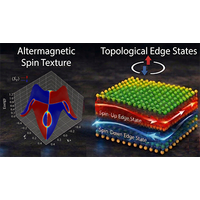
Coexistence of d-wave altermagnetism and topological states in Janus FeSeX (X = S, Te) monolayers

Alvaro González-García, William López-Pérez, Paola Pacheco, Luz Ramírez-Montes, and Rafael González-Hernández

Phys. Rev. Materials 10, 044004 (2026) - Published 28 April, 2026

The authors demonstrate the coexistence of d-wave altermagnetism and nontrivial band topology in Janus FeSeX (X = S, Te) monolayers. In the nonrelativistic limit, the two-dimensional system exhibits momentum-dependent spin splitting with vanishing net magnetization, a signature of d-wave altermagnetic order. Upon inclusion of spin–orbit coupling, a topological gap opens, accompanied by symmetry-protected, spin-polarized edge states. The intrinsic interplay between altermagnetic order and relativistic effects enables robust, low-dissipation spin transport, establishing Janus FeSeX as a compelling platform for next-generation quantum applications.

First-principles study of KCoF3: Jahn-Teller effect, dynamical magnetic charges, magnetoelectric multipoles, and antimagnetoelectricity

Bogdan Guster, Maxime Braun, and Eric Bousquet

Phys. Rev. Materials 10, 044408 (2026) - Published 28 April, 2026

Strain-gradient and curvature-induced changes in domain morphology of BaTiO3 nanorods: Experimental and theoretical studies

Olha A. Kovalenko, Eugene A. Eliseev, Yuriy O. Zagorodniy, Srečo Davor Škapin, Marjeta Maček Kržmanc, Lesya D. Demchenko, Valentyn V. Laguta, Zdravko Kutnjak, Dean R. Evans, and Anna N. Morozovska

Phys. Rev. Materials 10, 044409 (2026) - Published 28 April, 2026

Computing finite-temperature elastic constants with noise cancellation

Debashish Mukherji, Marcus Müller, and Martin H. Müser

Phys. Rev. Materials 10, 045605 (2026) - Published 27 April, 2026

Active-learning inspired ab initio theory-experiment loop approach for management of material defects: Application to superconducting qubits

Sarvesh Chaudhari, Cristóbal Méndez, Rushil Choudhary, Tathagata Banerjee, Maciej W. Olszewski, Jadrien T. Paustian, Jaehong Choi, Zhaslan Baraissov, Raul Hernandez, David A. Muller, B. L. T. Plourde, Gregory D. Fuchs, Valla Fatemi, and Tomás A. Arias

Phys. Rev. Materials 10, L040801 (2026) - Published 27 April, 2026

Pressure-stabilized dual-BCC polymorphism in a rhenium-based high-entropy alloy

Raimundas Sereika, Andrew D. Pope, Hunter Kantelis, Caleb M. Knight, Kallol Chakrabarty, and Yogesh K. Vohra

Phys. Rev. Materials 10, 043602 (2026) - Published 24 April, 2026

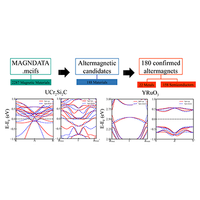
High-throughput quantification of altermagnetic band splitting

Ali Sufyan, Brahim Marfoua, J. Andreas Larsson, Erik van Loon, and Rickard Armiento

Phys. Rev. Materials 10, 044407 (2026) - Published 24 April, 2026

Altermagnetism is reshaping fundamental understanding of magnetism, combining zero net magnetization with spin-split electronic bands, all without needing heavy, expensive elements. But how to find these materials efficiently? The authors performed a high-throughput screening of the MAGNDATA database (2287 experimentally characterized magnetic structures) by combining symmetry analysis with spin-polarized DFT. This identified 180 robust altermagnets, both metallic and semiconducting, many previously unreported. Representative cases such as UCr2Si2C, NbMnP, and YRuO3 exhibit particularly large splittings. The authors’ open-access database (https://altermagnets.anyterial.se/) provides full results, and momentum-resolved analysis shows that maximal splitting often occurs away from conventional high-symmetry paths, directly guides future ARPES experiments.

ErAl:Al2O3 for telecom-band photonics: Electronic structure and optical properties

Mahtab A. Khan, Jayden D. Craft, Maida Noor, Hari P. Paudel, Yuhua Duan, Dirk R. Englund, and Michael N. Leuenberger

Phys. Rev. Materials 10, 046201 (2026) - Published 24 April, 2026

Geometry induced net spin polarization of d-wave altermagnets

Abhiram Soori

Phys. Rev. Materials 10, 044406 (2026) - Published 23 April, 2026

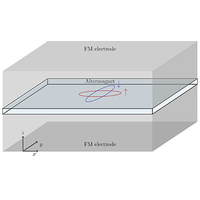
We show that the shape of a finite altermagnetic sample can generate a measurable spin polarization, even though these materials exhibit zero net magnetization in the large-system limit. This effect arises from the interplay between anisotropic spin-resolved band structures and the discrete set of allowed electron states in confined geometries. For rectangular samples, unequal dimensions lead to an imbalance between spin populations. We propose transport-based probes to detect this geometry-induced spin polarization, which manifests as characteristic signatures in magnetoresistance. Our results reveal a simple and robust route to controlling spin using sample geometry alone, opening new possibilities for nanoscale spintronic devices based on altermagnets.

Crystal phase of III-V ternary nanowires: Control parameters and open questions

Vladimir G. Dubrovskii

Phys. Rev. Materials 10, 046003 (2026) - Published 23 April, 2026

Mechanical manipulation of graphene nanoribbons on Au(111) using large amplitude scanning force microscopy experiments and calculations

Sebastian Schneider, Jonathan Eifler, Olga Artemyeva, Tillmann Klamroth, and Regina Hoffmann-Vogel

Phys. Rev. Materials 10, 043803 (2026) - Published 22 April, 2026

Hydrogen in brownmillerite perovskites: First-principles insights into energetics and induced electronic-magnetic changes

Vladislav Korostelev, Pjotrs Žguns, and Konstantin Klyukin

Phys. Rev. Materials 10, 044605 (2026) - Published 22 April, 2026

Helium diffusion and bubble nucleation evolution in α-Zr: Deep potential molecular dynamics simulations

Kunyang Cheng, Xuying Zhou, Mingyang Shi, Xiujuan Cheng, Jiahao Deng, Gang Jiang, and Jiguang Du

Phys. Rev. Materials 10, 043601 (2026) - Published 21 April, 2026

Intrinsic even-odd thickness-driven anomalous Hall effect in epitaxial MnBi2Te4 thin films

Debarghya Mallick, Simon Kim, An-Hsi Chen, Gabriel A. Vázquez-Lizardi, Alessandro R. Mazza, T. Zac Ward, Gyula Eres, Yue Cao, Debangshu Mukherjee, Hu Miao, Liang Wu, Christopher Nelson, Danielle Reifsnyder Hickey, Robert G. Moore, and Matthew Brahlek

Phys. Rev. Materials 10, 044203 (2026) - Published 21 April, 2026

First-principles theory of direct-gap optical emission in hexagonal Ge and its enhancement via strain engineering

Christopher A. Broderick, Xie Zhang, Mark E. Turiansky, and Chris G. Van de Walle

Phys. Rev. Materials 10, 044603 (2026) - Published 21 April, 2026

The emergence of metastable lonsdaleite germanium (2H-Ge) heralds a novel group-IV semiconductor, with the potential to address the longstanding challenge of realizing a direct-gap optical emitter for monolithic integration on Si. In this work, the nature of optical emission from direct-gap 2H-Ge is addressed theoretically. The authors’ first-principles calculations accurately account for measured photoluminescence spectra, and demonstrate that radiative recombination in 2H-Ge is significantly weaker than in a conventional direct-gap semiconductor. Strain-dependent analysis confirms the predicted emergence of an optically bright band gap under uniaxial tension, highlighting that strain engineering presents a promising route to realize 2H-Ge-based emitters for photonics.

Sign In to Your Journals Account

Filter

Recent Issues

Vol. 10, Iss. 10
October 2026
Vol. 10, Iss. 9
September 2026
Vol. 10, Iss. 8
August 2026
Vol. 10, Iss. 7
July 2026
Category
Article Type
Section

Filter

Article Lookup

Enter a citation