Highlights

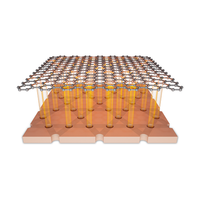
Dispersion-Selective Band Engineering in an Artificial Kagome Superlattice

Shuai Wang, Zhen Zhan, Xiaodong Fan, Yonggang Li, Pierre A. Pantaleón, Chaochao Ye, Zhiping He, Laiming Wei, Lin Li, Francisco Guinea, Shengjun Yuan, and Changgan Zeng

Phys. Rev. Lett. 133, 066302 (2024) - Published 6 August, 2024

Researchers have used a specially crafted electric potential to manipulate the electronic band structure of graphene, laying the groundwork for on-demand electronic band design.

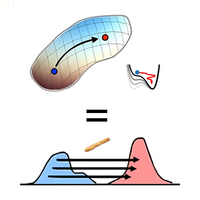
Langevin Equation in Heterogeneous Landscapes: How to Choose the Interpretation

Adrian Pacheco-Pozo, Michał Balcerek, Agnieszka Wyłomanska, Krzysztof Burnecki, Igor M. Sokolov, and Diego Krapf

Phys. Rev. Lett. 133, 067102 (2024) - Published 6 August, 2024

The overall characterization of the motion of a particle in heterogeneous two-phase systems depends on the interpretation (Itô, Stratonovich, or Hanggi-Klimontovich) of the Langevin equation.

Local Readout and Control of Current and Kinetic Energy Operators in Optical Lattices

Alexander Impertro, Simon Karch, Julian F. Wienand, SeungJung Huh, Christian Schweizer, Immanuel Bloch, and Monika Aidelsburger

Phys. Rev. Lett. 133, 063401 (2024) - Published 5 August, 2024

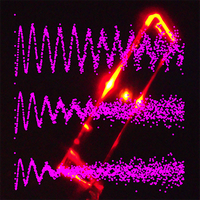
A new manipulation technique could enable the realization of more versatile quantum simulators.

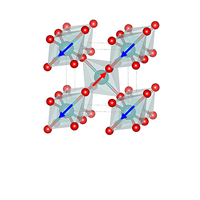
Origin of Magnetism in a Supposedly Nonmagnetic Osmium Oxide

S. Agrestini, F. Borgatti, P. Florio, J. Frassineti, D. Fiore Mosca, Q. Faure, B. Detlefs, C. J. Sahle, S. Francoual, J. Choi, M. Garcia-Fernandez, K.-J. Zhou, V. F. Mitrović, P. M. Woodward, G. Ghiringhelli, C. Franchini, F. Boscherini, S. Sanna, and M. Moretti Sala

Phys. Rev. Lett. 133, 066501 (2024) - Published 5 August, 2024

X-ray spectroscopy shows a finite magnetic moment in the double-perovskite compound Ba2NaOsO6 despite its nominally nonmagnetic 5d1 configuration.

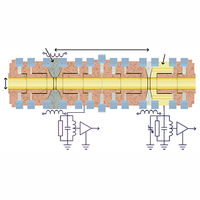
Strong Zero Modes in Integrable Quantum Circuits

Eric Vernier, Hsiu-Chung Yeh, Lorenzo Piroli, and Aditi Mitra

Phys. Rev. Lett. 133, 050606 (2024) - Published 2 August, 2024

Robust edge modes exist for a class of integrable spin chains in the interacting Floquet setting.

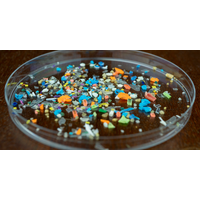
Full Rotational Dynamics of Plastic Microfibers in Turbulence

Vlad Giurgiu, Giuseppe Carlo Alp Caridi, Marco De Paoli, and Alfredo Soldati

Phys. Rev. Lett. 133, 054101 (2024) - Published 2 August, 2024

New data on the rotation around both long and short axes of plastic strands may help researchers track and remove microplastics that pollute the ocean.

X-Ray–Cosmic-Shear Cross-Correlations: First Detection and Constraints on Baryonic Effects

Tassia Ferreira, David Alonso, Carlos Garcia-Garcia, and Nora Elisa Chisari

Phys. Rev. Lett. 133, 051001 (2024) - Published 1 August, 2024

A correlation between two astronomical observables reveals the influence of visible matter on a universe dominated by dark matter.

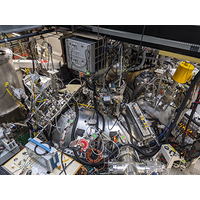
Orders of Magnitude Improved Cyclotron-Mode Cooling for Nondestructive Spin Quantum Transition Spectroscopy with Single Trapped Antiprotons

B. M. Latacz, M. Fleck, J. I. Jäger, G. Umbrazunas, B. P. Arndt, S. R. Erlewein, E. J. Wursten, J. A. Devlin, P. Micke, F. Abbass, D. Schweitzer, M. Wiesinger, C. Will, H. Yildiz, K. Blaum, Y. Matsuda, A. Mooser, C. Ospelkaus, C. Smorra, A. Soter, W. Quint, J. Walz, Y. Yamazaki, and S. Ulmer (BASE Collaboration)

Phys. Rev. Lett. 133, 053201 (2024) - Published 1 August, 2024

The subthermal resistive cooling of a single trapped proton to temperatures below 200 mK in particle preparation times below 500s, about 100 times faster than reported before, was achieved using a double-Penning-trap system.

Clock-Line-Mediated Sisyphus Cooling

Chun-Chia Chen (陳俊嘉), Jacob L. Siegel, Benjamin D. Hunt, Tanner Grogan, Youssef S. Hassan, Kyle Beloy, Kurt Gibble, Roger C. Brown, and Andrew D. Ludlow

Phys. Rev. Lett. 133, 053401 (2024) - Published 31 July, 2024

Sisyphus cooling applied to an ytterbium lattice clock improves atomic loading into the optical trap and the control of clock systematics.

Probabilistic Work Extraction on a Classical Oscillator Beyond the Second Law

Nicolas Barros, Sergio Ciliberto, and Ludovic Bellon

Phys. Rev. Lett. 133, 057101 (2024) - Published 31 July, 2024

In a fully classical continuous system, the second law of thermodynamics can be violated locally while being preserved on average.

Beyond Linear Response: Equivalence between Thermodynamic Geometry and Optimal Transport

Adrianne Zhong and Michael R. DeWeese

Phys. Rev. Lett. 133, 057102 (2024) - Published 31 July, 2024

Geodesic-counteradiabatic protocols unifying thermodynamic geometry and optimal transport provide exact optimal solutions for arbitrary protocol durations.

Maximally Entangled Mixed States for a Fixed Spectrum Do Not Always Exist

Julio I. de Vicente

Phys. Rev. Lett. 133, 050202 (2024) - Published 30 July, 2024

An answer to a decades-old question in the theory of quantum entanglement raises more questions about this quirky phenomenon.

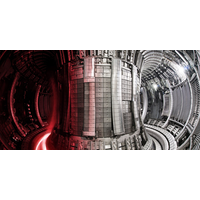
Measurement of the Gamma-Ray-to-Neutron Branching Ratio for the Deuterium-Tritium Reaction in Magnetic Confinement Fusion Plasmas

A. Dal Molin, G. Marcer, M. Nocente, M. Rebai, D. Rigamonti, M. Angelone, A. Bracco, F. Camera, C. Cazzaniga, T. Craciunescu, G. Croci, M. Dalla Rosa, L. Giacomelli, G. Gorini, Y. Kazakov, E. M. Khilkevitch, A. Muraro, E. Panontin, E. Perelli Cippo, M. Pillon, O. Putignano, J. Scionti, A. E. Shevelev, A. Žohar, and M. Tardocchi

Phys. Rev. Lett. 133, 055102 (2024) - Published 30 July, 2024

Experiments at the Joint European Torus make the case for using gamma rays to determine the fusion reaction rate in a magnetically confined plasma.

Separation of Inverse Altermagnetic Spin-Splitting Effect from Inverse Spin Hall Effect in RuO2

Ching-Te Liao, Yu-Chun Wang, Yu-Cheng Tien, Ssu-Yen Huang, and Danru Qu

Phys. Rev. Lett. 133, 056701 (2024) - Published 30 July, 2024

By isolating the relativistic spin Hall effect in an epitaxially grown film of RuO2 with well-defined Néel vectors, the spin-to-charge conversion of the nonrelativistic altermagnetic spin-splitting has been demonstrated.

Tokamak Plasmas with Density up to 10 Times the Greenwald Limit

N. C. Hurst, B. E. Chapman, J. S. Sarff, A. F. Almagri, K. J. McCollam, D. J. Den Hartog, J. B. Flahavan, and C. B. Forest

Phys. Rev. Lett. 133, 055101 (2024) - Published 29 July, 2024

Tokamak experiments in the Madison Symmetric Torus have produced plasma with an unprecedented density of up to ten times the Greenwald density limit, promising more stable fusion operating scenarios.

Persistence of Spin Coherence in a Crystalline Environment

Gerald Curran, III, Zachary Rex, Casper Xallan Wilson, Luke J. Weaver, and Ivan Biaggio

Phys. Rev. Lett. 133, 056901 (2024) - Published 29 July, 2024

A combined theoretical and experimental work in single-crystal rubrene provides a model of spin coherence that accounts for transport-induced dephasing and derives the triplet-exciton hopping rate between inequivalent sites.

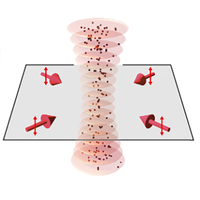
No Black Holes from Light

Álvaro Álvarez-Domínguez, Luis J. Garay, Eduardo Martín-Martínez, and José Polo-Gómez

Phys. Rev. Lett. 133, 041401 (2024) - Published 26 July, 2024

The formation of a black hole from light alone is permitted by general relativity, but a new study says quantum physics rules it out.

Giant Piezoelectric Effects of Topological Structures in Stretched Ferroelectric Membranes

Yihao Hu, Jiyuan Yang, and Shi Liu

Phys. Rev. Lett. 133, 046802 (2024) - Published 26 July, 2024

Emergence of helical dipole spirals in ferroelectric PbTiO3 is expected to increase the piezoelectric response by approximately 400%.

Collisionless Magnetorotational Turbulence in Pair Plasmas: Steady-State Dynamics, Particle Acceleration, and Radiative Cooling

Fabio Bacchini, Vladimir Zhdankin, Evgeny A. Gorbunov, Gregory R. Werner, Lev Arzamasskiy, Mitchell C. Begelman, and Dmitri A. Uzdensky

Phys. Rev. Lett. 133, 045202 (2024) - Published 25 July, 2024

The largest 3D fully kinetic shearing-box simulations of pair-plasma magnetorotational turbulence which take into account the radiation reaction self-consistently show how particles can be accelerated efficiently to nonthermal energies independently of initial conditions.

Hybrid van der Waals Epitaxy

Lin Hu, Danshuo Liu, Fawei Zheng, Xuelin Yang, Yugui Yao, Bo Shen, and Bing Huang

Phys. Rev. Lett. 133, 046102 (2024) - Published 24 July, 2024

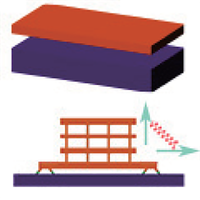
The growth of a nitride epilayer on a van der Waals substrate follows a new growth mechanism, different from the previously known models of material growth.

Sign In to Your Journals Account

Filter

Section

Filter

Article Lookup

Enter a citation