Highlights

Physical Running of Couplings in Quadratic Gravity

Diego Buccio, John F. Donoghue, Gabriel Menezes, and Roberto Percacci

Phys. Rev. Lett. 133, 021604 (2024) - Published 10 July, 2024

A theoretical analysis suggests that higher derivative gravity theories display signs of UV completeness.

Clock with 8×10⁻¹⁹ Systematic Uncertainty

Alexander Aeppli, Kyungtae Kim, William Warfield, Marianna S. Safronova, and Jun Ye

Phys. Rev. Lett. 133, 023401 (2024) - Published 10 July, 2024

An optical lattice clock with a 19-digit frequency accuracy results from the precise evaluation of the dynamic component of the clock transition’s blackbody radiation shift.

Irreversible Monte Carlo Algorithms for Hard Disk Glasses: From Event-Chain to Collective Swaps

Federico Ghimenti, Ludovic Berthier, and Frédéric van Wijland

Phys. Rev. Lett. 133, 028202 (2024) - Published 10 July, 2024

An irreversible algorithm utilizing collective particle swaps outperforms known Monte Carlo methods for configuration space sampling during the glassy slowing of dynamics in disordered systems.

Self-Interacting Dark Matter Solves the Final Parsec Problem of Supermassive Black Hole Mergers

Gonzalo Alonso-Álvarez, James M. Cline, and Caitlyn Dewar

Phys. Rev. Lett. 133, 021401 (2024) - Published 9 July, 2024

Dark matter that interacts with itself could extract significant momentum from a binary supermassive black hole system, causing the black holes to merge.

Time-Dependent Variational Principle with Controlled Bond Expansion for Matrix Product States

Jheng-Wei Li, Andreas Gleis, and Jan von Delft

Phys. Rev. Lett. 133, 026401 (2024) - Published 9 July, 2024

A controlled bond expansion approach to simulate quantum dynamics resolves the numerical difficulty of the standard time-dependent variational principle method for matrix product states, where dominant projection errors spoil the numerical accuracy.

Quantum Criticality with Emergent Symmetry in the Extended Shastry-Sutherland Model

Wen-Yuan Liu, Xiao-Tian Zhang, Zhe Wang, Shou-Shu Gong, Wei-Qiang Chen, and Zheng-Cheng Gu

Phys. Rev. Lett. 133, 026502 (2024) - Published 9 July, 2024

Identification of a continuous phase transition between the plaquette valence-bond solid phase and the antiferromagnetic phase accompanied by an emergent O(4) symmetry strongly suggests a deconfined quantum critical point in the ground state phase diagram of the extended Shastry-Sutherland model.

Mechanical Detection of Nuclear Decays

Jiaxiang Wang, T. W. Penny, Juan Recoaro, Benjamin Siegel, Yu-Han Tseng, and David C. Moore

Phys. Rev. Lett. 133, 023602 (2024) - Published 8 July, 2024

A levitating microparticle is observed to recoil when a nucleus embedded in the particle decays—opening the door to future searches of invisible decay products.

Abyss Aerosols: Drop Production from Underwater Bubble Collisions

Xinghua Jiang, Lucas Rotily, Emmanuel Villermaux, and Xiaofei Wang

Phys. Rev. Lett. 133, 024001 (2024) - Published 8 July, 2024

The flapping instability of the film squeezed between underwater colliding bubbles is the primary mechanism for submicron droplet formation.

Exchange Energy of the Ferromagnetic Electronic Ground State in a Monolayer Semiconductor

Nadine Leisgang, Dmitry Miserev, Hinrich Mattiat, Lukas Schneider, Lukas Sponfeldner, Kenji Watanabe, Takashi Taniguchi, Martino Poggio, and Richard J. Warburton

Phys. Rev. Lett. 133, 026501 (2024) - Published 8 July, 2024

The large exchange energy observed when flipping a spin in the ferromagnetic phase of MoS2, as determined from the optical emission spectrum, suggests very stable ferromagnetic ordering.

Decay Dynamics of a Single Spherical Domain in Near-Critical Phase-Separated Conditions

Raphael Saiseau, Henri Truong, Thomas Guérin, Ulysse Delabre, and Jean-Pierre Delville

Phys. Rev. Lett. 133, 018201 (2024) - Published 3 July, 2024

An experiment uncovers the role played by gravity in Ostwald ripening, a spontaneous thermodynamic process responsible for many effects such as the recrystallization of ice cream.

Laser Excitation of the Th229 Nuclear Isomeric Transition in a Solid-State Host

R. Elwell, Christian Schneider, Justin Jeet, J. E. S. Terhune, H. W. T. Morgan, A. N. Alexandrova, H. B. Tran Tan, Andrei Derevianko, and Eric R. Hudson

Phys. Rev. Lett. 133, 013201 (2024) - Published 2 July, 2024

Researchers have made the most precise measurement to date of the excited nuclear state of thorium-229, a candidate isotope for an ultraprecise nuclear clock.

Exact Numerical Solution of the Fully Connected Classical and Quantum Heisenberg Spin Glass

Nikita Kavokine, Markus Müller, Antoine Georges, and Olivier Parcollet

Phys. Rev. Lett. 133, 016501 (2024) - Published 2 July, 2024

The exact numerical solution of the quantum Heisenberg spin glass throughout the ordered phase and down to zero temperature clears a technical limitation in the investigation of a system of fundamental relevance.

Microscopic Origin of the Quantum Mpemba Effect in Integrable Systems

Colin Rylands, Katja Klobas, Filiberto Ares, Pasquale Calabrese, Sara Murciano, and Bruno Bertini

Phys. Rev. Lett. 133, 010401 (2024) - Published 1 July, 2024

In the Mpemba effect, a warm liquid freezes faster than a cold one. Three studies investigate quantum versions of this effect, challenging our understanding of quantum thermodynamics.

Observing the Quantum Mpemba Effect in Quantum Simulations

Lata Kh. Joshi, Johannes Franke, Aniket Rath, Filiberto Ares, Sara Murciano, Florian Kranzl, Rainer Blatt, Peter Zoller, Benoît Vermersch, Pasquale Calabrese, Christian F. Roos, and Manoj K. Joshi

Phys. Rev. Lett. 133, 010402 (2024) - Published 1 July, 2024

In the Mpemba effect, a warm liquid freezes faster than a cold one. Three studies investigate quantum versions of this effect, challenging our understanding of quantum thermodynamics.

Inverse Mpemba Effect Demonstrated on a Single Trapped Ion Qubit

Shahaf Aharony Shapira, Yotam Shapira, Jovan Markov, Gianluca Teza, Nitzan Akerman, Oren Raz, and Roee Ozeri

Phys. Rev. Lett. 133, 010403 (2024) - Published 1 July, 2024

In the Mpemba effect, a warm liquid freezes faster than a cold one. Three studies investigate quantum versions of this effect, challenging our understanding of quantum thermodynamics.

Hyperbolic Shear Metasurfaces

Enrico M. Renzi, Emanuele Galiffi, Xiang Ni, and Andrea Alù

Phys. Rev. Lett. 132, 263803 (2024) - Published 28 June, 2024

The introduction of hyperbolic shear metasurfaces that support ultraconfined hyperbolic surface modes with symmetry-tailored axial dispersion and loss redistribution makes possible the generalization of the features of shear polaritons to metasurfaces.

Phase Transition to Turbulence via Moving Fronts

Sébastien Gomé, Aliénor Rivière, Laurette S. Tuckerman, and Dwight Barkley

Phys. Rev. Lett. 132, 264002 (2024) - Published 28 June, 2024

Simulations of Couette flow that eliminate discreet structures show that turbulence proliferates through expanding fronts and decays through spontaneous formation of laminar zones.

Spin-Dependent ππ* Gap in Graphene on a Magnetic Substrate

P. M. Sheverdyaeva, G. Bihlmayer, E. Cappelluti, D. Pacilé, F. Mazzola, N. Atodiresei, M. Jugovac, I. Grimaldi, G. Contini, Asish K. Kundu, I. Vobornik, J. Fujii, P. Moras, C. Carbone, and L. Ferrari

Phys. Rev. Lett. 132, 266401 (2024) - Published 28 June, 2024

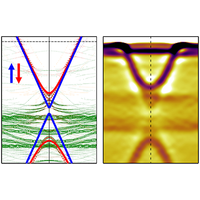
Photoemission spectroscopy and density-functional calculations indicate specific bands of graphene and spin-polarized Eu states induce a large spin-dependent gap at the Dirac point.

Agnostic Phase Estimation

Xingrui Song, Flavio Salvati, Chandrashekhar Gaikwad, Nicole Yunger Halpern, David R. M. Arvidsson-Shukur, and Kater Murch

Phys. Rev. Lett. 132, 260801 (2024) - Published 27 June, 2024

Quantum sensing can benefit from entanglement protocols that can be interpreted as allowing qubits to go backward in time to choose an optimal initial state.

Search for Dark Matter Ionization on the Night Side of Jupiter with Cassini

Carlos Blanco and Rebecca K. Leane

Phys. Rev. Lett. 132, 261002 (2024) - Published 27 June, 2024

A proposed dark matter (DM) search uses the possibility of excess H3+ in planetary atmospheres due to DM annihilation and uses this idea to place constraints on DM-nucleon cross section using data collected from Cassini’s Jupiter flyby.

Sign In to Your Journals Account

Filter

Section

Filter

Article Lookup

Enter a citation