Highlights

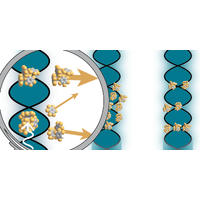
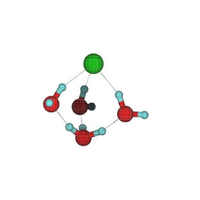
Electric Dipole Moments of Nanosolvated Acid Molecules in Water Clusters

Nicholas Guggemos, Petr Slavíček, and Vitaly V. Kresin

Phys. Rev. Lett. 114, 043401 (2015) - Published 30 January, 2015

A new experimental technique probes the dissociation of a single molecule in water and reveals more complexities than expected.

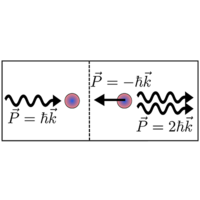
Laser Cooling without Spontaneous Emission

Christopher Corder, Brian Arnold, and Harold Metcalf

Phys. Rev. Lett. 114, 043002 (2015) - Published 28 January, 2015

Atom-light interactions using polychromatic laser fields permit energy and momentum exchange for laser cooling without spontaneous emission.

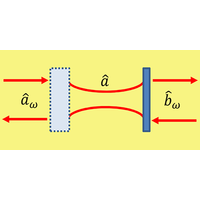
Observation of Generalized Optomechanical Coupling and Cooling on Cavity Resonance

Andreas Sawadsky, Henning Kaufer, Ramon Moghadas Nia, Sergey P. Tarabrin, Farid Ya. Khalili, Klemens Hammerer, and Roman Schnabel

Phys. Rev. Lett. 114, 043601 (2015) - Published 26 January, 2015

A new scheme for cooling a mechanical oscillator in a cavity may allow the observation of quantum effects on macroscopic objects and the realization of ultrasensitive gravitational-wave detectors.

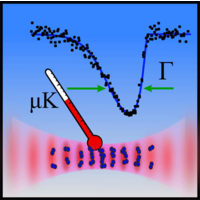
Thermometry via Light Shifts in Optical Lattices

M. McDonald, B. H. McGuyer, G. Z. Iwata, and T. Zelevinsky

Phys. Rev. Lett. 114, 023001 (2015) - Published 14 January, 2015

A new spectroscopic technique provides an order of magnitude improvement in the temperature measurement of ultracold gases in optical lattices.

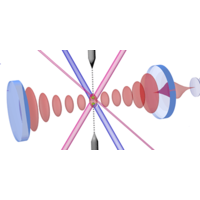
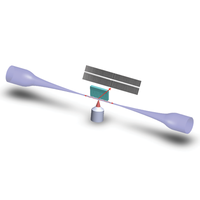
Cavity-Modified Collective Rayleigh Scattering of Two Atoms

René Reimann, Wolfgang Alt, Tobias Kampschulte, Tobias Macha, Lothar Ratschbacher, Natalie Thau, Seokchan Yoon, and Dieter Meschede

Phys. Rev. Lett. 114, 023601 (2015) - Published 14 January, 2015

Two groups have independently isolated two atoms in a single cavity and measured that the collective light output is not simply the sum of single emitters.

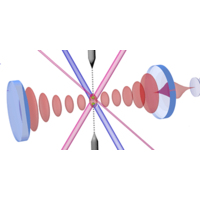
Enhanced Quantum Interface with Collective Ion-Cavity Coupling

B. Casabone, K. Friebe, B. Brandstätter, K. Schüppert, R. Blatt, and T. E. Northup

Phys. Rev. Lett. 114, 023602 (2015) - Published 14 January, 2015

Two groups have independently isolated two atoms in a single cavity and measured that the collective light output is not simply the sum of single emitters.

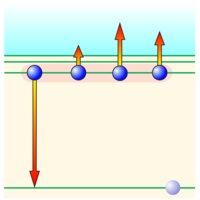
Observation of a Four-Electron Auger Process in Near-K-Edge Photoionization of Singly Charged Carbon Ions

A. Müller, A. Borovik, Jr., T. Buhr, J. Hellhund, K. Holste, A. L. D. Kilcoyne, S. Klumpp, M. Martins, S. Ricz, J. Viefhaus, and S. Schippers

Phys. Rev. Lett. 114, 013002 (2015) - Published 7 January, 2015

Using a new photon-ion merged-beam setup at PETRA III, DESY, resonant Auger decay in which three electrons are emitted simultaneously is observed in carbon ions.

Measurement of the Gravity-Field Curvature by Atom Interferometry

G. Rosi, L. Cacciapuoti, F. Sorrentino, M. Menchetti, M. Prevedelli, and G. M. Tino

Phys. Rev. Lett. 114, 013001 (2015) - Published 5 January, 2015

By measuring gravity with cold atoms at three different heights simultaneously, a team determined a new property of a gravitational field.

Generation and Detection of a Sub-Poissonian Atom Number Distribution in a One-Dimensional Optical Lattice

J.-B. Béguin, E. M. Bookjans, S. L. Christensen, H. L. Sørensen, J. H. Müller, E. S. Polzik, and J. Appel

Phys. Rev. Lett. 113, 263603 (2014) - Published 30 December, 2014

A minimally invasive measurement technique gives a precise, real-time estimate of the number of atoms in a one-dimensional trap.

All-Optical Formation of Coherent Dark States of Silicon-Vacancy Spins in Diamond

Benjamin Pingault, Jonas N. Becker, Carsten H. H. Schulte, Carsten Arend, Christian Hepp, Tillmann Godde, Alexander I. Tartakovskii, Matthew Markham, Christoph Becher, and Mete Atatüre

Phys. Rev. Lett. 113, 263601 (2014) - Published 22 December, 2014

The spin on a silicon defect in diamond can be prepared in a coherent quantum state, a promising sign that it could encode information in a quantum internet.

All-Optical Initialization, Readout, and Coherent Preparation of Single Silicon-Vacancy Spins in Diamond

Lachlan J. Rogers, Kay D. Jahnke, Mathias H. Metsch, Alp Sipahigil, Jan M. Binder, Tokuyuki Teraji, Hitoshi Sumiya, Junichi Isoya, Mikhail D. Lukin, Philip Hemmer, and Fedor Jelezko

Phys. Rev. Lett. 113, 263602 (2014) - Published 22 December, 2014

The spin on a silicon defect in diamond can be prepared in a coherent quantum state, a promising sign that it could encode information in a quantum internet.

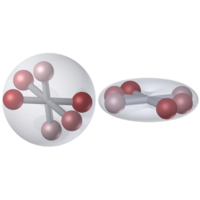
Probing the Axis Alignment of an Ultracold Spin-polarized Rb2 Molecule

Markus Deiß, Björn Drews, Benjamin Deissler, and Johannes Hecker Denschlag

Phys. Rev. Lett. 113, 233004 (2014) - Published 3 December, 2014

Cold molecules trapped in an optical lattice can be aligned by controlling their rotational quantum state.

Photofragmentation Beam Splitters for Matter-Wave Interferometry

Nadine Dörre, Jonas Rodewald, Philipp Geyer, Bernd von Issendorff, Philipp Haslinger, and Markus Arndt

Phys. Rev. Lett. 113, 233001 (2014) - Published 1 December, 2014

A new technique in matter-wave interferometry using laser light to fragment molecules may open the door to interference demonstrations with large biomolecules or nanoclusters.

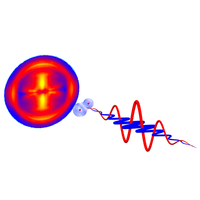
Two-Dimensional Directional Proton Emission in Dissociative Ionization of H2

Xiaochun Gong, Peilun He, Qiying Song, Qinying Ji, Haifeng Pan, Jingxin Ding, Feng He, Heping Zeng, and Jian Wu

Phys. Rev. Lett. 113, 203001 (2014) - Published 12 November, 2014

The dynamics of hydrogen photo-dissociation are controlled on an attosecond time-scale using orthogonally polarized two-color ultrashort laser pulses.

Cooperative Lamb Shift in a Mesoscopic Atomic Array

Z. Meir, O. Schwartz, E. Shahmoon, D. Oron, and R. Ozeri

Phys. Rev. Lett. 113, 193002 (2014) - Published 5 November, 2014

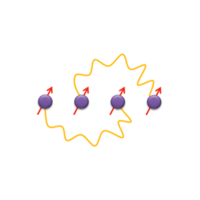
The roiling of the quantum vacuum tweaks the collective energy of far-apart ions.

Nonlinear Interaction between Single Photons

T. Guerreiro, A. Martin, B. Sanguinetti, J. S. Pelc, C. Langrock, M. M. Fejer, N. Gisin, H. Zbinden, N. Sangouard, and R. T. Thew

Phys. Rev. Lett. 113, 173601 (2014) - Published 22 October, 2014

The interaction between two individual photons in a nonlinear optical waveguide offers new possibilities for quantum information processing.

New Classes of Systematic Effects in Gas Spin Comagnetometers

D. Sheng, A. Kabcenell, and M. V. Romalis

Phys. Rev. Lett. 113, 163002 (2014) - Published 16 October, 2014

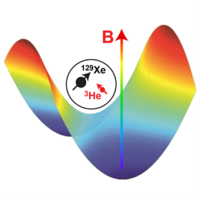
Progress has been made in understanding systematic effects from thermal and magnetic field gradients on comagnetometers – devices that compare the nuclear spin procession of two atomic species.

Reversing the Temporal Envelope of a Heralded Single Photon using a Cavity

Bharath Srivathsan, Gurpreet Kaur Gulati, Alessandro Cerè, Brenda Chng, and Christian Kurtsiefer

Phys. Rev. Lett. 113, 163601 (2014) - Published 15 October, 2014

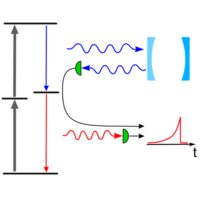
The temporal pulse shape of a single photon can be engineered, from an exponential decay to an exponential rise, using a Fabry-Perot optical cavity. This ‘shaping’ would make it easier to couple photons to atoms in a cavity.

Astrophysical Line Diagnosis Requires Nonlinear Dynamical Atomic Modeling

Natalia S. Oreshkina, Stefano M. Cavaletto, Christoph H. Keitel, and Zoltán Harman

Phys. Rev. Lett. 113, 143001 (2014) - Published 29 September, 2014

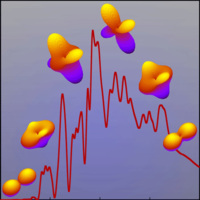
A discrepancy between atomic theory and laboratory astrophysics experiments measuring the x-ray emission lines from highly charged Iron ions can be resolved by including nonlinear dynamical light-atom interactions.

Cavity Quantum Electrodynamics on a Nanofiber Using a Composite Photonic Crystal Cavity

Ramachandrarao Yalla, Mark Sadgrove, Kali P. Nayak, and Kohzo Hakuta

Phys. Rev. Lett. 113, 143601 (2014) - Published 29 September, 2014
Spontaneous emission from a cavity made of an optical nanofiber and a nanostructured grating is demonstrated, which would allow single quantum emitters to be easily integrated into an optical network.

Sign In to Your Journals Account

Filter

Section

Filter

Article Lookup

Enter a citation