Highlights

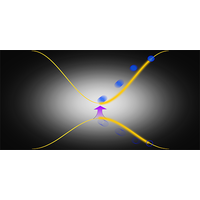
Squeezing of Quantum Noise of Motion in a Micromechanical Resonator

J.-M. Pirkkalainen, E. Damskägg, M. Brandt, F. Massel, and M. A. Sillanpää

Phys. Rev. Lett. 115, 243601 (2015) - Published 7 December, 2015

The act of a quantum measurement reduces the uncertainty in the motion of a vibrating membrane below the fundamental quantum limit.

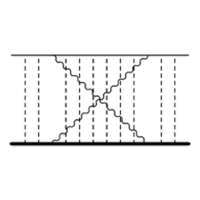
Nuclear Recoil Effect in the Lamb Shift of Light Hydrogenlike Atoms

V. A. Yerokhin and V. M. Shabaev

Phys. Rev. Lett. 115, 233002 (2015) - Published 4 December, 2015

The nuclear recoil correction in hydrogen-like atoms has been calculated nonperturbatively in the nuclear binding strength, Zα, improving the numerical accuracy by more than two orders of magnitude.

Sensing Atomic Motion from the Zero Point to Room Temperature with Ultrafast Atom Interferometry

K. G. Johnson, B. Neyenhuis, J. Mizrahi, J. D. Wong-Campos, and C. Monroe

Phys. Rev. Lett. 115, 213001 (2015) - Published 16 November, 2015

Ultrafast laser pulses can be used to control and characterize the quantum motion of a single trapped ion over 5 orders of magnitude in temperature.

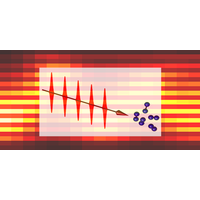
Observation of Bloch Oscillations in Molecular Rotation

Johannes Floß, Andrei Kamalov, Ilya Sh. Averbukh, and Philip H. Bucksbaum

Phys. Rev. Lett. 115, 203002 (2015) - Published 11 November, 2015

A type of quantum oscillation—known to occur for electrons in a crystal—has now been observed in a gas of molecular rotors that are spun around by laser pulses.

All-Optical Reconstruction of Crystal Band Structure

G. Vampa, T. J. Hammond, N. Thiré, B. E. Schmidt, F. Légaré, C. R. McDonald, T. Brabec, D. D. Klug, and P. B. Corkum

Phys. Rev. Lett. 115, 193603 (2015) - Published 5 November, 2015

An all-optical alternative to photoemission spectroscopy can probe the electronic band structure of a solid.

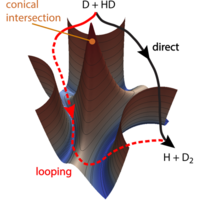
Geometric Phase Appears in the Ultracold Hydrogen Exchange Reaction

B. K. Kendrick, Jisha Hazra, and N. Balakrishnan

Phys. Rev. Lett. 115, 153201 (2015) - Published 8 October, 2015

Hydrogen exchange reactions can be turned on and off by geometric phase effects at temperatures well below one Kelvin.

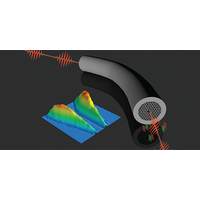
Raman-Free, Noble-Gas-Filled Photonic-Crystal Fiber Source for Ultrafast, Very Bright Twin-Beam Squeezed Vacuum

Martin A. Finger, Timur Sh. Iskhakov, Nicolas Y. Joly, Maria V. Chekhova, and Philip St. J. Russell

Phys. Rev. Lett. 115, 143602 (2015) - Published 30 September, 2015

An optical-fiber scheme generates a bright “twin beam”—a pair of quantum-correlated beams that could be used in high-precision metrology.

Precision Spectroscopy in Cold Molecules: The Lowest Rotational Interval of He2+ and Metastable He2

Paul Jansen, Luca Semeria, Laura Esteban Hofer, Simon Scheidegger, Josef A. Agner, Hansjürg Schmutz, and Frédéric Merkt

Phys. Rev. Lett. 115, 133202 (2015) - Published 23 September, 2015

The experimental accuracy needed to reveal quantum-electrodynamics corrections in a three-electron molecule is achieved. These measurements represent a benchmark and test for future ab initio calculations.

Coulomb Bound States of Strongly Interacting Photons

M. F. Maghrebi, M. J. Gullans, P. Bienias, S. Choi, I. Martin, O. Firstenberg, M. D. Lukin, H. P. Büchler, and A. V. Gorshkov

Phys. Rev. Lett. 115, 123601 (2015) - Published 16 September, 2015

Rydberg atoms can be used to mediate an effective Coulomb interaction between photons, according to this theoretical proposal.

Optimized Effective Potential for Quantum Electrodynamical Time-Dependent Density Functional Theory

Camilla Pellegrini, Johannes Flick, Ilya V. Tokatly, Heiko Appel, and Angel Rubio

Phys. Rev. Lett. 115, 093001 (2015) - Published 24 August, 2015

Time-dependent density functional theory for quantum electrodynamics is successfully applied to electronic structure calculations via a quantum-optical treatment of the electromagnetic field.

Observation of Noise-Assisted Transport in an All-Optical Cavity-Based Network

Silvia Viciani, Manuela Lima, Marco Bellini, and Filippo Caruso

Phys. Rev. Lett. 115, 083601 (2015) - Published 20 August, 2015

A system of optical fibers and cavities is used to simulate noise-assisted transport through a network. This system could potentially allow the contribution of noise to the transport of light in a complex system, analogous to photosynthesis, to be studied.

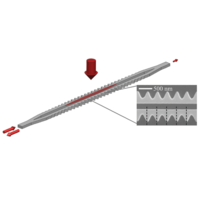
Superradiance for Atoms Trapped along a Photonic Crystal Waveguide

A. Goban, C.-L. Hung, J. D. Hood, S.-P. Yu, J. A. Muniz, O. Painter, and H. J. Kimble

Phys. Rev. Lett. 115, 063601 (2015) - Published 5 August, 2015

Trapping atoms near a photonic crystal waveguide produces strong atom-photon coupling that results in enhanced atomic emission of light.

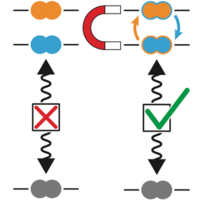
Control of Optical Transitions with Magnetic Fields in Weakly Bound Molecules

B. H. McGuyer, M. McDonald, G. Z. Iwata, W. Skomorowski, R. Moszynski, and T. Zelevinsky

Phys. Rev. Lett. 115, 053001 (2015) - Published 28 July, 2015

Magnetic fields can be used to make a normally forbidden molecular transition accessible to optical excitation, using much lower fields than would be needed to achieve the same with the constituent atoms.

Atom-Light Hybrid Interferometer

Bing Chen, Cheng Qiu, Shuying Chen, Jinxian Guo, L. Q. Chen, Z. Y. Ou, and Weiping Zhang

Phys. Rev. Lett. 115, 043602 (2015) - Published 24 July, 2015

A new type of interferometer, sensitive to the phases of an atomic spin wave and a light wave is experimentally demonstrated.

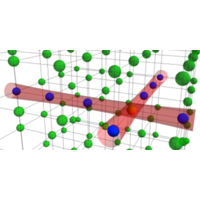
Coherent Addressing of Individual Neutral Atoms in a 3D Optical Lattice

Yang Wang, Xianli Zhang, Theodore A. Corcovilos, Aishwarya Kumar, and David S. Weiss

Phys. Rev. Lett. 115, 043003 (2015) - Published 23 July, 2015

Researchers manipulate atomic qubits individually in a three-dimensional optical lattice.

Density-Functional Theory for Strongly Correlated Bosonic and Fermionic Ultracold Dipolar and Ionic Gases

F. Malet, A. Mirtschink, C. B. Mendl, J. Bjerlin, E. Ö. Karabulut, S. M. Reimann, and Paola Gori-Giorgi

Phys. Rev. Lett. 115, 033006 (2015) - Published 14 July, 2015

An alternative functional for DFT calculations enables simulations of ultracold gases with long-ranged interactions.

Rydberg Electrons in a Bose-Einstein Condensate

Jia Wang, Marko Gacesa, and R. Côté

Phys. Rev. Lett. 114, 243003 (2015) - Published 18 June, 2015

Atoms in a condensate could be used to image the quantum wave function of an impurity charge.

Ultrasensitive Ultrafast Vibrational Spectroscopy Employing the Near Field of Gold Nanoantennas

O. Selig, R. Siffels, and Y. L. A. Rezus

Phys. Rev. Lett. 114, 233004 (2015) - Published 12 June, 2015

Micrometer-scale antennas made from gold may give chemists a peek into the dynamics of molecular bonds.

Coherent Control of Bond Making

Liat Levin, Wojciech Skomorowski, Leonid Rybak, Ronnie Kosloff, Christiane P. Koch, and Zohar Amitay

Phys. Rev. Lett. 114, 233003 (2015) - Published 10 June, 2015

A tailored laser pulse controls the formation of a molecular bond between two atoms.

First Measurement of the Atomic Electric Dipole Moment of Ra225

R. H. Parker, M. R. Dietrich, M. R. Kalita, N. D. Lemke, K. G. Bailey, M. Bishof, J. P. Greene, R. J. Holt, W. Korsch, Z.-T. Lu, P. Mueller, T. P. O’Connor, and J. T. Singh

Phys. Rev. Lett. 114, 233002 (2015) - Published 9 June, 2015
Researchers have devised a new technique to look for evidence of a permanent electric dipole moment in atoms, which would signal new physics.

Sign In to Your Journals Account

Filter

Section

Filter

Article Lookup

Enter a citation