Highlights

Hamiltonian for the Zeros of the Riemann Zeta Function

Carl M. Bender, Dorje C. Brody, and Markus P. Müller

Phys. Rev. Lett. 118, 130201 (2017) - Published 30 March, 2017

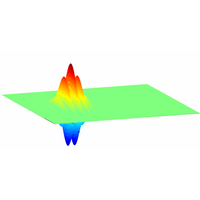
A Hamilonian with PT-symmetry invariant properties is investigated as a candidate for an operator that has eigenvalues corresponding to the nontrivial zeros of the Riemann zeta function.

Quantum Backreaction on Three-Dimensional Black Holes and Naked Singularities

Marc Casals, Alessandro Fabbri, Cristián Martínez, and Jorge Zanelli

Phys. Rev. Lett. 118, 131102 (2017) - Published 30 March, 2017

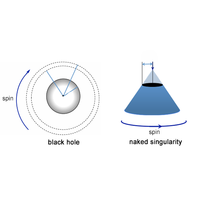
Quantum-mechanical effects may remove some unphysical features of spacetime predicted by classical general relativity.

Divergent and Ultrahigh Thermal Conductivity in Millimeter-Long Nanotubes

Victor Lee, Chi-Hsun Wu, Zong-Xing Lou, Wei-Li Lee, and Chih-Wei Chang

Phys. Rev. Lett. 118, 135901 (2017) - Published 30 March, 2017

Measurements show that the thermal conductivity of carbon nanotubes diverges with length. At 1-mm, the nanotubes conduct heat approximately four times better than diamond or graphene.

Nonuniversal Equation of State of the Two-Dimensional Bose Gas

L. Salasnich

Phys. Rev. Lett. 118, 130402 (2017) - Published 29 March, 2017

The equation of state of a 2D Bose gas is derived with finite-range corrections, commonly found in experiments.

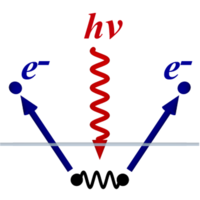
Correlated Electron Dynamics at Surfaces Investigated via He2+ Ion Neutralization

C. H. Li, C. Tusche, F. O. Schumann, and J. Kirschner

Phys. Rev. Lett. 118, 136402 (2017) - Published 29 March, 2017

Coincidence electron spectroscopy provides the first evidence that neutralization of an He2+ ion near a metal surface leads to the emission of an electron pair, which in some cases originates from a correlated single step neutralization involving 4 electrons from the metal.

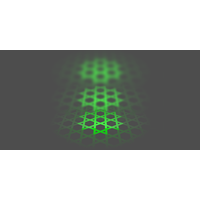
Gapless Spin-Liquid Ground State in the S=1/2 Kagome Antiferromagnet

H. J. Liao, Z. Y. Xie, J. Chen, Z. Y. Liu, H. D. Xie, R. Z. Huang, B. Normand, and T. Xiang

Phys. Rev. Lett. 118, 137202 (2017) - Published 29 March, 2017

A numerical analysis suggests that the elusive ground state of the antiferromagnetic Heisenberg model for the kagome lattice is a gapless spin liquid.

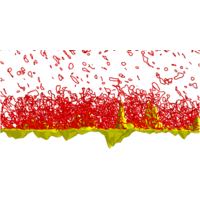
Superfluid Boundary Layer

G. W. Stagg, N. G. Parker, and C. F. Barenghi

Phys. Rev. Lett. 118, 135301 (2017) - Published 28 March, 2017

Numerical simulations indicate that boundary layers, normally the preserve of conventional fluids flowing past solid surfaces, can also arise in superfluids.

Quantum State Transfer via Noisy Photonic and Phononic Waveguides

B. Vermersch, P.-O. Guimond, H. Pichler, and P. Zoller

Phys. Rev. Lett. 118, 133601 (2017) - Published 27 March, 2017

A new quantum communication protocol is robust in the presence of thermal noise, paving the way for all-microwave quantum networks.

Band-Resolved Double Photoemission Spectroscopy on Correlated Valence Electron Pairs in Metals

Andreas Trützschler, Michael Huth, Cheng-Tien Chiang, Robin Kamrla, Frank O. Schumann, Jürgen Kirschner, and Wolf Widdra

Phys. Rev. Lett. 118, 136401 (2017) - Published 27 March, 2017

Double photoemission spectroscopy of silver and copper resolves band-specific electron pairs and reveals a band-dependent picture for electron correlation in solids.

Transport Signatures of Quasiparticle Poisoning in a Majorana Island

S. M. Albrecht, E. B. Hansen, A. P. Higginbotham, F. Kuemmeth, T. S. Jespersen, J. Nygård, P. Krogstrup, J. Danon, K. Flensberg, and C. M. Marcus

Phys. Rev. Lett. 118, 137701 (2017) - Published 27 March, 2017

A new method of estimating the limiting effects of unpaired electrons in a Majorana-based topological qubit clarifies the prospects for topological computing.

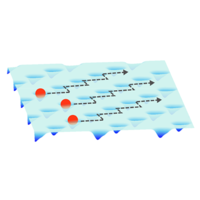
Omnidirectional Transport in Fully Reconfigurable Two Dimensional Optical Ratchets

Alejandro V. Arzola, Mario Villasante-Barahona, Karen Volke-Sepúlveda, Petr Jákl, and Pavel Zemánek

Phys. Rev. Lett. 118, 138002 (2017) - Published 27 March, 2017

Directed movement of Brownian particles in two-dimensions is achieved using a fully reconfigurable ratchet based on optical traps.

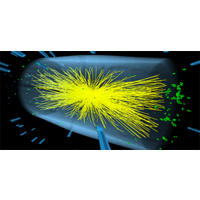
Observation of Charge-Dependent Azimuthal Correlations in p−Pb Collisions and Its Implication for the Search for the Chiral Magnetic Effect

V. Khachatryan et al. (CMS Collaboration)

Phys. Rev. Lett. 118, 122301 (2017) - Published 24 March, 2017

The CMS collaboration observes correlations between same and oppositely charged particles in proton-lead and lead-lead collisions. This challenges the chiral magnetic effect interpretation for charge-dependent azimuthal correlations, and indicates a common underlying mechanism for these correlations.

Bogoliubov Fermi Surfaces in Superconductors with Broken Time-Reversal Symmetry

D. F. Agterberg, P. M. R. Brydon, and C. Timm

Phys. Rev. Lett. 118, 127001 (2017) - Published 24 March, 2017

Predictions indicate that certain nodal superconductors with broken time-reversal symmetry have Fermi surfaces made up of charge-neutral broken Cooper pairs. This is a departure from earlier theory that accounted for the electronic structure of these superconductors via point or line nodes of the superconducting gap.

Temperature Dependence of Magnetic Excitations: Terahertz Magnons above the Curie Temperature

H. J. Qin, Kh. Zakeri, A. Ernst, and J. Kirschner

Phys. Rev. Lett. 118, 127203 (2017) - Published 24 March, 2017

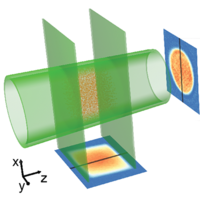
Magnetic waves in a permanent magnet can survive even when the material is too hot for large-scale magnetism to exist.

Homogeneous Atomic Fermi Gases

Biswaroop Mukherjee, Zhenjie Yan, Parth B. Patel, Zoran Hadzibabic, Tarik Yefsah, Julian Struck, and Martin W. Zwierlein

Phys. Rev. Lett. 118, 123401 (2017) - Published 23 March, 2017

A homogeneous Fermi gas is experimentally realized using a uniform trapping potential, allowing for the demonstration of phenomena not visible in inhomogeneous systems.

Vibronic Spectroscopy with Submolecular Resolution from STM-Induced Electroluminescence

Benjamin Doppagne, Michael C. Chong, Etienne Lorchat, Stéphane Berciaud, Michelangelo Romeo, Hervé Bulou, Alex Boeglin, Fabrice Scheurer, and Guillaume Schull

Phys. Rev. Lett. 118, 127401 (2017) - Published 21 March, 2017

A scanning tunneling microscope is used to excite the fluorescence of single molecules, leading to the observation of well resolved vibronic features. The work opens the way to vibronic spectroscopy with atomic-scale resolution.

Wind-Driven Formation of Ice Bridges in Straits

Bhargav Rallabandi, Zhong Zheng, Michael Winton, and Howard A. Stone

Phys. Rev. Lett. 118, 128701 (2017) - Published 21 March, 2017

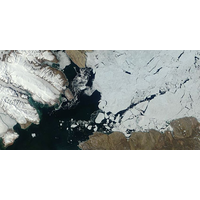
New theoretical work predicts the conditions under which sea ice will clog a narrow channel to create a natural bridge across it.

Size Sorting on the Rubble-Pile Asteroid Itokawa

Troy Shinbrot, Tapan Sabuwala, Theo Siu, Miguel Vivar Lazo, and Pinaki Chakraborty

Phys. Rev. Lett. 118, 111101 (2017) - Published 17 March, 2017

Experiments and computer simulations show that the segregation of small and large rocks on an asteroid’s surface can arise from the way particles hitting the surface collide with the rocks already present.

Spontaneous Core Rotation in Ferrofluid Pipe Flow

Alexei Krekhov and Mark Shliomis

Phys. Rev. Lett. 118, 114503 (2017) - Published 17 March, 2017

Ferrofluid flowing down a pipe is predicted to form either clockwise or counterclockwise swirls at the center of the pipe, and axial motion at the edges.

Exact Classical and Quantum Dynamics in Background Electromagnetic Fields

Tom Heinzl and Anton Ilderton

Phys. Rev. Lett. 118, 113202 (2017) - Published 16 March, 2017
Novel hidden special relativity Poincaré symmetries enable the construction of exactly solvable models of classical and quantum charge dynamics in laser fields, potentially allowing analytical studies of laser-matter interactions beyond the plane-wave approximation.

Sign In to Your Journals Account

Filter

Section

Filter

Article Lookup

Enter a citation