Highlights

Five-Loop Running of the QCD Coupling Constant

P. A. Baikov, K. G. Chetyrkin, and J. H. Kühn

Phys. Rev. Lett. 118, 082002 (2017) - Published 24 February, 2017

For the first time, theorists calculate the complete five-loop term in the beta function for quark-gluon coupling in quantum chromodynamics.

How to Make Distinct Dynamical Systems Appear Spectrally Identical

Andre G. Campos, Denys I. Bondar, Renan Cabrera, and Herschel A. Rabitz

Phys. Rev. Lett. 118, 083201 (2017) - Published 24 February, 2017

Calculations show that a carefully engineered laser pulse can induce an atom to emit light as if it were a different atom.

Impact of the Electronic Band Structure in High-Harmonic Generation Spectra of Solids

Nicolas Tancogne-Dejean, Oliver D. Mücke, Franz X. Kärtner, and Angel Rubio

Phys. Rev. Lett. 118, 087403 (2017) - Published 24 February, 2017

Advanced first-principles calculations reveal that the generation of high harmonic spectra is enhanced by the inhomogeneity of the electron­-nuclei potential, which is obtained from the band structure.

Fast Dynamics of Water Droplets Freezing from the Outside In

Sander Wildeman, Sebastian Sterl, Chao Sun, and Detlef Lohse

Phys. Rev. Lett. 118, 084101 (2017) - Published 23 February, 2017

High-speed video and modeling reveal the conditions under which water drops explode when they’re frozen from the outside in.

Selective Probing of Hidden Spin-Polarized States in Inversion-Symmetric Bulk MoS2

E. Razzoli, T. Jaouen, M.-L. Mottas, B. Hildebrand, G. Monney, A. Pisoni, S. Muff, M. Fanciulli, N. C. Plumb, V. A. Rogalev, V. N. Strocov, J. Mesot, M. Shi, J. H. Dil, H. Beck, and P. Aebi

Phys. Rev. Lett. 118, 086402 (2017) - Published 22 February, 2017

Photoemission spectroscopy has detected two different populations of spin-polarized electrons that are “hidden” within a layered, graphene-like material.

Observation of the Annihilation Decay Mode B0→K+K−

R. Aaij et al. (LHCb Collaboration)

Phys. Rev. Lett. 118, 081801 (2017) - Published 21 February, 2017

The LHCb Collaboration reports the rarest (8 in 100 million events) fully hadronic B0 meson decay ever observed.

Repulsive Fermi Polarons in a Resonant Mixture of Ultracold Li6 Atoms

F. Scazza, G. Valtolina, P. Massignan, A. Recati, A. Amico, A. Burchianti, C. Fort, M. Inguscio, M. Zaccanti, and G. Roati

Phys. Rev. Lett. 118, 083602 (2017) - Published 21 February, 2017

Radio frequency spectroscopy measurements are used to determine the effective mass, energy, and decay rate of repulsive Fermi polaron quasiparticles that emerge from impurities in an ultracold Fermi gas.

Nonmonotonic Aging and Memory Retention in Disordered Mechanical Systems

Yoav Lahini, Omer Gottesman, Ariel Amir, and Shmuel M. Rubinstein

Phys. Rev. Lett. 118, 085501 (2017) - Published 21 February, 2017

Crumpled sheets “remember” the application and removal of a force for days, a newly discovered memory effect that suggests crumpled sheets are a lot like glasses.

Marangoni Bursting: Evaporation-Induced Emulsification of Binary Mixtures on a Liquid Layer

L. Keiser, H. Bense, P. Colinet, J. Bico, and E. Reyssat

Phys. Rev. Lett. 118, 074504 (2017) - Published 17 February, 2017

A drop of water-alcohol mixture on a layer of oil was caught on video bursting into thousands of tiny droplets.

Optically Imaged Striped Domains of Nonequilibrium Electronic and Nuclear Spins in a Fractional Quantum Hall Liquid

John N. Moore, Junichiro Hayakawa, Takaaki Mano, Takeshi Noda, and Go Yusa

Phys. Rev. Lett. 118, 076802 (2017) - Published 17 February, 2017

Photoluminescence and magnetic resonance imaging reveal deformable regions in fractional quantum Hall liquids that produce nuclear spins from spin-polarized electrons.

Spontaneous Currents in Superconducting Systems with Strong Spin-Orbit Coupling

S. Mironov and A. Buzdin

Phys. Rev. Lett. 118, 077001 (2017) - Published 17 February, 2017

Spin-orbit-model calculations predict a spontaneous supercurrent at the interface between an s-wave superconductor and a ferromagnet.

Unifying Inflation with the Axion, Dark Matter, Baryogenesis, and the Seesaw Mechanism

Guillermo Ballesteros, Javier Redondo, Andreas Ringwald, and Carlos Tamarit

Phys. Rev. Lett. 118, 071802 (2017) - Published 15 February, 2017

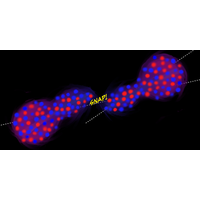
A minimal extension to the standard model of particle physics involves six new particles.

No-Go Theorem for the Characterization of Work Fluctuations in Coherent Quantum Systems

Martí Perarnau-Llobet, Elisa Bäumer, Karen V. Hovhannisyan, Marcus Huber, and Antonio Acin

Phys. Rev. Lett. 118, 070601 (2017) - Published 14 February, 2017

The operator of work in quantum thermodynamics is incompatible with quantum mechanics, which is why the correspondence principle has to be critically examined whenever work is involved.

Fundamental Limits to Collective Concentration Sensing in Cell Populations

Sean Fancher and Andrew Mugler

Phys. Rev. Lett. 118, 078101 (2017) - Published 14 February, 2017

Cells that communicate with each other can measure chemical concentrations with higher precision if they spread out into a sparse configuration.

Spin-Dependent Weakly-Interacting-Massive-Particle–Nucleon Cross Section Limits from First Data of PandaX-II Experiment

Changbo Fu et al. (PandaX-II Collaboration)

Phys. Rev. Lett. 118, 071301 (2017) - Published 13 February, 2017

New data from the PandaX-II experiment in China improves the bounds on the spin-dependent cross-sections for WIMP dark matter by a factor of two.

Transportable Optical Lattice Clock with 7×10⁻¹⁷ Uncertainty

S. B. Koller, J. Grotti, St. Vogt, A. Al-Masoudi, S. Dörscher, S. Häfner, U. Sterr, and Ch. Lisdat

Phys. Rev. Lett. 118, 073601 (2017) - Published 13 February, 2017

Transportable atomic clocks are now operating with fractional-frequency uncertainties below one part in 1016, opening up new applications.

Formation and Destabilization of the Particle Band on the Fluid-Fluid Interface

Jungchul Kim, Feng Xu, and Sungyon Lee

Phys. Rev. Lett. 118, 074501 (2017) - Published 13 February, 2017

New experiments show that when a particle suspension is injected into oil, the particles congregate at the oil-suspension interface, causing it to destabilize.

Characterizing Neutron-Proton Equilibration in Nuclear Reactions with Subzeptosecond Resolution

A. Jedele, A. B. McIntosh, K. Hagel, M. Huang, L. Heilborn, Z. Kohley, L. W. May, E. McCleskey, M. Youngs, A. Zarrella, and S. J. Yennello

Phys. Rev. Lett. 118, 062501 (2017) - Published 10 February, 2017

The equilibration of nuclei containing a large imbalance of protons and neutrons can occur in 3×10-22 seconds, according to experiments—important information for models of element-creation in supernovae.

Spin Polarization and Attosecond Time Delay in Photoemission from Spin Degenerate States of Solids

Mauro Fanciulli, Henrieta Volfová, Stefan Muff, Jürgen Braun, Hubert Ebert, Jan Minár, Ulrich Heinzmann, and J. Hugo Dil

Phys. Rev. Lett. 118, 067402 (2017) - Published 10 February, 2017

Time delay between photon entry and the resulting photoemission from a dispersive band of a solid is determined by measuring the spin polarization of the photoelectrons.

Odd-Integer Quantum Hall States and Giant Spin Susceptibility in p-Type Few-Layer WSe2

Shuigang Xu, Junying Shen, Gen Long, Zefei Wu, Zhi-qiang Bao, Cheng-Cheng Liu, Xiao Xiao, Tianyi Han, Jiangxiazi Lin, Yingying Wu, Huanhuan Lu, Jianqiang Hou, Liheng An, Yuanwei Wang, Yuan Cai, K. M. Ho, Yuheng He, Rolf Lortz, Fan Zhang, and Ning Wang

Phys. Rev. Lett. 118, 067702 (2017) - Published 10 February, 2017

Transition metal dichalcogenides in a tilted magnetic field display unconventional quantum Hall transport phenomena, including a Zeeman energy that is almost three times as large as the cyclotron energy.

Sign In to Your Journals Account

Filter

Section

Filter

Article Lookup

Enter a citation