Highlights

Phonon-Number-Sensitive Electromechanics

J. J. Viennot, X. Ma, and K. W. Lehnert

Phys. Rev. Lett. 121, 183601 (2018) - Published 29 October, 2018

Two teams demonstrate that they can count the number of quantized vibrations, or phonons, in cold mechanical oscillators by measuring the energy in the vibrations.

Observation of a Space-Time Crystal in a Superfluid Quantum Gas

J. Smits, L. Liao, H. T. C. Stoof, and P. van der Straten

Phys. Rev. Lett. 121, 185301 (2018) - Published 29 October, 2018

A space-time crystal can be created in a superfluid quantum gas by simultaneously breaking discrete time and spatial translation symmetries.

Symmetry Protection of Photonic Entanglement in the Interaction with a Single Nanoaperture

Alexander Büse, Mathieu L. Juan, Nora Tischler, Vincenzo D’Ambrosio, Fabio Sciarrino, Lorenzo Marrucci, and Gabriel Molina-Terriza

Phys. Rev. Lett. 121, 173901 (2018) - Published 26 October, 2018

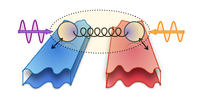
The fragile quantum state of a pair of entangled photons is undisturbed when the photons pass through a nanoscale hole, which may be useful in future light-based computing.

Quantum Ferrofluid Turbulence

T. Bland, G. W. Stagg, L. Galantucci, A. W. Baggaley, and N. G. Parker

Phys. Rev. Lett. 121, 174501 (2018) - Published 25 October, 2018

Dipolar interactions in ferrofluids can be exploited to polarize turbulence, with the potential for new structures and magnetic control.

Dynamo Effect and Turbulence in Hydrodynamic Weyl Metals

Victor Galitski, Mehdi Kargarian, and Sergey Syzranov

Phys. Rev. Lett. 121, 176603 (2018) - Published 25 October, 2018

Certain topological materials could be used in lab tests of the dynamo effect, thought to generate magnetic fields in stars and planets.

Quadrupolar Exchange-Only Spin Qubit

Maximilian Russ, J. R. Petta, and Guido Burkard

Phys. Rev. Lett. 121, 177701 (2018) - Published 25 October, 2018

A proposed spin qubit that finds a sweet spot between control and change noise may enable computation with high-speed qubit operations and very long coherence times.

Recovering Quantum Gates from Few Average Gate Fidelities

I. Roth, R. Kueng, S. Kimmel, Y.-K. Liu, D. Gross, J. Eisert, and M. Kliesch

Phys. Rev. Lett. 121, 170502 (2018) - Published 24 October, 2018

A resource efficient quantum process tomography scheme which is robust against errors is realized by combining features from randomized benchmarking and compressed sensing.

Search for CP Violation in Neutrino and Antineutrino Oscillations by the T2K Experiment with 2.2×10²¹ Protons on Target

K. Abe et al. (T2K Collaboration)

Phys. Rev. Lett. 121, 171802 (2018) - Published 24 October, 2018

More data and improved analysis methods lead to better confidence that neutrinos and antineutrinos behave slightly differently.

Topology and Geometry of Spin Origami

Krishanu Roychowdhury, D. Zeb Rocklin, and Michael J. Lawler

Phys. Rev. Lett. 121, 177201 (2018) - Published 23 October, 2018

A broad class of frustrated magnets show degenerate ground states which can be mapped onto the folding motions of origami sheets.

Atomic Step Flow on a Nanofacet

Jean-Christophe Harmand, Gilles Patriarche, Frank Glas, Federico Panciera, Ileana Florea, Jean-Luc Maurice, Laurent Travers, and Yannick Ollivier

Phys. Rev. Lett. 121, 166101 (2018) - Published 19 October, 2018

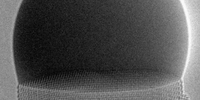
An electron microscope captures new atomic layers forming and spreading across the surface of a growing nanocrystal.

Observation of an Unusual Upward-Going Cosmic-Ray-like Event in the Third Flight of ANITA

P. W. Gorham et al.

Phys. Rev. Lett. 121, 161102 (2018) - Published 18 October, 2018

A fountain of high-energy particles that resembles an upside-down cosmic-ray shower is detected for the second time by the Antarctic Impulsive Transient Antenna.

Geometrical Bounds on Irreversibility in Open Quantum Systems

Luca Mancino, Vasco Cavina, Antonella De Pasquale, Marco Sbroscia, Robert I. Booth, Emanuele Roccia, Ilaria Gianani, Vittorio Giovannetti, and Marco Barbieri

Phys. Rev. Lett. 121, 160602 (2018) - Published 17 October, 2018

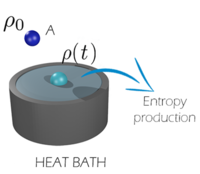
Theoretical bounds on irreversible entropy production in a thermalizing quantum system are supported by experiments simulating the thermalization of a qubit using a quantum photonic architecture.

Experimental Determination of Irreversible Entropy Production in out-of-Equilibrium Mesoscopic Quantum Systems

M. Brunelli, L. Fusco, R. Landig, W. Wieczorek, J. Hoelscher-Obermaier, G. Landi, F. L. Semião, A. Ferraro, N. Kiesel, T. Donner, G. De Chiara, and M. Paternostro

Phys. Rev. Lett. 121, 160604 (2018) - Published 17 October, 2018

Physicists observe entropy production in two intermediate-scale quantum systems, indicating that the systems have undergone an irreversible process.

Coherent Control of Penning and Associative Ionization: Insights from Symmetries

Juan J. Omiste, Johannes Floß, and Paul Brumer

Phys. Rev. Lett. 121, 163405 (2018) - Published 17 October, 2018

By taking into account formerly-neglected symmetry conditions, coherent control in atomic collision processes, such as control of Penning and Associative ionization, may be possible.

GW170817: Measurements of Neutron Star Radii and Equation of State

B. P. Abbott et al. (The LIGO Scientific Collaboration and the Virgo Collaboration)

Phys. Rev. Lett. 121, 161101 (2018) - Published 15 October, 2018

Analysis of the GW170817 event by the LIGO and Virgo collaborations constrains the radii of the progenitor neutron stars and obtains observational input on the neutron star equation of state.

Initiating and Monitoring the Evolution of Single Electrons Within Atom-Defined Structures

Mohammad Rashidi, Wyatt Vine, Thomas Dienel, Lucian Livadaru, Jacob Retallick, Taleana Huff, Konrad Walus, and Robert A. Wolkow

Phys. Rev. Lett. 121, 166801 (2018) - Published 15 October, 2018

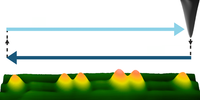
An atomic force microscope can move single-electrons at selected atomic positions on a silicon surface.

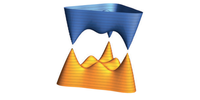
Emergent Dirac Gullies and Gully-Symmetry-Breaking Quantum Hall States in ABA Trilayer Graphene

A. A. Zibrov, P. Rao, C. Kometter, E. M. Spanton, J. I. A. Li, Cory R. Dean, T. Taniguchi, K. Watanabe, M. Serbyn, and A. F. Young

Phys. Rev. Lett. 121, 167601 (2018) - Published 15 October, 2018

Researchers observe new features in the band structure of multilayer graphene that point to enhanced electron interactions.

Mass Difference for Charged Quarks from Asymptotically Safe Quantum Gravity

Astrid Eichhorn and Aaron Held

Phys. Rev. Lett. 121, 151302 (2018) - Published 12 October, 2018

The hypothesized asymptotic safe behavior of gravity may be used to retrodict top and bottom quark masses by tracking the effect of quantum gravity fluctuations on matter fields.

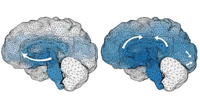
Multiphysics of Prionlike Diseases: Progression and Atrophy

Johannes Weickenmeier, Ellen Kuhl, and Alain Goriely

Phys. Rev. Lett. 121, 158101 (2018) - Published 12 October, 2018

Computer simulations of the diffusion and aggregation of harmful proteins in the brain reproduce the pattern of damage seen in several neurodegenerative diseases.

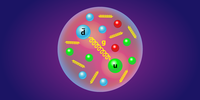
First Monte Carlo Global QCD Analysis of Pion Parton Distributions

P. C. Barry, N. Sato, W. Melnitchouk, and Chueng-Ryong Ji (Jefferson Lab Angular Momentum (JAM) Collaboration)

Phys. Rev. Lett. 121, 152001 (2018) - Published 10 October, 2018

Teaser: A combined analysis of collider data finds that the gluon contribution to the pion is three times larger than earlier estimates.

Sign In to Your Journals Account

Filter

Section

Filter

Article Lookup

Enter a citation