Highlights

Photonic Topological Insulating Phase Induced Solely by Gain and Loss

Kenta Takata and Masaya Notomi

Phys. Rev. Lett. 121, 213902 (2018) - Published 20 November, 2018

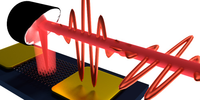
By simply tuning gain and loss, it’s possible to create and control band gap and edge states in a gapless and topologically trivial one-dimensional resonator array.

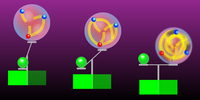
Circumventing Magnetostatic Reciprocity: A Diode for Magnetic Fields

J. Prat-Camps, P. Maurer, G. Kirchmair, and O. Romero-Isart

Phys. Rev. Lett. 121, 213903 (2018) - Published 20 November, 2018

Researchers have created a material that acts as a magnetic diode, transferring magnetism from one object to another but not the other way around.

Proton Mass Decomposition from the QCD Energy Momentum Tensor

Yi-Bo Yang, Jian Liang, Yu-Jiang Bi, Ying Chen, Terrence Draper, Keh-Fei Liu, and Zhaofeng Liu

Phys. Rev. Lett. 121, 212001 (2018) - Published 19 November, 2018

A calculation determines four distinct contributions to the proton mass, more than 90% of which arises entirely from the dynamics of quarks and gluons.

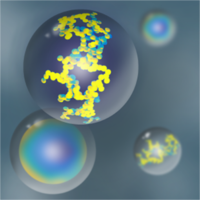
Scaling Laws for Light Absorption Enhancement Due to Nonrefractory Coating of Atmospheric Black Carbon Aerosol

Rajan K. Chakrabarty and William R. Heinson

Phys. Rev. Lett. 121, 218701 (2018) - Published 19 November, 2018

Identification of a universal power law-expression for mass-absorption cross-sections and mixing ratios of atmospheric black carbon provides a quantitative estimate of the enhancement of atmospheric light absorption.

Optimal Noise-Canceling Networks

Henrik Ronellenfitsch, Jörn Dunkel, and Michael Wilczek

Phys. Rev. Lett. 121, 208301 (2018) - Published 16 November, 2018

The structure of a network, such as an electricity grid, can be optimized to reduce the effects of fluctuations in the network’s inputs.

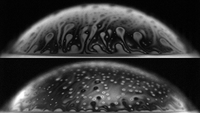
Biosurfactants Change the Thinning of Contaminated Bubbles at Bacteria-Laden Water Interfaces

S. Poulain and L. Bourouiba

Phys. Rev. Lett. 121, 204502 (2018) - Published 15 November, 2018

Bacteria in solution secrete surfactants capable of thinning bubble walls, making for smaller bubbles, increasing the contamination probability.

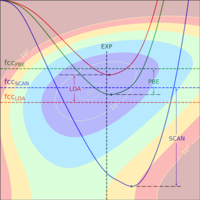
Applicability of the Strongly Constrained and Appropriately Normed Density Functional to Transition-Metal Magnetism

Yuhao Fu and David J. Singh

Phys. Rev. Lett. 121, 207201 (2018) - Published 14 November, 2018

Strongly constrained and appropriately normed density functional theory, an important technique for calculating the properties of materials, falls short when considering magnetic properties.

Coherent Electron Trajectory Control in Graphene

Christian Heide, Takuya Higuchi, Heiko B. Weber, and Peter Hommelhoff

Phys. Rev. Lett. 121, 207401 (2018) - Published 14 November, 2018

Orthogonally polarized laser pulses produce a controllable, variable current whose direction can be reversed in less than a femtosecond.

Impact-Induced Energy Transfer and Dissipation in Granular Clusters under Microgravity Conditions

Hiroaki Katsuragi and Jürgen Blum

Phys. Rev. Lett. 121, 208001 (2018) - Published 13 November, 2018

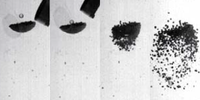
Astrophysicists dropped beads onto clumps of dust to better understand how planets coalesce from particulates.

Fine-Scale Droplet Clustering in Atmospheric Clouds: 3D Radial Distribution Function from Airborne Digital Holography

Michael L. Larsen, Raymond A. Shaw, Alexander B. Kostinski, and Susanne Glienke

Phys. Rev. Lett. 121, 204501 (2018) - Published 12 November, 2018

An imaging probe on an airplane observes the clustering of water droplets in clouds, confirming a predicted effect that is correlated with rainfall.

Transverse Kerker Scattering for Angstrom Localization of Nanoparticles

Ankan Bag, Martin Neugebauer, Paweł Woźniak, Gerd Leuchs, and Peter Banzer

Phys. Rev. Lett. 121, 193902 (2018) - Published 9 November, 2018

Laser tricks allow nanoparticle position measurements with just 0.6-angstrom uncertainty, which will be useful in future nanotech devices.

Tuning the Coupling of an Individual Magnetic Impurity to a Superconductor: Quantum Phase Transition and Transport

Laëtitia Farinacci, Gelavizh Ahmadi, Gaël Reecht, Michael Ruby, Nils Bogdanoff, Olof Peters, Benjamin W. Heinrich, Felix von Oppen, and Katharina J. Franke

Phys. Rev. Lett. 121, 196803 (2018) - Published 9 November, 2018

A magnetic-impurity junction whose exchange coupling can be mechanically tuned with an STM tip manipulating the flexibility of Fe-porphin.

Observation of Rydberg Blockade Induced by a Single Ion

F. Engel, T. Dieterle, T. Schmid, C. Tomschitz, C. Veit, N. Zuber, R. Löw, T. Pfau, and F. Meinert

Phys. Rev. Lett. 121, 193401 (2018) - Published 8 November, 2018

Forming an ion in an ultracold atomic cloud delays the subsequent creation of a Rydberg atom until the ion wanders away.

Secure Quantum Key Distribution over 421 km of Optical Fiber

Alberto Boaron, Gianluca Boso, Davide Rusca, Cédric Vulliez, Claire Autebert, Misael Caloz, Matthieu Perrenoud, Gaëtan Gras, Félix Bussières, Ming-Jun Li, Daniel Nolan, Anthony Martin, and Hugo Zbinden

Phys. Rev. Lett. 121, 190502 (2018) - Published 5 November, 2018

An optical-fiber-based quantum cryptography scheme works over a record distance of 421 km and at much faster rates than previous long-distance demonstrations.

Crack Front Interaction with Self-Emitted Acoustic Waves

D. Massy, F. Mazen, D. Landru, N. Ben Mohamed, S. Tardif, A. Reinhardt, F. Madeira, O. Kononchuk, and F. Rieutord

Phys. Rev. Lett. 121, 195501 (2018) - Published 5 November, 2018

The acoustic waves emitted by a propagating crack can affect the crack’s motion and the marks it leaves behind.

Sticky Matters: Jamming and Rigid Cluster Statistics with Attractive Particle Interactions

Dion J. Koeze and Brian P. Tighe

Phys. Rev. Lett. 121, 188002 (2018) - Published 2 November, 2018

A large system of particles with even a small attractive component jams differently than systems made of purely repulsive particles.

Density-Driven Flows in Evaporating Binary Liquid Droplets

A. M. J. Edwards, P. S. Atkinson, C. S. Cheung, H. Liang, D. J. Fairhurst, and F. F. Ouali

Phys. Rev. Lett. 121, 184501 (2018) - Published 1 November, 2018

The direction in which fluid circulates in binary drops doesn’t change when the drops are tilted, implicating gravity—not surface tension—as the driver of flow in these systems.

Observation of the Bogoliubov Dispersion in a Fluid of Light

Q. Fontaine, T. Bienaimé, S. Pigeon, E. Giacobino, A. Bramati, and Q. Glorieux

Phys. Rev. Lett. 121, 183604 (2018) - Published 31 October, 2018

At room temperature light propagates like a superfluid through an atomic vapor.

Nonlocal Spin Transport Mediated by a Vortex Liquid in Superconductors

Se Kwon Kim, Roberto Myers, and Yaroslav Tserkovnyak

Phys. Rev. Lett. 121, 187203 (2018) - Published 31 October, 2018

A proposed method for transporting spin from one place to another utilizes superconducting vortices as carriers of spin information.

Superallowed α Decay to Doubly Magic Sn100

K. Auranen, D. Seweryniak, M. Albers, A. D. Ayangeakaa, S. Bottoni, M. P. Carpenter, C. J. Chiara, P. Copp, H. M. David, D. T. Doherty, J. Harker, C. R. Hoffman, R. V. F. Janssens, T. L. Khoo, S. A. Kuvin, T. Lauritsen, G. Lotay, A. M. Rogers, J. Sethi, C. Scholey, R. Talwar, W. B. Walters, P. J. Woods, and S. Zhu

Phys. Rev. Lett. 121, 182501 (2018) - Published 30 October, 2018

The detection of unusually fast alpha emission from a heavy isotope could lead to new ways of testing the nuclear shell model.

Sign In to Your Journals Account

Filter

Section

Filter

Article Lookup

Enter a citation