Highlights

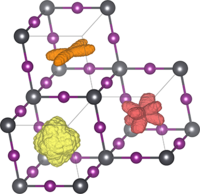
Phase Transitions of Hybrid Perovskites Simulated by Machine-Learning Force Fields Trained on the Fly with Bayesian Inference

Ryosuke Jinnouchi, Jonathan Lahnsteiner, Ferenc Karsai, Georg Kresse, and Menno Bokdam

Phys. Rev. Lett. 122, 225701 (2019) - Published 7 June, 2019

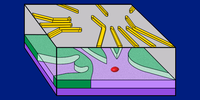
An on-the-fly machine learning approach that bypasses the construction of myriad reference datasets is used to study phase transitions in complex hybrid perovskites.

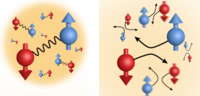
Contact Networks Enhance Shear Thickening in Attractive Colloid-Polymer Mixtures

Nayoung Park, Vikram Rathee, Daniel L. Blair, and Jacinta C. Conrad

Phys. Rev. Lett. 122, 228003 (2019) - Published 7 June, 2019

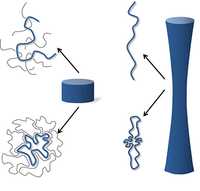
Adding long polymers to a fluid that becomes more viscous as it’s stirred amplifies the effect, in contrast to results with short polymers.

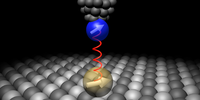
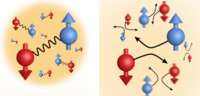
Tuning the Exchange Bias on a Single Atom from 1 mT to 10 T

Kai Yang, William Paul, Fabian D. Natterer, Jose L. Lado, Yujeong Bae, Philip Willke, Taeyoung Choi, Alejandro Ferrón, Joaquín Fernández-Rossier, Andreas J. Heinrich, and Christopher P. Lutz

Phys. Rev. Lett. 122, 227203 (2019) - Published 6 June, 2019

Researchers modify the magnetic field of a single atom, demonstrating a potential way to store information in tiny devices of the future.

Observation of a Narrow Pentaquark State, Pc(4312)+, and of the Two-Peak Structure of the Pc(4450)+

R. Aaij et al. (LHCb Collaboration)

Phys. Rev. Lett. 122, 222001 (2019) - Published 5 June, 2019

New Large Hadron Collider data reveal that exotic quark quintets, discovered in 2016, are composites of quark-antiquark mesons and three-quark baryons.

Early Dark Energy can Resolve the Hubble Tension

Vivian Poulin, Tristan L. Smith, Tanvi Karwal, and Marc Kamionkowski

Phys. Rev. Lett. 122, 221301 (2019) - Published 4 June, 2019

A discrepancy between measurements of the cosmic expansion rate might be resolved by adding an extra form of dark energy.

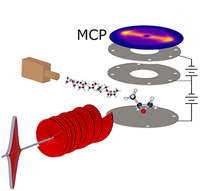
Controlled Enantioselective Orientation of Chiral Molecules with an Optical Centrifuge

Alexander A. Milner, Jordan A. M. Fordyce, Ian MacPhail-Bartley, Walter Wasserman, Valery Milner, Ilia Tutunnikov, and Ilya Sh. Averbukh

Phys. Rev. Lett. 122, 223201 (2019) - Published 3 June, 2019

By using properly shaped laser pulses (essentially creating an optical centrifuge) the rotational motion of molecular enantiomers can be changed in a way that depends on their handedness.

Large-Scale Photonic Ising Machine by Spatial Light Modulation

D. Pierangeli, G. Marcucci, and C. Conti

Phys. Rev. Lett. 122, 213902 (2019) - Published 31 May, 2019

A new optical processor for solving hard optimization problems breaks previous size records and is based on a highly scalable technology.

Continuously Sheared Granular Matter Reproduces in Detail Seismicity Laws

S. Lherminier, R. Planet, V. Levy dit Vehel, G. Simon, L. Vanel, K. J. Måløy, and O. Ramos

Phys. Rev. Lett. 122, 218501 (2019) - Published 31 May, 2019

A 2D array of disks under stress has replicated several statistical features of earthquakes, suggesting that this system is an accurate model of seismic phenomena.

Periodicity Disruption of a Model Quasibiennial Oscillation of Equatorial Winds

Antoine Renaud, Louis-Philippe Nadeau, and Antoine Venaille

Phys. Rev. Lett. 122, 214504 (2019) - Published 30 May, 2019

A new model provides a possible explanation for why Earth’s equatorial winds missed their scheduled direction switch from westerly to easterly flow.

Observation of CP Violation in Charm Decays

R. Aaij et al. (LHCb Collaboration)

Phys. Rev. Lett. 122, 211803 (2019) - Published 29 May, 2019

A study of particles containing charm quarks has uncovered a violation of so-called CP symmetry, which could help in understanding why matter dominates antimatter in the Universe.

Experimental Evidence of a Hydrodynamic Soliton Gas

Ivan Redor, Eric Barthélemy, Hervé Michallet, Miguel Onorato, and Nicolas Mordant

Phys. Rev. Lett. 122, 214502 (2019) - Published 29 May, 2019

Waves in a shallow water tank are made to behave like a gas of solitons, demonstrating an experimental platform for future investigations.

Operator Size at Finite Temperature and Planckian Bounds on Quantum Dynamics

Andrew Lucas

Phys. Rev. Lett. 122, 216601 (2019) - Published 29 May, 2019

There may be a universal bound on the dissipative timescale in a many-body quantum system for the decay of a small operator into a combination of large operators.

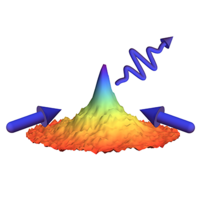
Direct Laser Cooling to Bose-Einstein Condensation in a Dipole Trap

Alban Urvoy, Zachary Vendeiro, Joshua Ramette, Albert Adiyatullin, and Vladan Vuletić

Phys. Rev. Lett. 122, 203202 (2019) - Published 24 May, 2019

A new scheme for cooling 87Rb to Bose-Einstein condensation uses only lasers, unlike the usual method combining laser and evaporation cooling.

Standing Waves Induced by Valley-Mismatched Domains in Ferroelectric SnTe Monolayers

Kai Chang, Brandon J. Miller, Hao Yang, Haicheng Lin, Stuart S. P. Parkin, Salvador Barraza-Lopez, Qi-Kun Xue, Xi Chen, and Shuai-Hua Ji

Phys. Rev. Lett. 122, 206402 (2019) - Published 24 May, 2019

Mismatched valleys across electrically neutral domain walls of a 2D ferroelectric material are shown to induce quasiparticle standing waves.

Contact and Sum Rules in a Near-Uniform Fermi Gas at Unitarity

C. Carcy, S. Hoinka, M. G. Lingham, P. Dyke, C. C. N. Kuhn, H. Hu, and C. J. Vale

Phys. Rev. Lett. 122, 203401 (2019) - Published 23 May, 2019

Cold-atom experiments probe how likely atoms are to pair up in strongly interacting fermion systems.

Spectral Response and Contact of the Unitary Fermi Gas

Biswaroop Mukherjee, Parth B. Patel, Zhenjie Yan, Richard J. Fletcher, Julian Struck, and Martin W. Zwierlein

Phys. Rev. Lett. 122, 203402 (2019) - Published 23 May, 2019

Cold-atom experiments probe how likely atoms are to pair up in strongly interacting fermion systems.

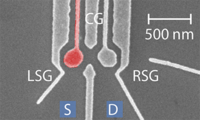
All-Microwave Control and Dispersive Readout of Gate-Defined Quantum Dot Qubits in Circuit Quantum Electrodynamics

P. Scarlino, D. J. van Woerkom, A. Stockklauser, J. V. Koski, M. C. Collodo, S. Gasparinetti, C. Reichl, W. Wegscheider, T. Ihn, K. Ensslin, and A. Wallraff

Phys. Rev. Lett. 122, 206802 (2019) - Published 22 May, 2019

A superconducting resonator coupled to a semiconductor double quantum dot allows for a detailed study of coherence properties of charge qubits.

Spectroscopy of Quantum Dot Orbitals with In-Plane Magnetic Fields

Leon C. Camenzind, Liuqi Yu, Peter Stano, Jeramy D. Zimmerman, Arthur C. Gossard, Daniel Loss, and Dominik M. Zumbühl

Phys. Rev. Lett. 122, 207701 (2019) - Published 22 May, 2019

A new experimental method provides a way to determine the 3D confining potential of an electron in a quantum dot, allowing improved control over the electron’s spin.

Unexpected Stretching of Entangled Ring Macromolecules

Q. Huang, J. Ahn, D. Parisi, T. Chang, O. Hassager, S. Panyukov, M. Rubinstein, and D. Vlassopoulos

Phys. Rev. Lett. 122, 208001 (2019) - Published 22 May, 2019

Macromolecules without free ends respond to uniaxial stretching in a way that distinguishes them from any other polymer.

Criticality between Cortical States

Antonio J. Fontenele, Nivaldo A. P. de Vasconcelos, Thaís Feliciano, Leandro A. A. Aguiar, Carina Soares-Cunha, Bárbara Coimbra, Leonardo Dalla Porta, Sidarta Ribeiro, Ana João Rodrigues, Nuno Sousa, Pedro V. Carelli, and Mauro Copelli

Phys. Rev. Lett. 122, 208101 (2019) - Published 21 May, 2019

Researchers observe a critical point—a feature indicative of a continuous phase transition—in the brain’s electrical activity as it switches from an asleep-like to an awake-like state.

Sign In to Your Journals Account

Filter

Section

Filter

Article Lookup

Enter a citation