Highlights

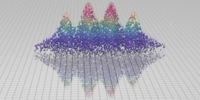
Topological Amorphous Metals

Yan-Bin Yang, Tao Qin, Dong-Ling Deng, L.-M. Duan, and Yong Xu

Phys. Rev. Lett. 123, 076401 (2019) - Published 12 August, 2019

A predicted 3D topological amorphous metal has properties that are fundamentally different from crystalline topological metals.

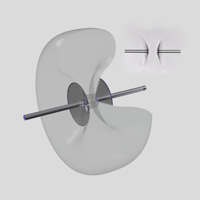
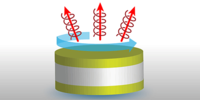
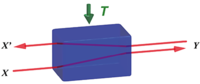
Nonreciprocal Refraction of Light in a Magnetoelectric Material

S. Toyoda, N. Abe, and T. Arima

Phys. Rev. Lett. 123, 077401 (2019) - Published 12 August, 2019

Predicted more than a decade ago, nonreciprocal refraction of light by a magnetoelectric material has been experimentally observed for the first time.

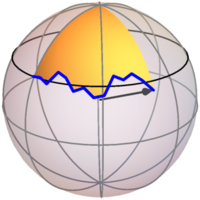
Non-Abelian Geometric Dephasing

Kyrylo Snizhko, Reinhold Egger, and Yuval Gefen

Phys. Rev. Lett. 123, 060405 (2019) - Published 9 August, 2019

Fluctuations in adiabatic quantum transport in systems coupled to a bath result in a type of geometric dephasing with clear signatures in interference experiments.

Realization of the Einstein-Podolsky-Rosen Paradox Using Radial Position and Radial Momentum Variables

Lixiang Chen, Tianlong Ma, Xiaodong Qiu, Dongkai Zhang, Wuhong Zhang, and Robert W. Boyd

Phys. Rev. Lett. 123, 060403 (2019) - Published 8 August, 2019

Correlations between the radial position and radial momentum of entangled photons demonstrate the suitability of these properties for quantum information applications.

Dark Matter from Scalar Field Fluctuations

Tommi Tenkanen

Phys. Rev. Lett. 123, 061302 (2019) - Published 7 August, 2019

A model postulates that dark matter may have been generated during inflation, sourced by fluctuations of a massive scalar field minimally coupled only to gravity.

Scaling Laws of an Exploding Liquid Column under an Intense Ultrashort X-Ray Pulse

Alfonso M. Gañán-Calvo

Phys. Rev. Lett. 123, 064501 (2019) - Published 7 August, 2019

A proposed general formulation of the partial destruction of a liquid object in vacuum impacted by an ultrashort x-ray pulse suggests that energy instantaneously raises the pressure of a portion of the liquid to extreme values and causes its explosive expansion into vacuum.

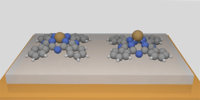
Charge-Induced Structural Changes in a Single Molecule Investigated by Atomic Force Microscopy

Philipp Scheuerer, Laerte L. Patera, Felix Simbürger, Fabian Queck, Ingmar Swart, Bruno Schuler, Leo Gross, Nikolaj Moll, and Jascha Repp

Phys. Rev. Lett. 123, 066001 (2019) - Published 7 August, 2019

Atomic force microscopy detects the subtle structural changes that take place when a molecule is ionized.

Theory of a Planckian Metal

Aavishkar A. Patel and Subir Sachdev

Phys. Rev. Lett. 123, 066601 (2019) - Published 7 August, 2019

A generalization of the Sachdev-Ye-Kitaev model realizes a compressible metal in which the resistivity is linear in temperature and independent of the strength of the interactions.

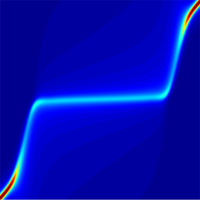
Landauer Formula for a Superconducting Quantum Point Contact

Sergey S. Pershoguba, Thomas Veness, and Leonid I. Glazman

Phys. Rev. Lett. 123, 067001 (2019) - Published 7 August, 2019

The Landauer formula, which relates the conductance of a mesoscopic conductor to the transmission coefficient for electrons passing through it, is reformulated for a superconducting point contact.

Rotational and Rotational-Vibrational Raman Spectroscopy of Air to Characterize Astronomical Spectrographs

Frédéric P. A. Vogt, Florian Kerber, Andrea Mehner, Shanshan Yu, Thomas Pfrommer, Gaspare Lo Curto, Pedro Figueira, Diego Parraguez, Francesco A. Pepe, Denis Mégevand, Marco Riva, Paolo Di Marcantonio, Christophe Lovis, Manuel Amate, Paolo Molaro, Alexandre Cabral, and Maria Rosa Zapatero Osorio

Phys. Rev. Lett. 123, 061101 (2019) - Published 6 August, 2019

Laser-generated “stars”—used at telescopes to correct for atmospheric turbulence—could help researchers calibrate the wavelengths of certain astrophysical observations.

Revisiting the Photon-Drag Effect in Metal Films

Jared H. Strait, Glenn Holland, Wenqi Zhu, Cheng Zhang, Bojan R. Ilic, Amit Agrawal, Domenico Pacifici, and Henri J. Lezec

Phys. Rev. Lett. 123, 053903 (2019) - Published 2 August, 2019

Light hitting a metal surface at an angle can push the electrons forward in air or backward in vacuum, a result that leaves theorists puzzled.

Excitation Spectrum of a Trapped Dipolar Supersolid and Its Experimental Evidence

G. Natale, R. M. W. van Bijnen, A. Patscheider, D. Petter, M. J. Mark, L. Chomaz, and F. Ferlaino

Phys. Rev. Lett. 123, 050402 (2019) - Published 1 August, 2019

Researchers find new evidence that a Bose-Einstein condensate made of erbium atoms undergoes a phase transition into a bizarre form of quantum matter.

Fluctuation-Induced Torque on a Topological Insulator out of Thermal Equilibrium

M. F. Maghrebi, A. V. Gorshkov, and J. D. Sau

Phys. Rev. Lett. 123, 055901 (2019) - Published 1 August, 2019

Theorists uncover a new magnetomechanical effect in topological insulators that are hotter than their environment.

Observation of Light-by-Light Scattering in Ultraperipheral Pb+Pb Collisions with the ATLAS Detector

G. Aad et al. (ATLAS Collaboration)

Phys. Rev. Lett. 123, 052001 (2019) - Published 31 July, 2019

Researchers at the Large Hadron Collider conclusively detect two photons scattering off each other, following initial evidence first published in 2017.

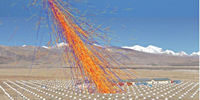
First Detection of Photons with Energy beyond 100 TeV from an Astrophysical Source

M. Amenomori et al. (Tibet ASγ Collaboration)

Phys. Rev. Lett. 123, 051101 (2019) - Published 29 July, 2019

An experiment operating at high altitudes in Tibet has detected the highest energy photons ever observed from an astrophysical source, the Crab Nebula.

Metric Space of Collider Events

Patrick T. Komiske, Eric M. Metodiev, and Jesse Thaler

Phys. Rev. Lett. 123, 041801 (2019) - Published 26 July, 2019

A new way to measure the “distance” between high-energy particle collision events can help researchers interpret events involving, for example, the production of Higgs bosons or of top quarks.

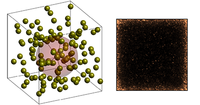
From Stress Chains to Acoustic Emission

Ke Gao, Robert Guyer, Esteban Rougier, Christopher X. Ren, and Paul A. Johnson

Phys. Rev. Lett. 123, 048003 (2019) - Published 26 July, 2019

Acoustics emissions in granular systems can be related to the dynamics of chains of particles pressing against each other.

Twenty-Five-Fold Reduction in Measurement Uncertainty for a Molecular Line Intensity

Adam J. Fleisher, Erin M. Adkins, Zachary D. Reed, Hongming Yi, David A. Long, Hélène M. Fleurbaey, and Joseph T. Hodges

Phys. Rev. Lett. 123, 043001 (2019) - Published 24 July, 2019

More accurate measurements of CO2 in the atmosphere can be obtained by accounting for discrepancies in spectroscopy hardware.

Electronic Compressibility of Magic-Angle Graphene Superlattices

S. L. Tomarken, Y. Cao, A. Demir, K. Watanabe, T. Taniguchi, P. Jarillo-Herrero, and R. C. Ashoori

Phys. Rev. Lett. 123, 046601 (2019) - Published 24 July, 2019

A capacitance bridge enables measurements of the thermodynamic density of states of magic-angle twisted bilayer graphene.

Photonic Anomalous Quantum Hall Effect

Sunil Mittal, Venkata Vikram Orre, Daniel Leykam, Y. D. Chong, and Mohammad Hafezi

Phys. Rev. Lett. 123, 043201 (2019) - Published 23 July, 2019
Researchers engineered semiconductor systems that sustain exotic phases of matter.

Sign In to Your Journals Account

Filter

Section

Filter

Article Lookup

Enter a citation