Highlights

Environmental Nanoparticle-Induced Toughening and Pinning of a Growing Crack in a Biopolymer Hydrogel

O. Ronsin, I. Naassaoui, A. Marcellan, and T. Baumberger

Phys. Rev. Lett. 123, 158002 (2019) - Published 8 October, 2019

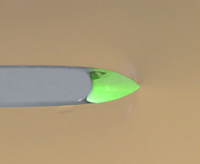
A single drop of silica nanoparticle solution deposited at the tip of a crack inside a stretched hydrogel material stops the crack from propagating further and strengthens the hydrogel material.

Shear-Jammed, Fragile, and Steady States in Homogeneously Strained Granular Materials

Yiqiu Zhao (赵逸秋), Jonathan Barés, Hu Zheng (郑虎), Joshua E. S. Socolar, and Robert P. Behringer

Phys. Rev. Lett. 123, 158001 (2019) - Published 7 October, 2019

The characterization of a new transition in sheared grains helps to fill in the phase diagram for granular materials.

Propelled Strings: Rising from Friction

Nicolas Taberlet, Jérémy Ferrand, and Nicolas Plihon

Phys. Rev. Lett. 123, 144501 (2019) - Published 4 October, 2019

Air friction allows a rapidly rotating loop of string to lift up its unsupported end.

Multiple Shape Coexistence in Cd110,112

P. E. Garrett et al.

Phys. Rev. Lett. 123, 142502 (2019) - Published 3 October, 2019

Cadmium nuclei take on multiple shapes at low excitation energies, a discovery that overturns a long-accepted tenet of nuclear structure.

First Star-Forming Structures in Fuzzy Cosmic Filaments

Philip Mocz, Anastasia Fialkov, Mark Vogelsberger, Fernando Becerra, Mustafa A. Amin, Sownak Bose, Michael Boylan-Kolchin, Pierre-Henri Chavanis, Lars Hernquist, Lachlan Lancaster, Federico Marinacci, Victor H. Robles, and Jesús Zavala

Phys. Rev. Lett. 123, 141301 (2019) - Published 2 October, 2019

Simulations show that competing models of dark matter produce primordial star-forming regions that look very different from one another.

Tunable Axion Plasma Haloscopes

Matthew Lawson, Alexander J. Millar, Matteo Pancaldi, Edoardo Vitagliano, and Frank Wilczek

Phys. Rev. Lett. 123, 141802 (2019) - Published 1 October, 2019

A proposed device could detect the hypothesized dark matter particle in a mass regime not probed by other devices.

Genuine Quantum Nonlocality in the Triangle Network

Marc-Olivier Renou, Elisa Bäumer, Sadra Boreiri, Nicolas Brunner, Nicolas Gisin, and Salman Beigi

Phys. Rev. Lett. 123, 140401 (2019) - Published 30 September, 2019

A quantum network with a triangular geometry displays nonclassical correlations that appear to be fundamentally different from those so far revealed through Bell tests.

Quantum Nonlocal Aberration Cancellation

A. Nicholas Black, Enno Giese, Boris Braverman, Nicholas Zollo, Stephen M. Barnett, and Robert W. Boyd

Phys. Rev. Lett. 123, 143603 (2019) - Published 30 September, 2019

Optical aberration cancellation is predicted and demonstrated to all orders by means of position-momentum entangled photons.

Chiral Gravitons in Fractional Quantum Hall Liquids

Shiuan-Fan Liou, F. D. M. Haldane, Kun Yang, and E. H. Rezayi

Phys. Rev. Lett. 123, 146801 (2019) - Published 30 September, 2019

In the limit of long wavelengths, collective excitations of fractional quantum Hall liquids are gravitons with a chiral nature.

Capturing the Shear and Secondary Compression Waves: High-Frame-Rate Ultrasound Imaging in Saturated Foams

J. Aichele, B. Giammarinaro, M. Reinwald, G. Le Moign, and S. Catheline

Phys. Rev. Lett. 123, 148001 (2019) - Published 30 September, 2019

Fast ultrasonic imaging can resolve shear and slow compression waves in foams, with direct implications for improved medical imaging of lung and liver tissue.

Hiding the Cosmological Constant

S. Carlip

Phys. Rev. Lett. 123, 131302 (2019) - Published 27 September, 2019

Theory suggests that empty space is filled with enormous energy, but according to a new proposal this energy may be hidden because its effects cancel at the tiniest scales.

Standard Ruler at Cosmic Dawn

Julian B. Muñoz

Phys. Rev. Lett. 123, 131301 (2019) - Published 26 September, 2019

A theoretical study pinpoints a new standard ruler for measuring the cosmic expansion rate when stars were just starting to form.

Topological Classification of Shot Noise on Fractional Quantum Hall Edges

Christian Spånslätt, Jinhong Park, Yuval Gefen, and Alexander D. Mirlin

Phys. Rev. Lett. 123, 137701 (2019) - Published 26 September, 2019

Shot noise generated on fractional quantum Hall edges can represent three possible combinations of electrical and thermal transport.

Advantage of Being Multicomponent and Spatial: Multipartite Viruses Colonize Structured Populations with Lower Thresholds

Yi-Jiao Zhang, Zhi-Xi Wu, Petter Holme, and Kai-Cheng Yang

Phys. Rev. Lett. 123, 138101 (2019) - Published 26 September, 2019

Proposed network-based model explains why multipartite viruses colonize mostly plants, but not animals or humans.

3D Strain in 2D Materials: To What Extent is Monolayer Graphene Graphite?

Y. W. Sun, W. Liu, I. Hernandez, J. Gonzalez, F. Rodriguez, D. J. Dunstan, and C. J. Humphreys

Phys. Rev. Lett. 123, 135501 (2019) - Published 25 September, 2019

Atomically thin graphene is considered a prototypical 2D material, but high-pressure experiments now reveal the 3D nature of its mechanical properties.

Alternative Frictional Model for Discontinuous Shear Thickening of Dense Suspensions: Hydrodynamics

Safa Jamali and John F. Brady

Phys. Rev. Lett. 123, 138002 (2019) - Published 25 September, 2019

Asperities change the dynamics of particles in the discontinuous shear thickening regime.

Deterministic Shaping and Reshaping of Single-Photon Temporal Wave Functions

O. Morin, M. Körber, S. Langenfeld, and G. Rempe

Phys. Rev. Lett. 123, 133602 (2019) - Published 24 September, 2019

Consistent control of an individual photon’s amplitude and phase inside a cavity is now possible, promising applications in quantum information.

Giant Thermoelectric Response of Nanofluidic Systems Driven by Water Excess Enthalpy

Li Fu, Laurent Joly, and Samy Merabia

Phys. Rev. Lett. 123, 138001 (2019) - Published 24 September, 2019

Improved modeling for nanofluidic systems predicts thermoelectric performance comparable to that of state of the art solid thermoelectrics.

Treelike Interactions and Fast Scrambling with Cold Atoms

Gregory Bentsen, Tomohiro Hashizume, Anton S. Buyskikh, Emily J. Davis, Andrew J. Daley, Steven S. Gubser, and Monika Schleier-Smith

Phys. Rev. Lett. 123, 130601 (2019) - Published 23 September, 2019

Scheme based on cold atoms to simulate many-body quantum effects in spin models with varying degrees of connectivity shows that a sparse, nonrandom interaction graph suffices to attain fast scrambling.

Underlying Topological Dirac Nodal Line Mechanism of the Anomalously Large Electron-Phonon Coupling Strength on a Be (0001) Surface

Ronghan Li, Jiangxu Li, Lei Wang, Jiaxi Liu, Hui Ma, Hai-Feng Song, Dianzhong Li, Yiyi Li, and Xing-Qiu Chen

Phys. Rev. Lett. 123, 136802 (2019) - Published 23 September, 2019
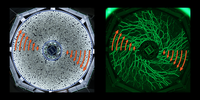
The underlying mechanism behind the anomalously large electron-phonon coupling effect in beryllium can be attributed to a novel electron-phonon enhancement caused by topologically protected Dirac-nodal-line-induced non-trivial surface states.

Sign In to Your Journals Account

Filter

Section

Filter

Article Lookup

Enter a citation