Highlights

Absence of Evidence of Electrical Switching of the Antiferromagnetic Néel Vector

C. C. Chiang, S. Y. Huang, D. Qu, P. H. Wu, and C. L. Chien

Phys. Rev. Lett. 123, 227203 (2019) - Published 27 November, 2019

New experiments suggest that heat might be responsible for the current-induced voltage signals measured in antiferromagnets and not a rotation of the material’s spins as previously thought.

Energy of the Th229 Nuclear Clock Isomer Determined by Absolute γ-ray Energy Difference

A. Yamaguchi, H. Muramatsu, T. Hayashi, N. Yuasa, K. Nakamura, M. Takimoto, H. Haba, K. Konashi, M. Watanabe, H. Kikunaga, K. Maehata, N. Y. Yamasaki, and K. Mitsuda

Phys. Rev. Lett. 123, 222501 (2019) - Published 26 November, 2019

A new technique to measure the first isomeric state in 229Th confirms that this isomer is in the laser-accessible vacuum ultraviolet range, and is therefore a candidate for driving a nuclear optical clock.

Robust Increase in Supply by Vessel Dilation in Globally Coupled Microvasculature

Felix J. Meigel, Peter Cha, Michael P. Brenner, and Karen Alim

Phys. Rev. Lett. 123, 228103 (2019) - Published 26 November, 2019

A new model predicts that the network pattern formed by the brain’s blood vessels plays no role in local metabolite transport, finding instead that vessel dilation is the key.

Improved Upper Limit on the Neutrino Mass from a Direct Kinematic Method by KATRIN

M. Aker et al. (KATRIN Collaboration)

Phys. Rev. Lett. 123, 221802 (2019) - Published 25 November, 2019

The Karlsruhe Tritium Neutrino Experiment (KATRIN) shows that the mass of the neutrino is no larger than about 1 eV—cutting in half the existing limit derived from similar experiments.

Underlying Structure of Collective Bands and Self-Organization in Quantum Systems

T. Otsuka, Y. Tsunoda, T. Abe, N. Shimizu, and P. Van Duppen

Phys. Rev. Lett. 123, 222502 (2019) - Published 25 November, 2019

Shell model calculations reveal that collectivity in heavy nuclei could be facilitated by quantum-mechanical self-organization.

Spectral Statistics and Many-Body Quantum Chaos with Conserved Charge

Aaron J. Friedman, Amos Chan, Andrea De Luca, and J. T. Chalker

Phys. Rev. Lett. 123, 210603 (2019) - Published 22 November, 2019

Diffuse scaling of the Thouless time is found for chaotic many-body quantum systems with a conserved charge.

Observation of the Leptonic Decay D+→τ+ντ

M. Ablikim et al. (BESIII Collaboration)

Phys. Rev. Lett. 123, 211802 (2019) - Published 22 November, 2019

The first observation of the two-body decay of a charm meson into a tau and its neutrino allow for a new probe of lepton flavor universality.

Magnus Hall Effect

Michał Papaj and Liang Fu

Phys. Rev. Lett. 123, 216802 (2019) - Published 22 November, 2019

A new type of linear-response Hall effect is a quantum analog to the Magnus effect, and has implications for current rectification devices and provides a tool to map Berry curvature distribution in momentum space.

Higher-Order Topological Insulator in Twisted Bilayer Graphene

Moon Jip Park, Youngkuk Kim, Gil Young Cho, and SungBin Lee

Phys. Rev. Lett. 123, 216803 (2019) - Published 22 November, 2019

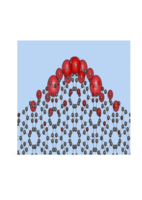
With the appearance of corner states at unexpectedly large angles, as long as its crystalline symmetry is left intact, twisted bilayer graphene functions as a higher-order topological insulator.

Guiding Dirac Fermions in Graphene with a Carbon Nanotube

Austin Cheng, Takashi Taniguchi, Kenji Watanabe, Philip Kim, and Jean-Damien Pillet

Phys. Rev. Lett. 123, 216804 (2019) - Published 22 November, 2019

A new waveguide that uses a nanotube to guide electrons could lead to novel types of circuitry in quantum computers.

Quantum Time Crystals from Hamiltonians with Long-Range Interactions

Valerii K. Kozin and Oleksandr Kyriienko

Phys. Rev. Lett. 123, 210602 (2019) - Published 20 November, 2019

A calculation shows that an elusive, isolated quantum time crystal may not be far from reality.

Quantitative Assessment of the Toner and Tu Theory of Polar Flocks

Benoît Mahault, Francesco Ginelli, and Hugues Chaté

Phys. Rev. Lett. 123, 218001 (2019) - Published 19 November, 2019

Unprecedented large-scale numerical simulations of Viscek-type active particles provide a much-needed quantitative evaluation of the seminal Toner-Tu theory of flocking.

Location of the Neutron Dripline at Fluorine and Neon

D. S. Ahn, N. Fukuda, H. Geissel, N. Inabe, N. Iwasa, T. Kubo, K. Kusaka, D. J. Morrissey, D. Murai, T. Nakamura, M. Ohtake, H. Otsu, H. Sato, B. M. Sherrill, Y. Shimizu, H. Suzuki, H. Takeda, O. B. Tarasov, H. Ueno, Y. Yanagisawa, and K. Yoshida

Phys. Rev. Lett. 123, 212501 (2019) - Published 18 November, 2019

Researchers have identified the largest possible isotopes of fluorine and neon, extending the neutron “dripline” for the first time in 20 years.

Hanbury Brown–Twiss Correlations for a Driven Superatom

J. Lampen, A. Duspayev, H. Nguyen, H. Tamura, P. R. Berman, and A. Kuzmich

Phys. Rev. Lett. 123, 203603 (2019) - Published 15 November, 2019

An experiment involving a gas of two-level atoms distinguishes between two mechanisms of light-matter interaction: stimulated emission and Hanbury Brown and Twiss interference.

Dirac Spin Liquid on the Spin-1/2 Triangular Heisenberg Antiferromagnet

Shijie Hu, W. Zhu, Sebastian Eggert, and Yin-Chen He

Phys. Rev. Lett. 123, 207203 (2019) - Published 15 November, 2019

Large scale iDMRG simulations show that the spin-1/2 J1-J2-Heisenberg antiferromagnet on a triangular lattice is a U(1) Dirac quantum spin liquid.

Tuning the Random Walk of Active Colloids: From Individual Run-and-Tumble to Dynamic Clustering

Hamid Karani, Gerardo E. Pradillo, and Petia M. Vlahovska

Phys. Rev. Lett. 123, 208002 (2019) - Published 14 November, 2019

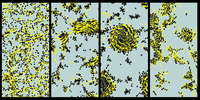
The jerky, random motion of bacteria has now been reproduced using artificial microswimmers, yielding collective behaviors similar to those of real-world bacterial swarms.

Entropy Production in Open Systems: The Predominant Role of Intraenvironment Correlations

Krzysztof Ptaszyński and Massimiliano Esposito

Phys. Rev. Lett. 123, 200603 (2019) - Published 13 November, 2019

Specific contributions to entropy may be the key to understanding how and when quantum systems equilibrate.

Entanglement-Ergodic Quantum Systems Equilibrate Exponentially Well

H. Wilming, M. Goihl, I. Roth, and J. Eisert

Phys. Rev. Lett. 123, 200604 (2019) - Published 13 November, 2019

Specific contributions to entropy may be the key to understanding how and when quantum systems equilibrate.

Rigid Band Shifts in Two-Dimensional Semiconductors through External Dielectric Screening

Lutz Waldecker, Archana Raja, Malte Rösner, Christina Steinke, Aaron Bostwick, Roland J. Koch, Chris Jozwiak, Takashi Taniguchi, Kenji Watanabe, Eli Rotenberg, Tim O. Wehling, and Tony F. Heinz

Phys. Rev. Lett. 123, 206403 (2019) - Published 13 November, 2019

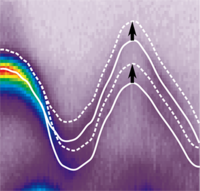
Valence and conduction bands exhibit rigid shifts in a monolayer of the dichalcogenide WS2 when it is exposed to spatially separated dielectric environments.

Topology, Geometry, and Mechanics of Strongly Stretched and Twisted Filaments: Solenoids, Plectonemes, and Artificial Muscle Fibers

Nicholas Charles, Mattia Gazzola, and L. Mahadevan

Phys. Rev. Lett. 123, 208003 (2019) - Published 13 November, 2019

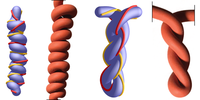
How an elastic filament deforms under stress has been quantified in simulations, with implications for the design of artificial muscles.

Sign In to Your Journals Account

Filter

Section

Filter

Article Lookup

Enter a citation