Highlights

Single-Cycle Optical Control of Beam Electrons

Yuya Morimoto and Peter Baum

Phys. Rev. Lett. 125, 193202 (2020) - Published 3 November, 2020

Researchers generate isolated, high-energy electron pulses that promise ultrafast electron imaging and more.

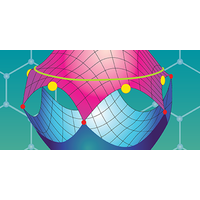
Blue Phosphorene Bilayer Is a Two-Dimensional Metal and an Unambiguous Classification Scheme for Buckled Hexagonal Bilayers

Jessica Arcudia, Roman Kempt, Miguel Eduardo Cifuentes-Quintal, Thomas Heine, and Gabriel Merino

Phys. Rev. Lett. 125, 196401 (2020) - Published 3 November, 2020

A scheme to identify and label honeycomb bilayers indicates that a configuration of blue phosphorene might be a 2D metal rather than an indirect band gap semiconductor.

Frictionless Motion of Lattice Defects

N. Gorbushin, G. Mishuris, and L. Truskinovsky

Phys. Rev. Lett. 125, 195502 (2020) - Published 2 November, 2020

Placing an acoustic source on a sample could eliminate the energy dissipation caused by atomic defects moving through the solid.

Electric Auxetic Effect in Piezoelectrics

Jian Liu, Shi Liu, Jia-Yue Yang, and Linhua Liu

Phys. Rev. Lett. 125, 197601 (2020) - Published 2 November, 2020

First-principles calculations predict that some piezoelectrics contract or expand in all directions, and not just one, in response to an electric field applied along a crystal axis.

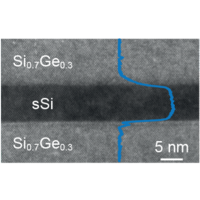
Effect of Quantum Hall Edge Strips on Valley Splitting in Silicon Quantum Wells

Brian Paquelet Wuetz, Merritt P. Losert, Alberto Tosato, Mario Lodari, Peter L. Bavdaz, Lucas Stehouwer, Payam Amin, James S. Clarke, Susan N. Coppersmith, Amir Sammak, Menno Veldhorst, Mark Friesen, and Giordano Scappucci

Phys. Rev. Lett. 125, 186801 (2020) - Published 28 October, 2020

Valley splitting in low-disorder silicon quantum wells in the quantum Hall regime increases with electric field at the edge of the device at a rate consistent with predictions.

Modeling the Microstructure and Stress in Dense Suspensions under Inhomogeneous Flow

J. J. J. Gillissen and C. Ness

Phys. Rev. Lett. 125, 184503 (2020) - Published 27 October, 2020

Incorporating shear rate fluctuations into a tensorial model captures the microstructural features of dense suspensions.

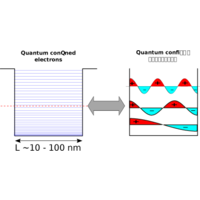
Semiconductor Quantum Plasmonics

Angela Vasanelli, Simon Huppert, Andrew Haky, Thibault Laurent, Yanko Todorov, and Carlo Sirtori

Phys. Rev. Lett. 125, 187401 (2020) - Published 27 October, 2020

A full quantum treatment of plasmons confined in a semiconductor layer, going beyond the commonly employed electromagnetic models, indicates the existence of higher order longitudinal modes that are subsequently experimentally observed.

Automatic Fine-Tuning in the Two-Flavor Schwinger Model

Howard Georgi

Phys. Rev. Lett. 125, 181601 (2020) - Published 26 October, 2020

A theoretical model illustrates that phenomena that might appear to be the result of ad hoc fine tuning at low energies may have a natural explanation in terms of physical principles that apply only at higher energy scales.

Imaging Charge Localization in a Conjugated Oligophenylene

Laerte L. Patera, Fabian Queck, and Jascha Repp

Phys. Rev. Lett. 125, 176803 (2020) - Published 23 October, 2020

A new technique determines both the charge distribution and the structural distortions that result from the addition of a single charge to a molecule.

Optimal Control of Active Nematics

Michael M. Norton, Piyush Grover, Michael F. Hagan, and Seth Fraden

Phys. Rev. Lett. 125, 178005 (2020) - Published 23 October, 2020

Optimal control theory finds spatiotemporal inputs that produce desired behaviors in active nematics.

Shear-Induced Gelation of Self-Yielding Active Networks

David A. Gagnon, Claudia Dessi, John P. Berezney, Remi Boros, Daniel T.-N. Chen, Zvonimir Dogic, and Daniel L. Blair

Phys. Rev. Lett. 125, 178003 (2020) - Published 22 October, 2020

Experiments show how to tune the viscosity of “active” filaments found in cells, something that could help in the design of biomimetic materials.

Understanding Frothing of Liquid Mixtures: A Surfactantlike Effect at the Origin of Enhanced Liquid Film Lifetimes

H.-P. Tran, M. Arangalage, L. Jørgensen, N. Passade-Boupat, F. Lequeux, and L. Talini

Phys. Rev. Lett. 125, 178002 (2020) - Published 21 October, 2020

Frothing can arise in mixtures of two fully miscible liquids with nonlinear composition-dependent surface tensions.

Green Bank and Effelsberg Radio Telescope Searches for Axion Dark Matter Conversion in Neutron Star Magnetospheres

Joshua W. Foster, Yonatan Kahn, Oscar Macias, Zhiquan Sun, Ralph P. Eatough, Vladislav I. Kondratiev, Wendy M. Peters, Christoph Weniger, and Benjamin R. Safdi

Phys. Rev. Lett. 125, 171301 (2020) - Published 20 October, 2020

Radio observations of neutron stars demonstrate a way to search for axions through their expected conversion to electromagnetic waves in a star’s magnetic field.

SENSEI: Direct-Detection Results on sub-GeV Dark Matter from a New Skipper CCD

Liron Barak, Itay M. Bloch, Mariano Cababie, Gustavo Cancelo, Luke Chaplinsky, Fernando Chierchie, Michael Crisler, Alex Drlica-Wagner, Rouven Essig, Juan Estrada, Erez Etzion, Guillermo Fernandez Moroni, Daniel Gift, Sravan Munagavalasa, Aviv Orly, Dario Rodrigues, Aman Singal, Miguel Sofo Haro, Leandro Stefanazzi, Javier Tiffenberg, Sho Uemura, Tomer Volansky, and Tien-Tien Yu (SENSEI Collaboration)

Phys. Rev. Lett. 125, 171802 (2020) - Published 20 October, 2020

A new sensor provides world-leading sensitivity for distinguishing lightweight dark matter from background noise.

Overdoping Graphene beyond the van Hove Singularity

Philipp Rosenzweig, Hrag Karakachian, Dmitry Marchenko, Kathrin Küster, and Ulrich Starke

Phys. Rev. Lett. 125, 176403 (2020) - Published 19 October, 2020

New experiments with doped graphene take the two-dimensional material beyond its “Van Hove singularity” to regions that may host exotic states of matter.

Why Two-Dimensional Semiconductors Generally Have Low Electron Mobility

Long Cheng, Chenmu Zhang, and Yuanyue Liu

Phys. Rev. Lett. 125, 177701 (2020) - Published 19 October, 2020

The density of scattering determines why electron mobility at room temperature in two-dimensional semiconductors is typically lower than that in silicon.

Cluster Frustration in the Breathing Pyrochlore Magnet LiGaCr4S8

Ganesh Pokharel, Hasitha Suriya Arachchige, Travis J. Williams, Andrew F. May, Randy S. Fishman, Gabriele Sala, Stuart Calder, Georg Ehlers, David S. Parker, Tao Hong, Andrew Wildes, David Mandrus, Joseph A. M. Paddison, and Andrew D. Christianson

Phys. Rev. Lett. 125, 167201 (2020) - Published 16 October, 2020

A frustrated magnetic phase of ferromagnetic clusters in the breathing pyrochlore material LiGaCr4S8 is revealed by inelastic neutron scattering.

Demonstration of Muon-Beam Transverse Phase-Space Compression

A. Antognini, N. J. Ayres, I. Belosevic, V. Bondar, A. Eggenberger, M. Hildebrandt, R. Iwai, D. M. Kaplan, K. S. Khaw, K. Kirch, A. Knecht, A. Papa, C. Petitjean, T. J. Phillips, F. M. Piegsa, N. Ritjoho, A. Stoykov, D. Taqqu, and G. Wichmann (muCool Collaboration)

Phys. Rev. Lett. 125, 164802 (2020) - Published 15 October, 2020

An important step towards a high brightness, low energy, muon beam is achieved by compressing a positive muon beam from a vertical spread of 10 mm to 0.7 mm within a few microseconds.

Topological Phase Transitions in Disordered Electric Quadrupole Insulators

Chang-An Li, Bo Fu, Zi-Ang Hu, Jian Li, and Shun-Qing Shen

Phys. Rev. Lett. 125, 166801 (2020) - Published 15 October, 2020

The quantization of electric quadrupole moments is protected by chiral symmetry even in the presence of strong disorder.

Analog of a Quantum Heat Engine Using a Single-Spin Qubit

K. Ono, S. N. Shevchenko, T. Mori, S. Moriyama, and Franco Nori

Phys. Rev. Lett. 125, 166802 (2020) - Published 15 October, 2020

An experimental realization and a theoretical description of heat-engine-like cycles for highly controllable spin-1/2 states is achieved using impurity electron spin in a silicon tunnel field-effect transistor.

Sign In to Your Journals Account

Filter

Section

Filter

Article Lookup

Enter a citation