Recent Articles

Effects of tunable hydrophobicity on the collective hydrodynamics of Janus particles under flows

Szu-Pei Fu, Rolf Ryham, Bryan Quaife, and Y.-N. Young

Phys. Rev. Fluids 8, 050501 (2023) - Published 11 May, 2023

Understanding active colloidal systems with nonequilibrium self-organization is a long-standing, challenging area in material sciences and biology. In this work we use a colloidal suspension of Janus particles to investigate the hydrodynamics that underlies their various morphologies (unilamellar, multilamellar, and striated structures) and rheological properties.

Generation of vorticity at the open end of acoustic waveguides

León Martínez del Río, Carlos Málaga, Roberto Zenit, and Pablo L. Rendón

Phys. Rev. Fluids 8, 053402 (2023) - Published 11 May, 2023

It is well-known that high-intensity acoustic fields in narrow open ducts can give rise to shock waves, where the length of the duct is a key factor, but the geometry of the edges at the opening is not. However, the precise geometry of the inner edges of the duct is critical, together with the value of a Reynolds number associated with the boundary layer, in determining whether or not vortices form at the open end of the duct and whether or not they are radiated outwards. The generation and dynamics of these vortical structures are studied experimentally by means of particle image velocimetry, and numerically using Lattice Boltzmann simulations.

Influence of wind on a viscous liquid film flowing down a thread

Annette Cazaubiel and Andreas Carlson

Phys. Rev. Fluids 8, 054002 (2023) - Published 11 May, 2023

A liquid film flowing down a fiber or thread is well known to destabilize into an axisymmetric bead-like pattern in stagnant air. We demonstrate experimentally how side wind affects such a film flow. Our results show that side wind increases the descent speed of the liquid beads, highlighting that the film flow regime can be changed by controlling the magnitude of the wind speed.

Determination of Klinkenberg and higher-order correction tensors for slip flow in porous media

Didier Lasseux, Tony Zaouter, and Francisco J. Valdés-Parada

Phys. Rev. Fluids 8, 053401 (2023) - Published 10 May, 2023

The flow fields in a porous medium under no slip conditions contain all the physical information to predict the Klinkenberg slip correction tensor, without requiring the solution of additional problems. For situations in which higher-order terms are needed to predict the apparent permeability tensor, the flow problem with no-slip and considering a first-order slip are enough to build an excellent estimate using a Padé approximant.

Curvature and shape relaxation in surface-viscous domains

Joseph M. Barakat and Todd M. Squires

Phys. Rev. Fluids 8, 054001 (2023) - Published 10 May, 2023

Surface viscosity triggers surface shear flows in incompressible two-dimensional domains when surface curvature changes, triggering stretching flows and stresses (top) and non-axisymmetric shape instabilities (bottom).

Hidden scale invariance of turbulence in a shell model: From forcing to dissipation scales

Alexei A. Mailybaev

Phys. Rev. Fluids 8, 054605 (2023) - Published 10 May, 2023

We describe a hidden scaling symmetry in developed turbulence which is restored in the inertial interval and, as a consequence, substantiates basic properties of intermittency, such as anomalous scaling. In this work we focus on how this symmetry gets broken in the forcing and dissipation ranges. The study is based on a shell model.

Vorticity locking and pressure dynamics in finite-temperature superfluid turbulence

Jason Laurie and Andrew W. Baggaley

Phys. Rev. Fluids 8, 054604 (2023) - Published 9 May, 2023

Thanks to the recent unprecedented leap in computational power, we can now delve into the fascinating realm of finite-temperature superfluid turbulence and study the intricate interplay of two-fluid dynamics. Our analysis focuses on two-fluid vorticity locking where turbulent normal and superfluid flows interact and create complex pressure dynamics. Through careful examination, we showcase how the flow statistics seamlessly transfer and manifest in the mutual pressure field, unravelling new insights into the fundamental laws of fluid mechanics.

Experimental measurements of streamwise and lateral forces acting on bio-inspired pitching panels

Justin T. King and Melissa A. Green

Phys. Rev. Fluids 8, 053101 (2023) - Published 8 May, 2023

The influence of planform and Strouhal number on the performance of bio-inspired pitching panels is investigated by changing the trailing edge sweep of a trapezoidal planform, resulting in panels of forked (F), straight (S), and pointed (P) trailing edges. Positive mean thrust only develops for S and P panels of reduced aspect ratio. Decomposition of thrust into its normal and axial force components (NF and AF) show that a thrust-producing panel has large propulsive efficiency for small AF, and that thrust is then due primarily to NF. However, once a thrust-producing panel reaches a local efficiency maximum, increases in Strouhal number result in increases in mean thrust due to larger AF.

Strongly supercritical non-Boussinesq sustained gravity currents: Time-dependent and steady-state approximate solutions

M. Ungarish

Phys. Rev. Fluids 8, 053801 (2023) - Published 8 May, 2023

An inertial supercritical gravity current sustained by a constant source at x=0 propagates toward a free drainage edge at x=xD. After the nose spills over the edge, a steady state is possible. We show that the time-dependent process leading to the steady state is important in applications (e.g., fire on the ceiling) and is strongly affected by the mixing/entrainment model between the current and the ambient.

Flow field disturbance due to point viscosity variations in a heterogeneous fluid

Debasish Das

Phys. Rev. Fluids 8, L051301 (2023) - Published 8 May, 2023

A fluid can be heterogeneous in either its density or viscosity - its two basic material properties. In this Letter, we ask how an ambient flow field is disturbed due to a point viscosity variation in the fluid. If we are able to answer this question, we can create an arbitrary spatial distribution of viscosity discretely by placing viscosity sources and sinks of appropriate strength, allowing us to model complex fluids. As an example, we show how the hydrodynamics of a rigid particle is altered due to the presence of point viscosity variations.

Feasibility of the Obukhov-Bolgiano scaling in buoyancy affected turbulence

R. Stepanov, A. Shestakov, and P. Frick

Phys. Rev. Fluids 8, L052601 (2023) - Published 8 May, 2023

The paper focuses on the effect of buoyancy on the spectral characteristics of turbulent flows. We obtain an analytical solution in the nondissipative limit for the spectrum containing both ranges with Obukhov-Bolgiano and Kolmogorov scalings. This leads to the derivation of an expression for the Bolgiano scale through the governing parameters of the problem.

Physics-informed machine learning with smoothed particle hydrodynamics: Hierarchy of reduced Lagrangian models of turbulence

Michael Woodward, Yifeng Tian, Criston Hyett, Chris Fryer, Mikhail Stepanov, Daniel Livescu, and Michael Chertkov

Phys. Rev. Fluids 8, 054602 (2023) - Published 5 May, 2023

Construction of efficient and generalizable reduced order models of developed turbulence is a formidable challenge. Bridging the gap between physics-based models and data-driven methods, we introduce a novel approach that involves constructing a hierarchy of learnable and parameterized reduced Lagrangian models based on Smoothed Particle Hydrodynamics (SPH) and machine learning. By training these models on high fidelity Direct Numerical Simulation data sets and comparing their generalizability, we demonstrate the effectiveness of SPH-informed models at predicting statistical and field-based quantities of turbulent flows across a range of resolutions, time scales, and turbulent Mach numbers.

Angular momentum and moment of total enthalpy integral equations for high-speed boundary layers

Armin Kianfar, Mario Di Renzo, Christopher Williams, Ahmed Elnahhas, and Perry L. Johnson

Phys. Rev. Fluids 8, 054603 (2023) - Published 5 May, 2023

Angular momentum and moment of total enthalpy integral (AMI and MTEI) equations provide a quantitative mapping between flow phenomena such as turbulence on skin friction and surface heat flux for high-speed boundary layers relative to laminar flows. Using the AMI equation, the effect of edge Mach number (Ma) and wall-cooling are measured on the turbulent torque that enhances the skin friction coefficient. Moreover, the AMI equation introduces stress-weighted density that yields a more robust collapse of the dataset with different configurations. The MTEI equation distinguishes the impact of Ma and wall-cooling on the turbulent flux of mean kinetic energy and enthalpy, respectively.

Characterizing energy dissipation of shallow-water wave breaking in a storm surge

Hunter Boswell, Guirong Yan, and Wouter Mostert

Phys. Rev. Fluids 8, 054801 (2023) - Published 5 May, 2023

While understanding breaking waves is crucial for the development of parameterizations used in modeling ocean and climate, the complete description of wave breaking is not well understood. We present direct numerical simulations of two-dimensional solitary waves that break on a uniform beach in shallow water, including storm surge represented by an inshore region.

Contribution of the Hall term in small-scale magnetohydrodynamic dynamos

Arijit Halder, Supratik Banerjee, Anando G. Chatterjee, and Manohar K. Sharma

Phys. Rev. Fluids 8, 053701 (2023) - Published 4 May, 2023

The Hall effect plays an interesting role in the context of astrophysical dynamos. Using direct numerical simulation, the dynamo action in Hall magnetohydrodynamic turbulence has been systematically studied. Unlike previous studies, the total Hall contribution has been decomposed, separating the contribution of magnetic and current fields in feeding the large-scale magnetic field. Using scale-specific flux relations, it is shown that the small-scale magnetic and current fields contribute to the large-scale magnetic field growth. Unlike small-scale magnetic fields and large-scale current fields, the small-scale current fields appear to be the leading contributors to small-scale dynamo action.

Liquid film instability of an internally coated horizontal tube

Shahab Eghbali, Yves-Marie Ducimetière, Edouard Boujo, and François Gallaire

Phys. Rev. Fluids 8, 053901 (2023) - Published 4 May, 2023

A liquid film coating the inner side of a horizontal tube is prone to the Rayleigh-Plateau instability resulting from surface tension forces. However, when these capillary forces are dominated by gravity forces (i.e. when the Bond number increases), the liquid film possibly stabilizes. In this study, we determine numerically the instability threshold in good agreement with preexisting experiments and show that deformation of the interface during liquid drainage is responsible for flow stabilization.

Presence of surfactants controls the stability of bubble chains in carbonated drinks

Omer Atasi, Mithun Ravisankar, Dominique Legendre, and Roberto Zenit

Phys. Rev. Fluids 8, 053601 (2023) - Published 3 May, 2023

In this paper we explain why bubble chains are stable in champagne, but unstable in other carbonated beverages. The hydrodynamic interactions among bubbles in a chain determine its stability. The wake behind each bubble affects the subsequent ones, producing a lift force. For a clean and small bubble, the lift force is destabilizing; when surfactants are present or the bubble size exceeds a certain value, the additional vorticity production on the surface changes the structure of the wake and the sign of the lift force is reversed resulting in a stable chain.

Mean flow and fluctuations in the three-dimensional turbulent cellular flow

S. Berti, G. Boffetta, and S. Musacchio

Phys. Rev. Fluids 8, 054601 (2023) - Published 3 May, 2023

Theoretical and numerical turbulent flow studies either consider turbulence as generated by fluid-solid interactions or focus on intrinsic, bulk properties. There is another group of flows for which homogeneity and isotropy are broken by the body force that sustains the flow, not by physical boundaries. In this class we consider the cellular flow produced by a two-dimensional spatially periodic forcing whose laminar state corresponds to a regular array of counter-rotating vortices. We find that, despite the developed turbulence recovering isotropic features at small scales, the signature of forcing remains in the mean flow, allowing us to quantify the efficiency of the work done by the force.

Stokesian dynamics with odd viscosity

Hang Yuan and Monica Olvera de la Cruz

Phys. Rev. Fluids 8, 054101 (2023) - Published 2 May, 2023

Stokesian Dynamics is a well-established computational method for simulating dynamics of many particles suspended in a conventional passive fluid medium such as water. Active fluids composed of self-driving microscopic particles with broken time reversal symmetry permit the emergence of a so-called odd viscosity. In this work, we extended the conventional Stokesian Dynamics formalism to incorporate the additional hydrodynamic effects due to odd viscosity under a simplified quasi-two-dimensional case. This demonstrates that Stokesian Dynamics can be generalized to simulate collective behaviors of many particles suspended in an active fluid medium with both even and odd viscosity.

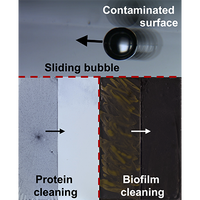
Effect of angle in removing proteins or bacteria on a tilted surface using air bubbles

Alireza Hooshanginejad, Timothy Sheppard, Purui Xu, Janeth Manyalla, John Jaicks, Ehsan Esmaili, and Sunghwan Jung

Phys. Rev. Fluids 8, 043602 (2023) - Published 28 April, 2023

Our work investigates cleaning surfaces coated with protein solutions or bacterial biofilms using continuous collisions and sliding air bubbles in an aqueous medium. Air bubbles between 0.5-1 mm in radius perform best when tilted at 20-25 degrees with respect to the horizontal plane. Based on our model, the interplay between the steady sliding speed and the steady film thickness between the bubble and the surface yields the best cleaning at 22.5 degrees. The technique offers a safe and environmentally friendly way of cleaning fresh agricultural produce without damaging it or reducing its freshness period.

Sign In to Your Journals Account

Filter

Recent Issues

Vol. 11, Iss. 10
October 2026
Vol. 11, Iss. 9
September 2026
Vol. 11, Iss. 8
August 2026
Vol. 11, Iss. 7
July 2026
Category
Article Type
Section

Filter

Article Lookup

Enter a citation