Recent Articles

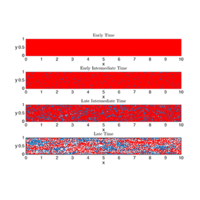
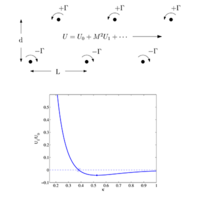
Minimal model for a hydrodynamic fingering instability in microroller suspensions

Blaise Delmotte, Aleksandar Donev, Michelle Driscoll, and Paul Chaikin

Phys. Rev. Fluids 2, 114301 (2017) - Published 10 November, 2017

A simple continuum model to study the fingering instability in systems of micro-particles rotating parallel to a floor is developed. Analytical results are in agreement with the simulations and experiments, and are used to extract the physical mechanisms that trigger the instability.

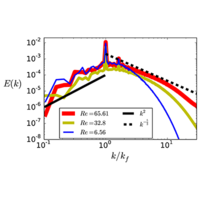
Sustaining mechanism of small-scale turbulent eddies in a precessing sphere

Yasufumi Horimoto and Susumu Goto

Phys. Rev. Fluids 2, 114603 (2017) - Published 10 November, 2017

Laboratory experiments of turbulence of non-Newtonian fluids reveal that the fully developed turbulence of Newtonian fluids in a precessing sphere is sustained by an energy cascading process.

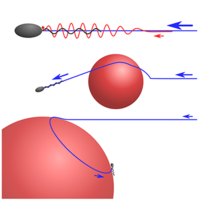
Entrainment and scattering in microswimmer-colloid interactions

Henry Shum and Julia M. Yeomans

Phys. Rev. Fluids 2, 113101 (2017) - Published 9 November, 2017

Scattering trajectories for a swimmer interacting with a particle are simulated in Stokes flow, varying the size of the particle from much smaller than to much larger than the swimmer. The particle deflects the swimmer’s path, which can lead to a larger particle having a larger net displacement.

Effects of incomplete mixing on reactive transport in flows through heterogeneous porous media

Elise E. Wright, David H. Richter, and Diogo Bolster

Phys. Rev. Fluids 2, 114501 (2017) - Published 8 November, 2017

The role of incomplete mixing through an idealized two-dimensional heterogeneous porous medium is studied using a Lagrangian reactive particle tracking method. Velocity-gradient-based flow deformation metrics are considered and connections are made to conservative transport.

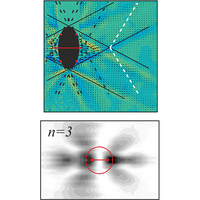
Generation of higher harmonic internal waves by oscillating spheroids

Natalia Shmakova, Evgeny Ermanyuk, and Jan-Bert Flór

Phys. Rev. Fluids 2, 114801 (2017) - Published 7 November, 2017

Higher harmonic internal waves are generated at wave intersections and critical points of oscillating bodies, with higher amplitudes at steeper slopes and amplitude increase due to focusing for axisymmetric bodies. The horizontal structure of the nth harmonic corresponds to multipole order 2n.

Effect of helicity on the correlation time of large scales in turbulent flows

Alexandre Cameron, Alexandros Alexakis, and Marc-Étienne Brachet

Phys. Rev. Fluids 2, 114602 (2017) - Published 6 November, 2017

Kolmogorov’s theory gives predictions for the inertial scales of turbulent flows but not for the large scales. Direct numerical simulations and analytic derivation are used to investigate the spatiotemporal properties of large scales for flow solutions of Navier-Stokes and truncated Euler equations.

Speed of a von Kármán point vortex street in a weakly compressible fluid

Darren G. Crowdy and Vikas S. Krishnamurthy

Phys. Rev. Fluids 2, 114701 (2017) - Published 3 November, 2017

The modification due to weak fluid compressibility of the speed of travel of the incompressible point vortex streets of von Karman is determined in analytical form as a function of the street aspect ratio.

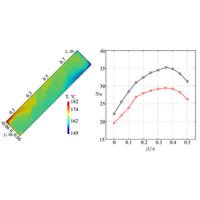
Thermal convection of liquid metal in a long inclined cylinder

Andrei Teimurazov and Peter Frick

Phys. Rev. Fluids 2, 113501 (2017) - Published 2 November, 2017

The influence of inclination angle on the turbulent liquid metal convection in a cylindrical cell under an axial temperature gradient is studied numerically. The applicability of idealized thermal boundary conditions for modeling experiments on liquid sodium convection is examined.

Life stages of wall-bounded decay of Taylor-Couette turbulence

Rodolfo Ostilla-Mónico, Xiaojue Zhu, Vamsi Spandan, Roberto Verzicco, and Detlef Lohse

Phys. Rev. Fluids 2, 114601 (2017) - Published 1 November, 2017

A numerical study of decaying wall-bounded turbulence is made by stopping the forcing in a Taylor-Couette system. The decay progressively exhausts all modes through which perturbations grow, from most unstable to least unstable until a final stage of self-similar viscous decay is reached.

Stokes resistance of a cylinder near a slippery wall

Uri Kaynan and Ehud Yariv

Phys. Rev. Fluids 2, 104103 (2017) - Published 31 October, 2017

The resistance to the motion of a cylinder near a slippery wall is calculated in the lubrication limit. The properly scaled resistance depends only upon the ratio of slip length to cylinder-wall clearance. The companion problem of a slippery cylinder reveals a symmetry relating the two problems.

Geometry of thresholdless active flow in nematic microfluidics

Richard Green, John Toner, and Vincenzo Vitelli

Phys. Rev. Fluids 2, 104201 (2017) - Published 31 October, 2017

Active nematics, e.g., liquid crystals filled with living bacteria, are known to spontaneously flow in large systems. A new study shows that in some geometries, spontaneous flow can occur in arbitrarily small systems and that such flows can power microfluidic pumps with no moving parts.

Frequency dependence of the electrophoretic mobility for single colloids as measured using optical tweezers

Jun Ma, Tim Stangner, and Friedrich Kremer

Phys. Rev. Fluids 2, 104306 (2017) - Published 30 October, 2017

Electrophoretic mobility of single colloids under an ac electric field is studied experimentally and theoretically. At low electric field frequencies, we observe a decay of the mobility as the frequency increases. The theoretical model is in good agreement with the observations.

Steady state model and experiment for an oscillating grid turbulent two-layer stratified flow

Lilly Verso, Maarten van Reeuwijk, and Alex Liberzon

Phys. Rev. Fluids 2, 104605 (2017) - Published 30 October, 2017

A modification of the classical Turner two-layer-stratified grid experiment is presented. The system is capable of maintaining a steady state and specifying the Richardson number and the entrainment velocity independently. The analytical model developed is in good agreement with the experiment.

Turbulent entrainment across turbulent-nonturbulent interfaces in stably stratified mixing layers

T. Watanabe, J. J. Riley, and K. Nagata

Phys. Rev. Fluids 2, 104803 (2017) - Published 30 October, 2017

Entrainment in stably stratified mixing layers is studied in relation to the turbulent/nonturbulent interface with Eulerian and Lagrangian statistics from direct numerical simulations. The characteristics of entrainment change as the buoyancy Reynolds number decreases and the flow begins to layer.

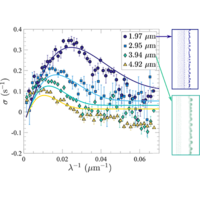
Stretching of red blood cells at high strain rates

J. E. Mancuso and W. D. Ristenpart

Phys. Rev. Fluids 2, 101101(R) (2017) - Published 27 October, 2017

Analysis of many observations of individual red blood cells entering a microfluidic constriction yields a nonlinear elastic modulus of 60 μN/m, an order of magnitude larger than moduli found previously in the linearized regime.

Dissipated power within a turbulent flow forced homogeneously by magnetic particles

Eric Falcon, Jean-Claude Bacri, and Claude Laroche

Phys. Rev. Fluids 2, 102601(R) (2017) - Published 27 October, 2017

Turbulence is forced at small scales by applying an alternating magnetic field to magnetic particles within the fluid. Measuring the increase in temperature, the dissipation is found to be proportional to the number of particles.

Closure theory for the split energy-helicity cascades in homogeneous isotropic homochiral turbulence

Antoine Briard, Luca Biferale, and Thomas Gomez

Phys. Rev. Fluids 2, 102602(R) (2017) - Published 27 October, 2017

When helicity is made sign-definite by retaining only specific triadic interactions, an inverse energy cascade develops towards large scales in k-5/3, with a direct helicity cascade towards small scales in k-7/3.

Bubble plumes in a stratified environment: Source parameters, scaling, intrusion height, and neutral height

Shigan Chu and Andrea Prosperetti

Phys. Rev. Fluids 2, 104503 (2017) - Published 27 October, 2017

A horizontally integrated model for bubble plumes in stratified environments, including inlet conditions, finds that the maximum plume momentum height cannot be identified with the neutral buoyancy height, which it is always less than. These results are in agreement with existing observations.

Large-scale sweeping of small-scale eddies in turbulence: A filtering approach

Theodore D. Drivas, Perry L. Johnson, Cristian C. Lalescu, and Michael Wilczek

Phys. Rev. Fluids 2, 104603 (2017) - Published 27 October, 2017

The impact of large-scale advection on smaller-scale velocity fluctuations in turbulent flows is investigated using an analysis of the Navier-Stokes equations based on a spatial filtering technique. Analytical results are compared to direct numerical simulations of fully developed turbulence.

Time irreversibility and multifractality of power along single particle trajectories in turbulence

Massimo Cencini, Luca Biferale, Guido Boffetta, and Massimo De Pietro

Phys. Rev. Fluids 2, 104604 (2017) - Published 27 October, 2017

For a particle in a turbulent flow in stationary conditions, kinetic energy is lost faster than it accumulates. This time asymmetry depends on the Reynolds number of the flow. Here we show how the Reynolds number dependence of Lagrangian irreversibility can be predicted by the multifractal model.

Sign In to Your Journals Account

Filter

Recent Issues

Vol. 11, Iss. 11
November 2026
Vol. 11, Iss. 10
October 2026
Vol. 11, Iss. 9
September 2026
Vol. 11, Iss. 8
August 2026
Category
Article Type
Section

Filter

Article Lookup

Enter a citation