Recent Articles

Asymptotic far-field behavior of macroscopic quantities in a problem of slow uniform rarefied gas flow past a sphere

Satoshi Taguchi and Toshihiro Suzuki

Phys. Rev. Fluids 2, 113401 (2017) - Published 17 November, 2017

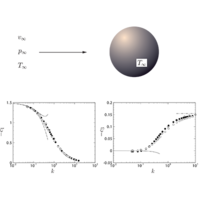
The asymptotic far-field behavior of macroscopic quantities in a problem of slow uniform rarefied gas flow past a sphere is investigated for the purpose of acquiring a function occurring in the second-order drag. The thermal force in the problem of thermophoresis of a sphere is also discussed.

Effect of Marangoni stress on the bulk rheology of a dilute emulsion of surfactant-laden deformable droplets in linear flows

Shubhadeep Mandal, Sayan Das, and Suman Chakraborty

Phys. Rev. Fluids 2, 113604 (2017) - Published 17 November, 2017

The impact of surfactant redistribution along a droplet surface on the deformation and suspension rheology of a dilute droplet emulsion suspended in a linear flow field is analyzed. The study find that an increase in surfactant convection augments droplet deformation and emulsion effective viscosity.

Time-delayed feedback technique for suppressing instabilities in time-periodic flow

Léopold Shaabani-Ardali, Denis Sipp, and Lutz Lesshafft

Phys. Rev. Fluids 2, 113904 (2017) - Published 17 November, 2017

A numerical method for the computation of unstable limit-cycle flows is presented. This technique, straightforward to implement, filters nonperiodic components with a time-delayed feedback. It is shown for the examples of an axisymmetric forced jet subject to pairing and a 3D lid-driven cavity.

Three-wave and four-wave interactions in gravity wave turbulence

Quentin Aubourg, Antoine Campagne, Charles Peureux, Fabrice Ardhuin, Joel Sommeria, Samuel Viboud, and Nicolas Mordant

Phys. Rev. Fluids 2, 114802 (2017) - Published 17 November, 2017

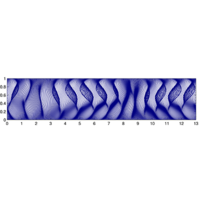
Water surface deformation is reconstructed by stereoscopic imaging to develop a high-order statistical analysis of randomly forced turbulent gravity waves. Resonant wave coupling is investigated and laboratory data compared to field measurements in the Black Sea.

Scale effects in internal wave attractors

C. Brouzet, I. N. Sibgatullin, E. V. Ermanyuk, S. Joubaud, and T. Dauxois

Phys. Rev. Fluids 2, 114803 (2017) - Published 17 November, 2017

Physical effects scale differently with size. As a necessary preliminary step toward geophysically significant extrapolations, an experimental and numerical study of the scale effects in internal wave attractors in linear and nonlinear regimes is made, showing two different scalings for the beam width.

How merging droplets jump off a superhydrophobic surface: Measurements and model

Timothée Mouterde, Thanh-Vinh Nguyen, Hidetoshi Takahashi, Christophe Clanet, Isao Shimoyama, and David Quéré

Phys. Rev. Fluids 2, 112001(R) (2017) - Published 16 November, 2017

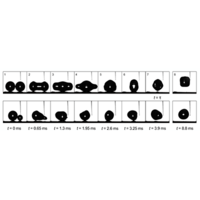
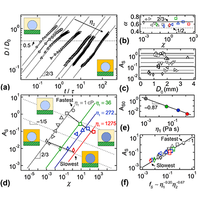
In an investigation of how drops merging on a nonwetting surface jump off the surface, the takeoff velocity is measured and modeled.

Biopolymer dynamics driven by helical flagella

Andrew K. Balin, Andreas Zöttl, Julia M. Yeomans, and Tyler N. Shendruk

Phys. Rev. Fluids 2, 113102 (2017) - Published 16 November, 2017

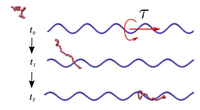
A rotating helical pump actively stretches nearby polymers and draws them inwards as demonstrated in Stokesian dynamics simulations. The effect of such an interaction hinders the helix, increasing the amount of work required to maintain constant rotation.

Scaling of Lyapunov exponents in homogeneous isotropic turbulence

Prakash Mohan, Nicholas Fitzsimmons, and Robert D. Moser

Phys. Rev. Fluids 2, 114606 (2017) - Published 16 November, 2017

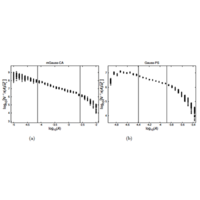
New work characterizes the chaotic nature of isotropic turbulence using Lyapunov exponents and determines how they scale with Reynolds number. The scaling results suggest that instabilities could act on sub-Kolmogorov scales at sufficiently high Reynolds numbers.

Extended scale invariance in the vortices of freely evolving two-dimensional turbulence

B. H. Burgess, D. G. Dritschel, and R. K. Scott

Phys. Rev. Fluids 2, 114702 (2017) - Published 16 November, 2017

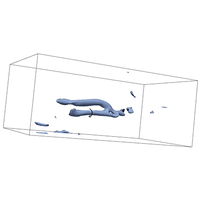
Numerical simulations of the decay of two-dimensional turbulence find new scalings for the distribution of the sizes of vortices and their strength, such that the time for vortices to cross the intervortex separation is independent of their size.

Mean temperature profiles in turbulent thermal convection

Olga Shishkina, Susanne Horn, Mohammad S. Emran, and Emily S. C. Ching

Phys. Rev. Fluids 2, 113502 (2017) - Published 15 November, 2017

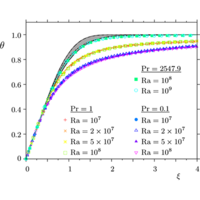
A thermal boundary layer equation that includes fluctuations is solved using a relation between the eddy thermal diffusivity and the stream function, and a closed-form expression for the mean temperature profiles in turbulent Rayleigh-Bénard convection is obtained for fluids with a general Prandtl number .

Numerical study of Rayleigh fission of a charged viscous liquid drop

Neha Gawande, Y. S. Mayya, and Rochish Thaokar

Phys. Rev. Fluids 2, 113603 (2017) - Published 15 November, 2017

A spherical drop charged beyond its Rayleigh limit ejects a significant fraction of its charge as a jet. Coupled hydrodynamics and electrostatics are used to find the charge loss in the low Re limit. Simulations show this is 39% of the initial charge, within the known experimental range of 20–50%.

Linear stability of buffer layer streaks in turbulent channels with variable density and viscosity

Enrico Rinaldi, Ashish Patel, Philipp Schlatter, and Rene Pecnik

Phys. Rev. Fluids 2, 113903 (2017) - Published 15 November, 2017

A linear stability analysis of the mean flow of turbulent channels with temperature-dependent density and viscosity predicts modified energy growth rate and threshold for secondary instability of streaks consistent with direct numerical simulation observations. Semilocal scaling parametrizes the effect of properties.

Simulations of pilot-wave dynamics in a simple harmonic potential

Kristin M. Kurianski, Anand U. Oza, and John W. M. Bush

Phys. Rev. Fluids 2, 113602 (2017) - Published 14 November, 2017

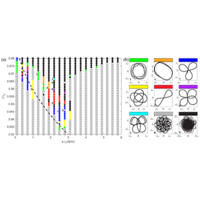
We present the results of a numerical investigation of droplets walking in a harmonic potential. Particular attention is given to delineating the parameter regimes in which periodic and chaotic trajectories arise, and double quantization in energy and angular momentum emerges.

Thermoelectrokinetic instability and salt superconcentration near permselective electric membranes

E. N. Kalaydin, N. Yu. Ganchenko, G. S. Ganchenko, N. V. Nikitin, and E. A. Demekhin

Phys. Rev. Fluids 2, 114201 (2017) - Published 14 November, 2017

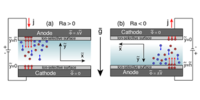
In an electrolyte solution near ion-selective surfaces in an external electric field we theoretically find a thermoelectrokinetic instability and study it numerically. The instability comes from nonuniformity of the electric current and conductivity in long channels with good thermal insulation.

Mechanism of mean flow generation in rotating turbulence through inhomogeneous helicity

Kazuhiro Inagaki, Nobumitsu Yokoi, and Fujihiro Hamba

Phys. Rev. Fluids 2, 114605 (2017) - Published 14 November, 2017

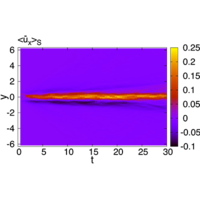
Numerical simulations have revealed that mean flow directed to the rotation axis is generated against the turbulent diffusion only in the case of both inhomogeneous helical forcing and system rotation. The origin of the phenomenon is examined in terms of the Reynolds-stress transport equation.

Leading-edge flow reattachment and the lateral static stability of low-aspect-ratio rectangular wings

Thomas Linehan and Kamran Mohseni

Phys. Rev. Fluids 2, 113901 (2017) - Published 13 November, 2017

An experimental study of low-aspect-ratio rectangular wings in cross flow shows that the reorganization of vortex flow on the wing plays a key role in initiating “roll stall” at angles of attack of sustained/increasing lift.

Stability analysis for n-periodic arrays of fluid systems

Peter J. Schmid, Miguel Fosas de Pando, and N. Peake

Phys. Rev. Fluids 2, 113902 (2017) - Published 13 November, 2017

Many fluid systems consisting of an assembly of multiple but identical elements exhibit collective and synchronized motion involving groups of locked-in units. A computational framework for this type of fluid system with examples from hydrodynamic stability and turbomachinery is presented.

Comparison of forcing functions in magnetohydrodynamics

Mairi E. McKay, Moritz Linkmann, Daniel Clark, Adam A. Chalupa, and Arjun Berera

Phys. Rev. Fluids 2, 114604 (2017) - Published 13 November, 2017

Three commonly used methods of energy injection are tested in simulations of homogeneous, incompressible magnetohydrodynamic turbulence without a mean magnetic field, showing, among other things, that the cross helicity is sensitive to the forcing function.

Role of viscosity coefficients during spreading and coalescence of droplets in liquids

Bibin M. Jose and Thomas Cubaud

Phys. Rev. Fluids 2, 111601(R) (2017) - Published 10 November, 2017

Experiments with immersed drops spreading on a surface or with two drops coalescing find that the contact diameter obeys a power law in time and in the internal and external viscosities.

Active elastohydrodynamics of vesicles in narrow blind constrictions

T. G. Fai, R. Kusters, J. Harting, C. H. Rycroft, and L. Mahadevan

Phys. Rev. Fluids 2, 113601 (2017) - Published 10 November, 2017

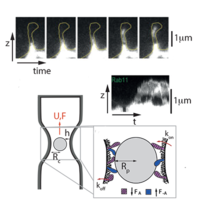
Vesicle motion through a narrow channel with fluid resistance is studied with lubrication theory and lattice Boltzman simulations. We find two dimensionless parameters that characterize the motion and that multistable dynamics, in which a vesicle may move in either direction, are possible.

Sign In to Your Journals Account

Filter

Recent Issues

Vol. 11, Iss. 11
November 2026
Vol. 11, Iss. 10
October 2026
Vol. 11, Iss. 9
September 2026
Vol. 11, Iss. 8
August 2026
Category
Article Type
Section

Filter

Article Lookup

Enter a citation