Recent Articles

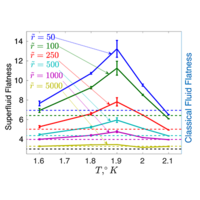
Turbulent statistics and intermittency enhancement in coflowing superfluid He4

L. Biferale, D. Khomenko, V. L'vov, A. Pomyalov, I. Procaccia, and G. Sahoo

Phys. Rev. Fluids 3, 024605 (2018) - Published 21 February, 2018

The statistics of velocity fluctuations in coflowing superfluid 4He are studied by direct numerical simulations. The statistics are highly non-Gaussian, generally more than in classical turbulence, with the maximal non-Gaussianity occurring when the super and normal fluid densities are comparable.

Onset of low Prandtl number thermal convection in thin spherical shells

F. Garcia, F. R. N. Chambers, and A. L. Watts

Phys. Rev. Fluids 3, 024801 (2018) - Published 21 February, 2018

Low Prandtl number shell convection occurs in many geophysical and astrophysical scenarios. An exploration of the patterns that form at convective onset in this extreme regime finds new mode transitions and a triple point bifurcation.

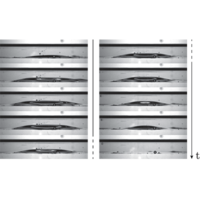
Enhanced interfacial deformation in a Marangoni flow: A measure of the dynamical surface tension

Rodrigo Leite Pinto, Sébastien Le Roux, Isabelle Cantat, and Arnaud Saint-Jalmes

Phys. Rev. Fluids 3, 024003 (2018) - Published 20 February, 2018

Once a drop of water-soluble surfactant is deposited on a bare oil-water interface, flows are induced in water and in oil (Marangoni effect). An investigation shows that the interface is also deformed, with an upward water bump into the oil, and that the vertical shape of the interface is linked to the in-plane surface tension profile.

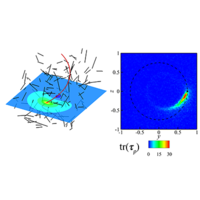
Morphing continuum analysis of energy transfer in compressible turbulence

Mohamad Ibrahim Cheikh, Louis B. Wonnell, and James Chen

Phys. Rev. Fluids 3, 024604 (2018) - Published 20 February, 2018

A computationally friendly morphing continuum theory for the energy cascade of compressible turbulence characterizes the statistical coupling of energy transfer at the length scale of eddies, with one-tenth of the computational costs required in the Navier-Stokes based DNS.

Hysteretic growth and decay of a waterspout column

Igor V. Naumov, Miguel A. Herrada, Bulat R. Sharifullin, and Vladimir N. Shtern

Phys. Rev. Fluids 3, 024701 (2018) - Published 20 February, 2018

Experimental and numerical studies reveal the hysteretic formation and decay of a water column extending from the bottom to the top of a sealed vertical cylinder filled with sunflower oil and water. The fluid motion is driven by the rotating lid and appears multicellular.

Reduced viscosity for flagella moving in a solution of long polymer chains

Yuchen Zhang, Gaojin Li, and Arezoo M. Ardekani

Phys. Rev. Fluids 3, 023101 (2018) - Published 16 February, 2018

Brownian dynamics simulations of polymer molecules near bacterial flagella show that they experience a reduced viscosity in a long chain polymer solution. This can lead to an enhanced swimming speed when flagellum thickness is smaller than the radius of gyration of polymer molecules.

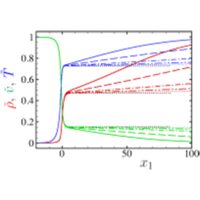
Shock-wave structure for a polyatomic gas with large bulk viscosity

Shingo Kosuge and Kazuo Aoki

Phys. Rev. Fluids 3, 023401 (2018) - Published 16 February, 2018

Numerical simulation and theoretical analysis based on a model Boltzmann equation show that a plane shock wave in a polyatomic gas with large bulk viscosity exhibits three different types of structure, depending on the upstream Mach number.

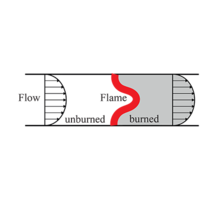
Taylor dispersion in premixed combustion: Questions from turbulent combustion answered for laminar flames

Joel Daou, Philip Pearce, and Faisal Al-Malki

Phys. Rev. Fluids 3, 023201 (2018) - Published 14 February, 2018

We study Taylor dispersion in premixed combustion. Analytical formulas are derived which answer fundamental questions related to Damköhler’s second hypothesis of turbulent combustion and occurrence of the “bending-effect” of turbulent flame speed, when the questions are for laminar one-scale flows.

Inelastic accretion of inertial particles by a towed sphere

Robin Vallée, Christophe Henry, Elie Hachem, and Jérémie Bec

Phys. Rev. Fluids 3, 024303 (2018) - Published 14 February, 2018

A large sphere moving through a fluid at rest collects small suspended particles. Estimating the efficiency of this process is of importance for wet aerosol deposition or planet formation. Multiple bounces do not lead to inelastic collapse but are still shown to significantly enhance accretion.

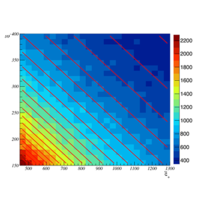
High-order moments of streamwise fluctuations in a turbulent channel flow with spanwise rotation

Zhenhua Xia, Geert Brethouwer, and Shiyi Chen

Phys. Rev. Fluids 3, 022601(R) (2018) - Published 13 February, 2018

Analysis of recent direct numerical simulations of wall-bounded turbulence with spanwise rotation find that even-order moments up to the 12th in the streamwise velocity fluctuations vary linearly with distance from the wall.

Degeneracy of velocity strain-rate tensor statistics in random isotropic incompressible flows

A. V. Kopyev

Phys. Rev. Fluids 3, 024603 (2018) - Published 13 February, 2018

We find a strong degeneracy in the strain-rate tensor probability distribution in numerical simulations of isotropic turbulence in incompressible flows, reducing the distribution to a function of one variable. We also find a universal distribution for the ratio of strain tensor eigenvalues.

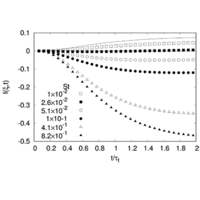
Irreversibility inversions in two-dimensional turbulence

Andrew D. Bragg, Filippo De Lillo, and Guido Boffetta

Phys. Rev. Fluids 3, 024302 (2018) - Published 12 February, 2018

An analysis shows that in 2D turbulence the nature of the irreversibility of two-particle dispersion inverts when the particle inertia exceeds a certain threshold. The results also imply that in turbulent flows with an inverse energy flux, inertial particle-pairs may yet exhibit a downscale flux of energy.

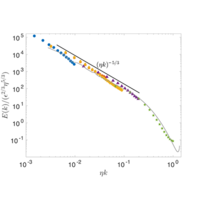
Experimental test of the crossover between the inertial and the dissipative range in a turbulent swirling flow

Paul Debue, Denis Kuzzay, Ewe-Wei Saw, François Daviaud, Bérengère Dubrulle, Léonie Canet, Vincent Rossetto, and Nicolás Wschebor

Phys. Rev. Fluids 3, 024602 (2018) - Published 9 February, 2018

A crossover from a Kolmogorov decay of two decades in the inertial range to a stretched exponential in the dissipative range is unveiled in the experimental spatial energy spectrum of a turbulent swirling flow, as recently predicted based on nonperturbative renormalization group theory.

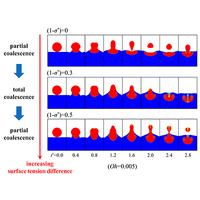
Marangoni-flow-induced partial coalescence of a droplet on a liquid/air interface

Kai Sun, Peng Zhang, Zhizhao Che, and Tianyou Wang

Phys. Rev. Fluids 3, 023602 (2018) - Published 8 February, 2018

Numerical simulations show that the coalescence of a droplet on a liquid-air interface of lower surface tension manifests the nonmonotonic phenomena of emergence, disappearance, and re-emergence of “partial coalescence” with increasing surface-tension difference.

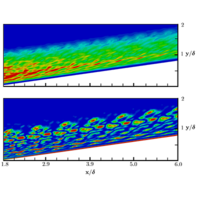
Direct numerical simulation of a compressible boundary-layer flow past an isolated three-dimensional hump in a high-speed subsonic regime

D. De Grazia, D. Moxey, S. J. Sherwin, M. A. Kravtsova, and A. I. Ruban

Phys. Rev. Fluids 3, 024101 (2018) - Published 8 February, 2018

The boundary-layer separation produced by a small hump in a high-speed subsonic regime typical of civil aviation is studied. Different heights of the hump are considered, with the larger resulting in a fully nonlinear regime and the formation of a pair of streamwise counterrotating vortices.

Viscous entrainment on hairy surfaces

Alice Nasto, P.-T. Brun, and A. E. Hosoi

Phys. Rev. Fluids 3, 024002 (2018) - Published 7 February, 2018

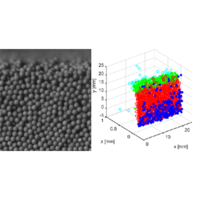
Inspired by nectar-drinking bats, an experimental and theoretical study investigates viscous entrainment in hairy textures. The trapped liquid is modeled using a Darcy-Brinkmann-like approach and the drainage flow solution is derived. The results reveal an optimal hair density to maximize fluid uptake.

Gravity-driven, dry granular flows over a loose bed in stationary and homogeneous conditions

Sabrina Meninno, Aronne Armanini, and Michele Larcher

Phys. Rev. Fluids 3, 024301 (2018) - Published 5 February, 2018

Vertical and transversal structures clearly change as interparticle interactions become more collisional. Bottom and lateral confinement prove to be decisive for friction and energy dissipation as experimental evidence shows.

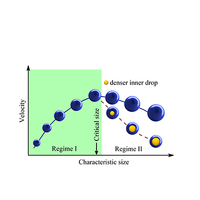
Influence of outer medium viscosity on the motion of rolling droplets down an incline

Muhammad Rizwanur Rahman and Prashant R. Waghmare

Phys. Rev. Fluids 3, 023601 (2018) - Published 2 February, 2018

When droplets roll down inclines, their velocities are affected by their characteristic size. Larger droplets will travel faster unless they’re too big. Droplets larger than a “critical” size travel more slowly. An investigation shows that this critical size is determined by the viscosity of the surrounding medium.

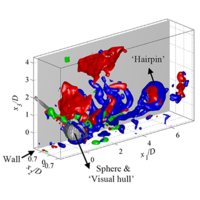
Experimental study of the flow in the wake of a stationary sphere immersed in a turbulent boundary layer

René van Hout, Jerke Eisma, Gerrit E. Elsinga, and Jerry Westerweel

Phys. Rev. Fluids 3, 024601 (2018) - Published 2 February, 2018

3D flow measurements in the wake of a sphere positioned close to the wall in a turbulent boundary layer indicate that the wake deflects away from the wall as a result of induced motion of preferentially aligned, shed “hairpin” vortices. This is increasingly so with decreasing sphere-wall gap.

Publisher's Note: Turbulence intermittency in a multiple-time-scale Navier-Stokes-based reduced model [Phys. Rev. Fluids 2, 072601(R) (2017)]

Perry L. Johnson and Charles Meneveau

Phys. Rev. Fluids 3, 029901 (2018) - Published 2 February, 2018

Sign In to Your Journals Account

Filter

Recent Issues

Vol. 11, Iss. 11
November 2026
Vol. 11, Iss. 10
October 2026
Vol. 11, Iss. 9
September 2026
Vol. 11, Iss. 8
August 2026
Category
Article Type
Section

Filter

Article Lookup

Enter a citation