Recent Articles

Resistive-force theory for mesh-like superhydrophobic surfaces

Ory Schnitzer and Ehud Yariv

Phys. Rev. Fluids 3, 032201(R) (2018) - Published 13 March, 2018

A simple leading-order approximation for the slip-length tensor of an arbitrary mesh geometry is obtained in the limit of small solid-fraction of the mesh.

Interactions between vortex tubes and magnetic-flux rings at high kinetic and magnetic Reynolds numbers

Demosthenes Kivotides

Phys. Rev. Fluids 3, 033701 (2018) - Published 13 March, 2018

Calculations of interactions between vortex tubes and magnetic rings at high kinetic and magnetic Reynolds numbers indicate that when the Lorentz force dominates plasma inertia there is significant new structure generation that results in similar vorticity and magnetic structure morphologies.

Effect of synthetic jet modulation schemes on the reduction of a laminar separation bubble

J. H. Seo, F. Cadieux, R. Mittal, E. Deem, and L. Cattafesta

Phys. Rev. Fluids 3, 033901 (2018) - Published 12 March, 2018

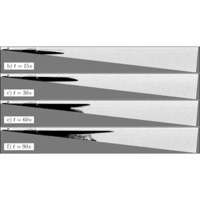
The response of a laminar separation bubble to synthetic jet forcing with various modulation schemes is numerically investigated. The study suggests that the effectiveness of synthetic jet-based flow control could be improved by carefully designing the spectral content of the modulation scheme.

Single-particle dispersion in stably stratified turbulence

N. E. Sujovolsky, P. D. Mininni, and M. P. Rast

Phys. Rev. Fluids 3, 034603 (2018) - Published 12 March, 2018

We develop a model for particle dispersion observed in stably stratified flows, such as in the ocean and the nocturnal atmosphere, where turbulence is very efficient at mixing and diffusing transported quantities. The model opens new efficient paths for statistical prediction of particle dispersion.

Modeling the effects of small turbulent scales on the drag force for particles below and above the Kolmogorov scale

Mikhael Gorokhovski and Rémi Zamansky

Phys. Rev. Fluids 3, 034602 (2018) - Published 9 March, 2018

A stochastic model is proposed for the response of heavy particles to the small scales of high Reynolds number turbulent flow. Particles below and above the Kolmogorov scale are both considered. In the context of large eddy simulations, this model is assessed by comparison with statistics from direct numerical simulations and experiments.

Wake of inertial waves of a horizontal cylinder in horizontal translation

Nathanaël Machicoane, Vincent Labarre, Bruno Voisin, Frédéric Moisy, and Pierre-Philippe Cortet

Phys. Rev. Fluids 3, 034801 (2018) - Published 9 March, 2018

The inertial wave wake of a horizontal cylinder translated horizontally in a fluid rotating about the vertical is analyzed. Results show that, owing to horizontal invariance, the slender-body approximation leads to a quantitative theoretical model of the experimental wake, even for a nonslender body.

Universal stability curve for pattern formation in pulsed gas-solid fluidized beds of sandlike particles

Lilian de Martín, Coen Ottevanger, J. Ruud van Ommen, and Marc-Olivier Coppens

Phys. Rev. Fluids 3, 034303 (2018) - Published 8 March, 2018

Granular matter can form regular patterns under periodic excitations, such as ripples on a sandy beach. Pattern formation can also be used to structure the dynamics of a fluidized bed. New experiments show that the pattern stability curve is governed by universal scaling, underpinned by fluid-dynamical fundamentals.

Time-dependent particle migration and margination in the pressure-driven channel flow of blood

Qin M. Qi and Eric S. G. Shaqfeh

Phys. Rev. Fluids 3, 034302 (2018) - Published 7 March, 2018

The time evolution of the red blood cell and platelet concentration distributions in pressure-driven flow through a straight channel is studied using a coarse-grained theory with comparison to boundary integral simulations. Key time scales and entrance lengths to reach steady state are reported.

Three-dimensional simulations of void collapse in energetic materials

Nirmal Kumar Rai and H. S. Udaykumar

Phys. Rev. Fluids 3, 033201 (2018) - Published 6 March, 2018

We study the dynamics of void collapse and hot spot formation with 3D reactive void collapse simulations for various void shapes. We find that dimensionality plays an important role in hot-spot dynamics, underlining the importance of 3D simulations.

Competition between drag and Coulomb interactions in turbulent particle-laden flows using a coupled-fluid–Ewald-summation based approach

Yuan Yao and Jesse Capecelatro

Phys. Rev. Fluids 3, 034301 (2018) - Published 6 March, 2018

A new method is presented for capturing charged inertial particles in turbulence. Numerical simulations show that even in dilute suspensions, particles can self-induce an electric field because of preferential concentration by the particles, resulting in particle agglomeration and enhanced clustering.

Contribution of large scale coherence to wind turbine power: A large eddy simulation study in periodic wind farms

Tanmoy Chatterjee and Yulia T. Peet

Phys. Rev. Fluids 3, 034601 (2018) - Published 5 March, 2018

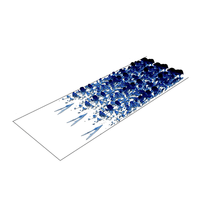
We study massive wind farms with large eddy simultations to improve understanding of wind turbine interaction with atmospheric turbulence. Large scale structures are found to be linked to downdraft mechanisms contributing to turbine power and to modulation of near wall eddies.

Role of flexural stiffness of leukocyte microvilli in adhesion dynamics

Tai-Hsien Wu and Dewei Qi

Phys. Rev. Fluids 3, 031101(R) (2018) - Published 1 March, 2018

Simulations using the Lattice-Boltzmann lattice-spring method (LLM) combined with adhesive dynamics (AD) find that the flexural stiffness of microvilli and their bending deformation have a significant effect on the rolling velocity and on the adhesive forces.

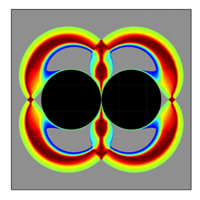
Viscoplastic squeeze flow between two identical infinite circular cylinders

A. R. Koblitz, S. Lovett, and N. Nikiforakis

Phys. Rev. Fluids 3, 023301 (2018) - Published 28 February, 2018

The interstitial squeeze flow between two approaching circular cylinders in a viscoplastic medium is studied numerically and semi-analytically. Yield stress effects external to the gap—not picked up by viscoplastic lubrication theory—are found to significantly affect the lubrication pressure.

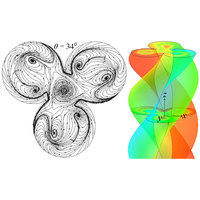
Flow through triple helical microchannel

Pravat Rajbanshi and Animangsu Ghatak

Phys. Rev. Fluids 3, 024201 (2018) - Published 28 February, 2018

Flow analysis in triple-helical micro-channels via µ-PIV experiments and 3D simulations show generation of strong secondary flow at the channel cross-section. Such flow is expected to significantly enhance mixing between liquids in the laminar regime useful for a host of microfluidic applications.

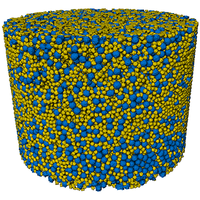
Symmetric wetting heterogeneity suppresses fluid displacement hysteresis in granular piles

R. Moosavi, M. Schröter, and S. Herminghaus

Phys. Rev. Fluids 3, 024304 (2018) - Published 26 February, 2018

Fluid displacement in random piles of spheres occurs with strong hysteresis. Increasing heterogeneity (spheres with different wettability) is expected to increase hysteresis. Instead, we show that under certain conditions, hysteresis can be almost completely suppressed by adding heterogeneity.

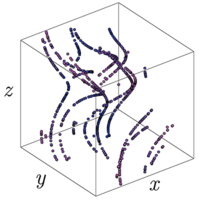
Gyrotactic suppression and emergence of chaotic trajectories of swimming particles in three-dimensional flows

S. I. Heath Richardson, A. W. Baggaley, and N. A. Hill

Phys. Rev. Fluids 3, 023102 (2018) - Published 23 February, 2018

Pattern formation is an intriguing, and biologically important, feature of many motile microorganisms. A new study shows that gyrotatic swimmers can form complex patterns even in the presence of a chaotic background flow, through the local suppression of Lagrangian chaos.

Particle-bearing currents in uniform density and two-layer fluids

Bruce R. Sutherland, Murray K. Gingras, Calla Knudson, Luke Steverango, and Christopher Surma

Phys. Rev. Fluids 3, 023801 (2018) - Published 23 February, 2018

Experiments of hypopycnal and mesopycnal currents demonstrate that the microscopic transport of fresh water in viscous boundary layers surrounding the settling particles significantly impacts the macroscopic current evolution.

Evolving geometry of a vortex triangle

Vikas S. Krishnamurthy, Hassan Aref, and Mark A. Stremler

Phys. Rev. Fluids 3, 024702 (2018) - Published 23 February, 2018

A new study shows that the motion of three interacting point vortices in the plane can be formulated in terms of the size and location of the circle that circumscribes the vortex triangle, the interior angles of the triangle, and the orientation of the triangle, giving an alternate perspective on this classic problem.

Predictive model for local scour downstream of hydrokinetic turbines in erodible channels

Mirko Musa, Michael Heisel, and Michele Guala

Phys. Rev. Fluids 3, 024606 (2018) - Published 22 February, 2018

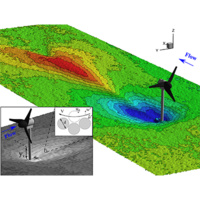
Inspired by recent theoretical advances in bridge scour research, a modeling framework is derived to predict the scour induced by Hydrokinetic turbines on erodible river bed surfaces. Using a mixed scaling formulation of the Reynolds stresses, the turbine performance is linked to the scour evolution.

Modeling boundary-layer transition in direct and large-eddy simulations using parabolized stability equations

A. Lozano-Durán, M. J. P. Hack, and P. Moin

Phys. Rev. Fluids 3, 023901 (2018) - Published 21 February, 2018

The potential of the nonlinear parabolized stability equations is examined to provide an accurate yet computationally efficient treatment of the laminar flow regime in direct and large-eddy simulations of transitional boundary layers.

Sign In to Your Journals Account

Filter

Recent Issues

Vol. 11, Iss. 11
November 2026
Vol. 11, Iss. 10
October 2026
Vol. 11, Iss. 9
September 2026
Vol. 11, Iss. 8
August 2026
Category
Article Type
Section

Filter

Article Lookup

Enter a citation