Recent Articles

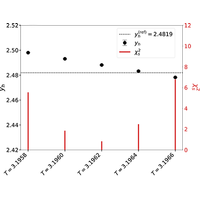
Molecular Stokes-Einstein and Stokes-Einstein-Debye relations for water including viscosity-dependent slip and hydrodynamic radius

Sina Zendehroud, Jan O. Daldrop, Yann von Hansen, Henrik Kiefer, and Roland R. Netz

Phys. Rev. E 110, 064610 (2024) - Published 24 December, 2024

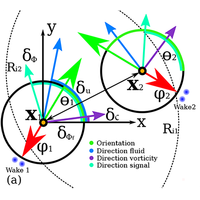
Laser-driven nematic flow in microfluidic devices

Izabela Śliwa, Pavel V. Maslennikov, Dmitrii P. Shcherbinin, and Alex V. Zakharov

Phys. Rev. E 110, 064702 (2024) - Published 24 December, 2024

Random interfaces generated by the addition of structures of variable size

Nicolas Pétrélis and François Pétrélis

Phys. Rev. E 110, 064804 (2024) - Published 24 December, 2024

Erratum: Broken detailed balance and entropy production in directed networks [Phys. Rev. E 110, 034313 (2024)]

Ramón Nartallo-Kaluarachchi, Malbor Asllani, Gustavo Deco, Morten L. Kringelbach, Alain Goriely, and Renaud Lambiotte

Phys. Rev. E 110, 069901 (2024) - Published 24 December, 2024

Reliability of correlation-length measurements: A comparative study

Aleksandr V. Kukharskii and Sergey G. Abaimov

Phys. Rev. E 110, 064143 (2024) - Published 23 December, 2024

Critical and tricritical behavior of the d=3 Blume-Capel model: Results from small-scale Monte Carlo simulations

Leïla Moueddene, Nikolaos G. Fytas, and Bertrand Berche

Phys. Rev. E 110, 064144 (2024) - Published 23 December, 2024

This work describes a Monte Carlo method that intentionally uses only small system sizes. By analyzing the behavior of the first Lee-Yang zero, the density of partition function zeros, and higher-order cumulants of the magnetization, the authors investigate the location of the critical and tricritical points of the three-dimensional Blume-Capel model. The approach produces accurate results with a reasonably low computational cost.

Semi-Markov processes in open quantum systems. III. Large deviations of first-passage-time statistics

Fei Liu, Shihao Xia, and Shanhe Su

Phys. Rev. E 110, 064145 (2024) - Published 23 December, 2024

Swarm coherence mechanism for jellyfish

Erik Gengel, Zafrir Kuplik, Dror Angel, and Eyal Heifetz

Phys. Rev. E 110, 064406 (2024) - Published 23 December, 2024

This article addresses the question of the mechanism underlying formation of jellyfish swarms. The authors model jellyfish as active Brownian particles and consider behavioral reactions to environmental conditions and to self-induced stimuli. They numerically study how different parameters affect the system behavior. Their analysis suggests that jellyfish swarms are formed due to a mutual interplay of environment and behavior.

Modeling the efficiency and effective temperature of bacterial heat engines

Roland Wiese, Klaus Kroy, and Viktor Holubec

Phys. Rev. E 110, 064608 (2024) - Published 23 December, 2024

Active Ornstein-Uhlenbeck model for bacterial heat engines

Roland Wiese, Klaus Kroy, and Viktor Holubec

Phys. Rev. E 110, 064609 (2024) - Published 23 December, 2024

Hyperoptimized approximate contraction of tensor networks for rugged-energy-landscape spin glasses on periodic square and cubic lattices

Adil A. Gangat and Johnnie Gray

Phys. Rev. E 110, 065306 (2024) - Published 23 December, 2024

Logarithmic finite-size scaling of the four-dimensional Ising model

Zhiyi Li, Tianning Xiao, Zongzheng Zhou, Sheng Fang, and Youjin Deng

Phys. Rev. E 110, 064139 (2024) - Published 20 December, 2024

Double power-law universal scaling function for the distribution of waiting times in labquake catalogs

Honglian Li, Emma Valdés, and Eduard Vives

Phys. Rev. E 110, 064140 (2024) - Published 20 December, 2024

The authors investigate waiting times between avalanches in a self-organized critical system. They obtained long sequences of “labquake” experimental data from compression of charcoal samples of different hardness. The data could be described by two exponents, characterizing short and long waiting times, and a crossover parameter separating the two power laws. It would be interesting to investigate whether conclusions from the labquake data could be extrapolated to earthquakes.

Self-organized critical dynamic on the Sierpinski carpet

Viviana Gómez and Gabriel Téllez

Phys. Rev. E 110, 064141 (2024) - Published 20 December, 2024

Scaling analysis of mosaic phase separation in Li-ion batteries

Debbie Zhuang and Martin Z. Bazant

Phys. Rev. E 110, 064142 (2024) - Published 20 December, 2024

Contraction and synchronization in reservoir systems

Adrian S. Wong, Robert S. Martin, and Daniel Q. Eckhardt

Phys. Rev. E 110, 064219 (2024) - Published 20 December, 2024

Nonlinear dynamics and chaos in dissipative optical trimers with complex couplings

Johanne Hizanidis and Konstantinos G. Makris

Phys. Rev. E 110, 064220 (2024) - Published 20 December, 2024

Stability of oscillation quenching in coupled oscillator populations with heterogeneous coupling

Can Xu and Huajian Yu

Phys. Rev. E 110, 064221 (2024) - Published 20 December, 2024

Producing entangled photon pairs and quantum squeezed states in plasmas

Kenan Qu and Nathaniel J. Fisch

Phys. Rev. E 110, 065211 (2024) - Published 20 December, 2024

This study addresses the question: how bright can one make a beam with nontrivial quantum correlations such as entanglement or squeezing? The authors consider a nonlinear mechanism in plasmas, namely four wave mixing to make polarization-entangled photon pairs. The discovery of stable high intensity “quantum light” in plasmas opens the door to remarkable applications, including enhanced x-ray imaging, quantum (sub-Rayleigh) lithography, and greatly improved quantum communication.

Geometrical interpretation of critical exponents

Henrique A. Lima, Edwin E. Mozo Luis, Ismael S. S. Carrasco, Alex Hansen, and Fernando A. Oliveira

Phys. Rev. E 110, L062107 (2024) - Published 20 December, 2024

Sign In to Your Journals Account

Filter

Recent Issues

Vol. 114, Iss. 4
October 2026
Vol. 114, Iss. 3
September 2026
Vol. 114, Iss. 2
August 2026
Vol. 114, Iss. 1
July 2026
Category
Article Type
Section

Filter

Article Lookup

Enter a citation